From what I understand the number of passes is unrelated to the gray scale range. Each pass applies the full 256 available power gradient. Passes serve to accentuate or deepen the effect by simply repeating the process.
Think of it as removing one layer of grayscale per pass.
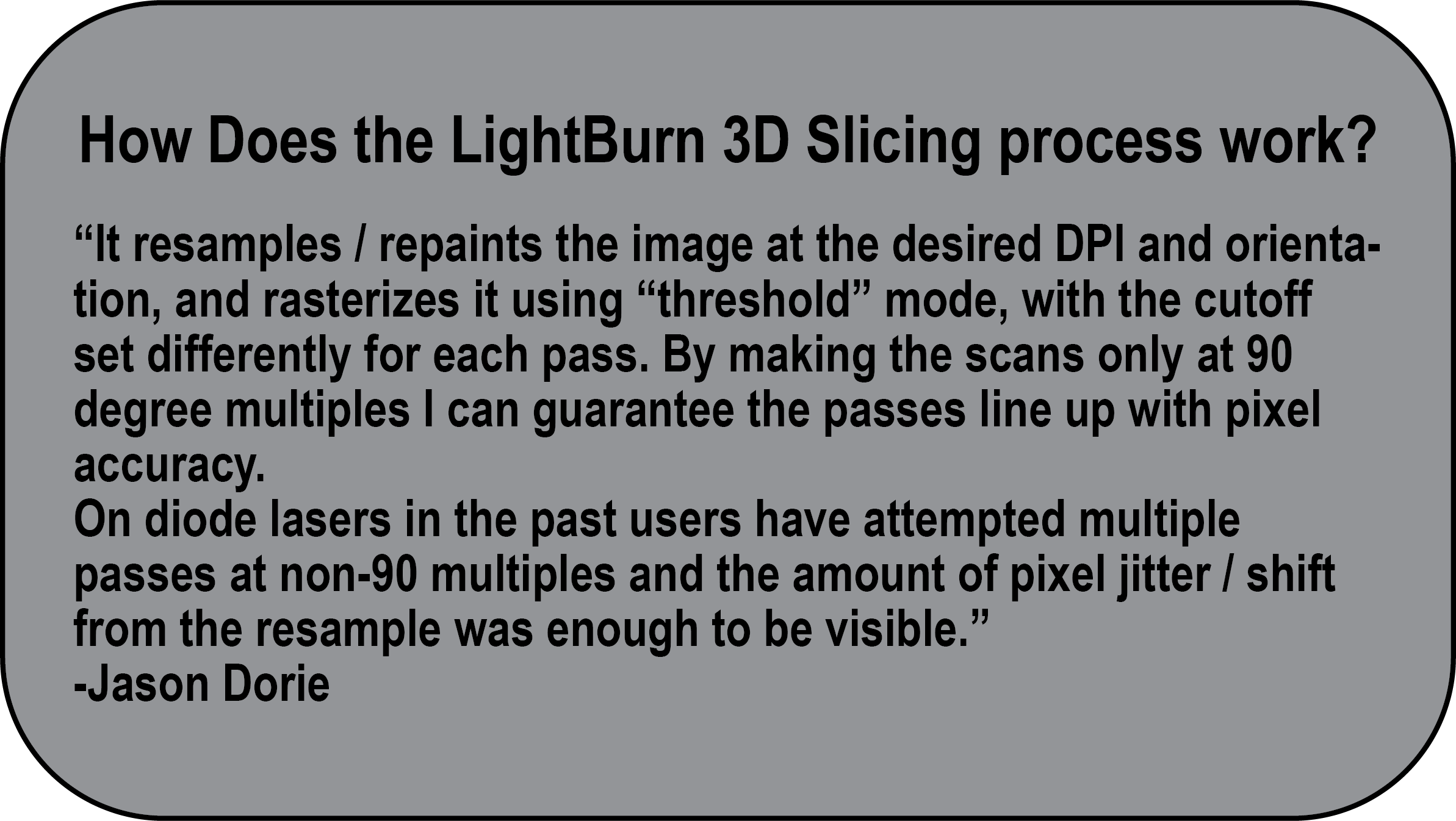
[EDIT] Rethinking this based on what @patrick322 has shared. Seems there’s a conversion of the grayscale to discrete threshold based passes. Not clear to me if the Number of Passes that’s user adjusted directly affects that threshold conversion.
yes, that is why i run 256 as a typical coin or 3d slice so each shade gets a pass. obviously different materials require different passes. acrylic for example i get by with 75.
Incorrect. With 3D Slice, each pass is thresholded to the current threshold value, and the result is run as a 1-bit image. If you use 256 passes you get exactly one pass per gray-level in the image. Every pixel at or below brightness 255 for the first pass, every pixel at or below 254, then 253, and so on.
If you choose 128 passes, you get every pixel at or below 254 for the first pass, then 252, then …
It “clusters” the layers together into batches if you use fewer than 256 passes, and will duplicate some layers (with even spacing) if you use more than 256. 384 passes would duplicate every 2nd layer. 512 passes would duplicate every layer.