Can't you just refill the gas?

Hi everyone,

Out of every 100 support inquiries we get, a big chunk are people with a dying or weakening tube, and the very first request is almost always:

“My tube is losing power — can you just open it and refill the gas?”

Sometimes they ship the tube back to us. Sometimes they’ve already tried prying it open themselves. We see this happen constantly on the factory floor, so I wanted to explain what’s actually going on — because refilling almost never works, and a lot of people waste money trying.

Why you can’t just “top up” a sealed CO2 tube

A sealed glass CO2 laser tube isn’t a bottle of CO2. It’s a sealed vacuum device built around a precise gas mix (CO2/N2/He in specific ratios and pressure), sealed electrodes, a catalyst layer, and matched optics. When we make one, it goes through vacuum pumping → precision gas filling → sealing → performance testing, all in one continuous process. Once it’s fused shut, opening it and putting gas back in means redoing that entire production line, by hand — and the old tube’s electrodes and optics are already contaminated, so it will never perform like a fresh one.

But here’s the part most people get wrong

When a tube starts weakening, the gas is usually the last thing to blame. Before writing off the tube, we tell everyone to check these first — because we’ve diagnosed countless “dead” tubes that were actually just:

  • Dirty mirrors / focus lens — the #1 cause of “my laser got weak.” Smoke residue kills transmission and it’s free to clean.
  • Beam alignment — a drifted beam cuts poorly and looks identical to a dying tube.
  • Cooling water temperature / flow — hot or low-flow water throttles output within minutes. (Note: the cooling water is separate from the laser gas — it only circulates through the outer jacket.)
  • Laser power supply — an aging or mismatched PSU produces the exact same symptoms.
  • Running current too high — overdriving the tube ages it fast.

We’ve had customers ship us tubes they were convinced were finished — and after a clean, an alignment, and a PSU check, the machine was cutting fine again. That’s the whole point of the diagnosis step: don’t buy a tube you don’t need.

When the tube really is done

If optics, alignment, cooling, and PSU are all good and you still see fading output, unstable performance, rising operating voltage, or abnormal discharge — then yes, the tube has reached end of life and it’s replacement time. When you do replace, match more than wattage: dimensions, electrical specs, cooling needs, optical config, and PSU compatibility all matter.

3 Likes

Of course this only applies to glass tubes. RF or metal tubes can be refilled.


Curious how you measure the laser power supply (lps) for performance? Was it done via a replacement or do you have some type of instrumentation?

How do you determine if the gas has leaked, broken down and how often does this occur?

:grinning_cat:

1 Like

1: Test by replacing the power supply.
2: Observing the color of the CO2 laser discharge tube is one way to detect gas leaks; the appearance of pure white light or a deep red glow indicates that the tube has begun to degrade and leak. Such leakage results in a significant drop in laser power or a complete loss of output. We currently keep the incidence of this issue within 1%.

Hi @eco2laser

Glass CO2 tubes can be regassed/refurbished. There are specialist companies that can evacuate them, refill them, repair/replace optics, and re-test them.

However, this often costs more than buying a replacement tube and depends on having someone reasonably local with the specialist equipment to do the work. For most inexpensive sealed glass tubes, replacement is simply more practical and economical.

I’d also be cautious about diagnosing tube condition from discharge color alone. It can be a useful clue, but measuring the actual CO₂ output with a laser power meter, alongside tube current, gives you considerably more information about whether the problem is the tube or the power supply.

3 Likes

Hello Dominic,I totally agree with what you said, color judgment is just one of the judgment methods. As you said, the power supply, etc. must be considered within the range. Of course, the most direct way is to judge by replacing it.
In addition, I feel the same as you about the repair and renovation you mentioned. In the past, when the technology had not yet broken through and the market price was still high, there was still a certain value in renovation. For our production enterprises, they have already been mass-produced and the prices have reached a very low level. At this time, we think that there is not much value in refurbishing and repairing, so it is better to buy new ones directly.

1 Like

I was hoping for a solution to identify if it’s the tube or lps. You suggestion is pretty much change it out.

Fixing stuff for over 50 years, I am still very hesitant to take this approach, which is very much a shotgun approach. Because if the lps isn’t bad and the tube is, you’re stuck with a component that you don’t need.

And you end up buying a tube anyway… :thinking:

:grinning_cat:

Exactly, throw money at it until it is fixed. This is usually the result of not fully understanding the system.

I agree with @jkwilborn on this issue, there should be known diagnostic tests and check points provided by the supplier or manufacturer. If someone that sells tubes told me to replace the tube, I would be skeptical without further proof.

I think it’s worth remembering that these glass CO₂ tubes and their power supplies are relatively inexpensive, sealed components, particularly compared with industrial RF tubes. They’re effectively consumables, a little like lightbulbs, even if replacement isn’t cheap for the owner.

The PSU can also develop faults, including transformer failures, that reduce output. Without a cathode-side milliammeter, it’s difficult to know what current the tube is actually receiving.

I’ve diagnosed quite a few weak or apparently failed tubes in the field simply by substituting a known-good PSU. It’s a perfectly reasonable diagnostic approach when proper HV testing isn’t practical.

4 Likes

I’m glad you can afford to throw away a $100 lps, simply because you consider it a consumable. I’ve had mine for 7 years and have gone through 2 tube and on my third.. Just changing out tubes is expensive enough.

Maybe you should look at the costs from the angle of a broke retiree who values his money. If you have deep enough pockets, just swap out the machines? lol

You have to dray a line somewhere and for people to say, this is lowest cost, just change it out is a bit overboard. What if you get a faulty lps for a replacement, just replace the tube?

Having grown up in commercial computer products, we’d kill the company if we followed that line of reckoning.

Simply put, I can’t afford to replace both, as some people suggest. Your Ruida can fail also, but I wouldn’t call it a consumable. Simple fact is anything can fail.

Ever had a light bulb burn out? Why didn’t you change it before it broke as it’s a consumable.

Just IMHO… :thinking:

:grinning_cat:

1 Like

Hi @jkwilborn

That isn’t really what I was suggesting. When I repaired CO2 lasers in the field, I did have a spare PSU on hand, and it would confirm the fault.

In my actual experience, tubes and PSUs rarely fail and most laser cutter users blame the tube for what is really poor alignment and maintenance. My point more with a tube is, its either failed or it isn’t… you can’t sort of rub it better :rofl:

2 Likes

When I was in industry I had access to parts, like you mention. However, it ignores the simple fact most people have limited amounts of money.

Likely the same with an lps… It goes entirely by money, how deep are your pockets.

I’m afraid I still think of @eco2laser as a salesman rather than a technician. I don’t know that he’s actually told us anything. Along with any data for his reason to do this. I was hoping for some kind of way to test an lps, rather than a swap it out resolution.

You have to do what you feel comfortable with, as anything can fail, mechanical or electrical.

:grinning_cat:

I’ll come down on the other side of this, because …

After we’ve eliminated the usual non-TEM00 resonance / misaligned optics / charred HV wiring / whatever, AFAICT there are two components responsible for poor cutting:

  • The tube
  • The HV power supply

Given that nobody has HV test equipment (or the requisite skills) and (many?) low-end CO₂ lasers lack milliammeters, replacing (possibly) failing parts is the only diagnostic tool at hand.

Replacing the tube requires:

  • Sending 5 Benjamins to a reputable supplier
  • Draining coolant
  • Removing the old tube
  • Installing the new tube
  • Refilling coolant
  • Verifying / realigning the optics

Replacing the power supply requires:

  • Sending 2 Benjamins to a reputable supplier
  • Unplugging the controller & tube wiring
  • Unscrewing the old supply
  • Screwing the new supply
  • Plugging in the wiring

Which is why I recommend replacing the power supply first: it’s cheap, readily available, and easily installed with no more than a screwdriver.

If that doesn’t solve the problem, then the next step is the tube, because there are no other parts involved.

Maybe I look at the cost differently: my last three orders of acrylic / chipboard / plywood set me back a bit over 7 Benjamins. For somebody doing biz, a spare power supply is a no-brainer:

While a power supply isn’t lost in the roundoff, laser consumables, even for a dilettante such as I, are much more expensive.

2 Likes

I guess my whole point is I don’t have money to buy this, if it’s not needed. Was hoping this guy would give us something other than what you people want to replace.

I’ve gotten lots of bad parts. How does that fit into replacing the lps with a bad one, then were do you go? You could end up replacing the tube anyway with the same results.

Looking to measure with instrumentation, not a look at the color, which is entirely relative, just like they are cheap.

:grinning_cat:

I liked this thread for a couple reasons…
The fact that there is ‘reason’ behind the poor laser cutting scenareo always makes me smile.

Not sure I know too many folks that just throw $ at a failure situation, I must profess, I do drop $ on test equipment when designing a job to ensure reliability to the customer. But that is supposed to be considered in the price, well guilty, as I sometimes just want a new toy to have on the shelf for next time… and buy it anyway…

As Ed mentions, the lps is a unique animal that even us old engineers will just buy new and swap out to see if it is the issue. But not with out at least having a current meter (a few $) installed to monitor the current output. But this helps ‘not’ ! with the High Voltage check… I’ve been bitten a few times in my career by careless probing, especially when working on old TV repairs.. only a few :zany_face:. And as Ed opines, there are few if any folks out there that would have the on-hand test equipement to chase down an lps issue.
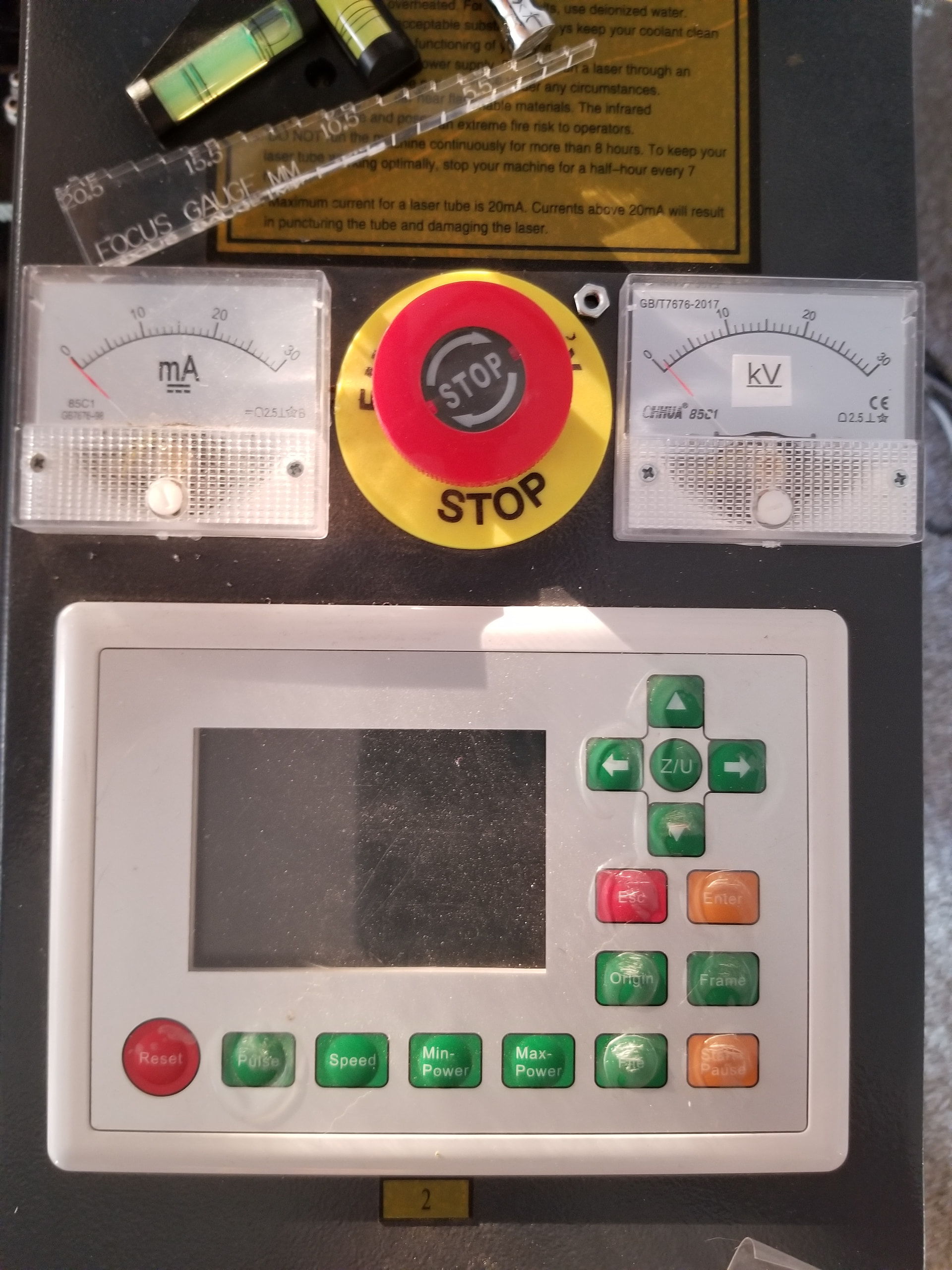
I look at owning a laser as a somewhat expensive hobby, I ridiculously justify spending $ on stuff that will be onhand when needed, or just something I want to have, as a designer, and play with because I can.. I use the excuse ‘cant take it you’… but I do find great joy in using the laser and other UV printing toys to make stuff for friends and family. As we all do I am sure, we get more pleasure out of giving than recieving in our later years…
And I have the benefit of a business write off, that most do not!

I have no suggestion to remedy a failing tube or lps. As Jack opines, Spening $ on something like an lps that is gonna sit on the shelf does not make sense when you have other living expenses..

I guess I have to look at the Tube and LPS the two items that will be a $$ expense when the day comes, but I need to look back and decide that all the hours of cutting have justified its worth.

As usual, I ramble with my simple observations.. but thanks guys for this topic…
It got the ole grey matter stirred up…

2 Likes

Not only I but many people have a way on the newer controllers to see what voltage it’s producing.

I have a high voltage meter on my machine, that’s been there quite a while, so I can watch the HV output. However since the high voltage is a very high impedance, it bleeds off more slowly.

Mine works via a simple resistor, have no clue how they do it with a dsp that can display it or how accurate it is. The meter is really a 50ua meter with a 0 to 30 scale relating to, full scale, 30kv. If I recall, I use a 600mohm resistor in series to the voltmeter.

So you can measure it, but like many things, it’s got to be stable enough to be usable. I’ve watched mine and even when a tube goes out ot TEM00, there appears to be little to no change in current or voltage.

I haven’t had a tube go dead really quickly, most of mine have gone into at TEM01 state that’s not recoverable.

I considered it as a learning experience, that’s what I got it for, learn how they work. I got what I could afford at the time, lowest price. A 50W OMTech China Blue, which was only 43W… :face_with_spiral_eyes:

What’s enjoyment worth to you?

In any case if you don’t have the cash, you can’t buy things off the general market, especially if it’s instrumentation.

What did @eco2laser tell you that you didn’t already know? Especially from a vendor?

A vendor, of course, wouldn’t tell you anything that’s in error. None of these Chinese companies would be misleading about their products … would they?

:grinning_cat:

1 Like

I thought it was a reasonably informative post - in fact his point in the first post seemed to say don’t just buy a new tube, check all the easy stuff first. That is probably obvious to many, but it remains a sensible way to diagnose possible problems before having to spend money. And it is an unfortunate fact that for the average Joe with no access to expensive test equipment and the knowledge to use it and interpret the findings, replacement of parts is the next best method of diagnosis, (provided you have first eliminated anything the simple checks suggested didn’t sort out). Known as ‘firing the parts cannon’ in the auto trade.

2 Likes

There’s not a lot of choice. The vast majority of problems where the laser stops working is the HVDC excited tube dies. If there was a refill port like a car AC system- well, first off, that glass-to-metal interface could easily cause more failures than it solves. You’d get quite the sticker shock at the price of a high vacuum pump, manifold and canister of lasing gas. And not all dead tubes can be brought back this way.

Simply re-shipping the tube out to a service with that equipment that could try regassing is a very high risk of breakage. Shipping there and back alone is like half the cost of a new tube, and has a substantial chance of breakage in transit. The technician work is beyond the price of a new tube and stands a poor chance of returning it to new condition, if it can be revived at all, and maintain the power in the long term.

The milliammeter is the one diagnostic tool you do want for sure. Perhaps more important, you can set the current properly to install it right in the first place.

I asked the same questions initially- there’s just no merit to trying to refill these HVDC excited glass tubes. It’s also a ratio of cost here- these tubes are kind of junk, but the cost of a new tube is pretty amazingly cheap. If a new tube cost 5x-10x more than it does now, I’d consider opening a regassing business for them but that service is going to have to be expensive with only like a 50/50 chance of retuning a usable tube that will work for at least 6 months. It’s not going to make CO2 laser cutting a lower budget thing than it is now.

Hey I was in college in the 90’s and thrilled to put together a red 5mW He-Ne gas laser tube on a power supply and make it go. CO2 cutting lasers were unobtainable fantasy tech. The idea that there would be a point where hobbyists could get one on this sort of budget was science fiction for a long time.

5 Likes

Since when is $200 cheap?

I get it that this is relative to whether it is a hobbyist or production output. Even when I was a maintenance tech, I would be reluctant to replace a $200 part on a maybe.

I agree with @jkwilborn that just throwing money at it is a wasteful troubleshooting method. Of course you can always stock spare parts, which is a good idea if you are in production.

You guys are missing the point.

The laser is defunct and you must find out why. After you eliminate all the usual problems, there are only two things left: the power supply and the tube.

You don’t have any instrumentation, you don’t have any diagnostics, all you can do is change something to see if the situation improves.

Pick one: a $200 power supply or a $500+ tube.

On that scale, it’s the cheapest / least awful alternative.

2 Likes

If he’s replaced both tube, lps and it still fails, where does that leave you?

Once you get to this point, you have to look at either a replacement or something else is broke.

:grinning_cat: