I’m reading somewhat conflicting stuff about diode lasers and styrene. Some websites say “no”, others say it’s OK. Part of the concern is melting, another is poisonous gas.
So what’s the experience/wisdom here for thin styrene (.020, .040, 1/16, e.g. Evergreen brand)? Does color make a difference?
Because a diode laser produces visible blue (-ish) light, it cannot cut transparent material like styrene.
Styrene with an opaque colorant on the red-orange end of the spectrum may be cuttable, but (probably) poorly with considerable melting due to its high reflectivity and low absorption.
Styrene is a hydrocarbon: a benzene ring with a vinyl group stuck on the side.
I think folks misunderstand “vinyl” to be “vinyl chloride”, as in PVC, which is an entirely different plastic that produces hydrochloric acid when vaporized by a laser.
Polystyrene tends to be flammable when cut with blue, 450nm, LED laser modules and it needs to be watched closely. Cutting thin sheets is possible. According to an MSDS for polystyrene, it can produce dangerous gasses when burning. Other information I read stated that CO2 lasers are better than a blue diode for cutting polystyrene. Check out Vintauri’s Workshop YouTube channel as he does have a few model airplane videos where he uses lasers to cut out parts.
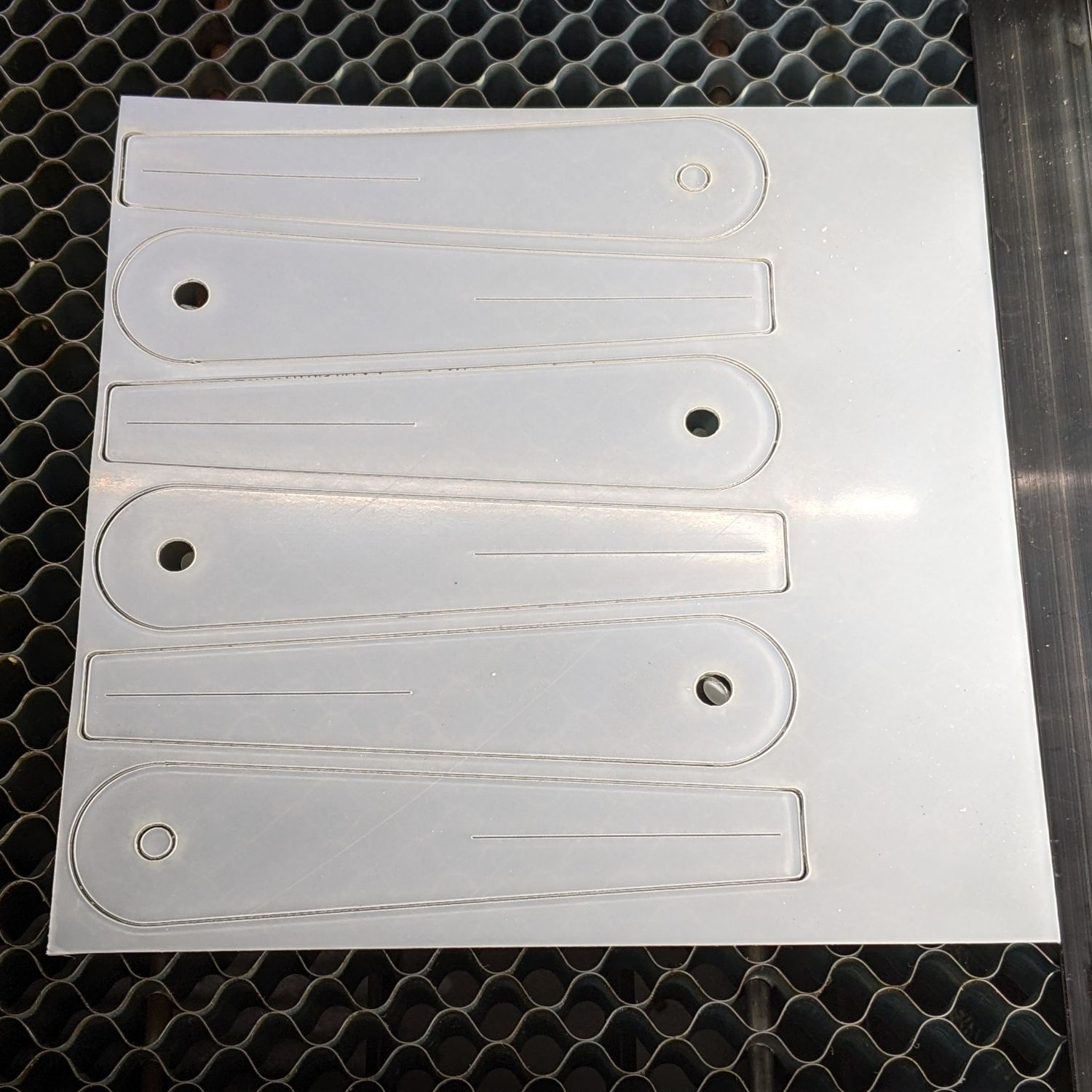
This is an interesting video: https://www.youtube.com/watch?v=D3hJpouFT6E He had good luck scribing styrene with a diode laser, and then snapping/breaking along the scribe lines.
Apparently styrene doesn’t contain chlorine, it’s just a hydrocarbon: Polystyrene - Wikipedia So that contradicts the fear that cutting styrene would release chlorine… (confirming what Ed said above…)
 )
