I think it makes no sense, the fiber laser was hardly invented at this time , there has been so much new since 1.4.00 … I don’t want to start with a new laser on such an old version.
Yes, you can run all the lasers you want on up to 3 computers on a single license.
Fiber lasers are quite complex and have a lot more setting parameters than diode or CO2 lasers, so there will be a learning curve that requires time and desire.
Alternatively, you can buy e.g. XTools laser with their proprietary software, here they have tried to make it as easy as possible, with machine-specific profiles and settings for all possible materials.
Metal can be engraved and in some cases cut, if the fiber laser is powerful enough, (more than 50 Watt I would say).
Acrylic can only be cut with a UV fiber laser and in my opinion is not the right tool for that either, unless the parts are very small and the beveled cutting edge does not matter.
Depending on what you want to produce, for general/universal use I could be tempted to buy a (minimum) 60Watt Mopalaser and/or a 10Watt UV laser.
If you’re running 1.4, then I’d suggest you install the most recent public release version. You do need the pro version. As @bernd.dk mentioned.
I’ve an M60 JPT M7 MOPA. If you’ve used a diode or co2 laser before, then it is like no other in the way it operates. Basic idea is the same, but the tool is quite different.
One of the reasons they work better is that it’s a pulse laser, not a cw laser, like the diode or co2 devices. The pulses are what make them work as they have a very high peak power. Where they operate 1064um, their wavelength is absorbed the very least. A fiber can produce a peak pulse of 18kw.
Be sure you get one that’s supported by Lightburn. Some of these are gcode machines and Lightburn can’t tell if it’s a galvo or not.
It does not work on most natural material types and is more limited to man made materials, such as wood, acrylic or glass. Seems a lot like visible lasers don’t work on something and the fiber it may be limiting factor if you want to do primarily one of these materials.
Mine is 60W and it does all I want with everything I’ve worked with. Although there are higher wattage machine, most have some type of drawback. Although they can put more heat into something, that’s not necessarily a good thing. I’ve burn up 40mm brass coins from Amazon. The price of a lens goes up starting around 80W where they recommend a different type of lens (quartz), which is over 6 times the cost/lens.
Not knowing more specific what exactly what are you intending to do and how thick it is.
My 40W Diode Blue light Galvo laser does cut color Acrylic. Clear needs to be sprayed or covered. I have only cut up to 1/4” but it only took approximately 12 passes.
When you coat it with something, that’s what the laser is operating on. Once you get through the coating layer, the visible led is back to shining through clear acrylic and is pretty ineffective.
The acrylic that I cut was colored. The laser manufacture sells clear and mirror clears and the description says it will cut it with that. They also say to paint the far side of clear glass. I have done this with my fiber laser.
My fiber goes right through glass. When you paint the back side, it’s the same thing, it goes through it and heats the ‘far side’ material, heats that (indirect marking) and that heat does the damage to to glass.
You can’t cut through glass, with these. Might be possible with a UV machine, don’t have one so don’t know.
Any galvo you can get, that’s identified as a galvo by Lightburn, you’ll need the pro version. There are many grbl types with galvo, that are not identified by Lightburn as a galvo, so many of the galvo settings, such as 3d slice are not available except with a known galvo.
Most of the galvo machines were initially brought on-line with Lightburn, in v1.2, I believe, but there has been additions since then. Windows 10 has hit it’s end of life, there are no updates for it.
The pro version will run all supported platforms, including grbl.
I may not be the one to ask as I don’t own a UV machine. However I’ve done some research on them and I believe the way a UV works is mainly by using the high photon energy of 355nm to knock molecules apart. They refer to them as cold lasers, but I’ve seen them smoking. Better than most lasers from a heat standpoint, but I’d shy away from calling them cold.
You may have to engage in a different thought process to effectively use one, at least in my opinion. We normally don’t think about a laser eating it’s own optics, but the UV photon impact effects the whole optical path in one of these. I’ve seen some nice products, like my fiber, MTBF is about 100k hours, some of the UV machines only warrant up to 5k hours…?
I’ve watched people use these to cut out glass and put holes in glass. The minimal heat makes this possible. There is tons of information on UV lasers, you just have to spend the time to carouse them all.
You can probably cut acrylic, but it’s limited to a couple mm, these are mostly used to engrave fine lines, not deep types of materials. You can probably mark metals in some way, but a fiber is a better choice for this as these are really engravers, not cutters.
Most of these that are reasonable in price are 5W models, shorter wavelengths make generating the basic signal more troublesome that longer wavelength frequencies. Some use a fiber as source, but use it’s third harmonic. 1064nm / 3 = 354.666666667nm.
I have noticed that, although a 5W is around $5k, most of the 10W or over increase almost exponentially in price. Keep in mind there are less available settings with a UV.
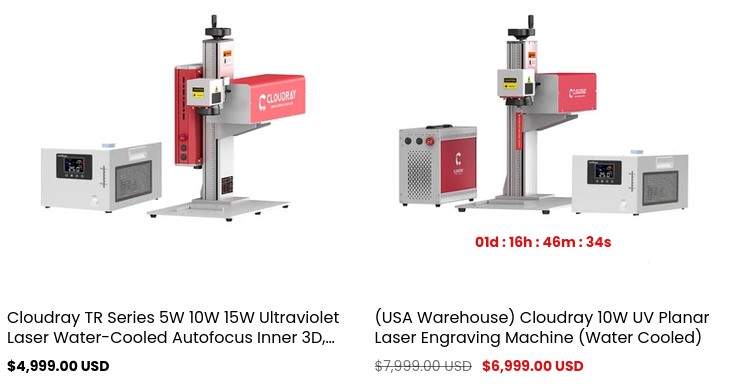
Although from Cloudray, here’s the best comparison of price/power I’ve seen. Doesn’t mean I’ve seen them all.
Even with a discount of $1000, the 10W is still $2k more expensive. Most hobbyists can’t afford this increase in price for a doubling of power. Can you find them lower cost, probably.
In my limited research over the last year, it seems a liquid cooled system is recommended. As I mentioned the source is difficult to create and the temperature of the actual diode is very critical to maintaining power and emitted wavelength, water cooling helps maintain a more constant temperature.
There are many that are air cooled. Many of these I’ve seen recommend up to 45 minutes of warm up time. More likely is they want a stable temperature environment. The TR series like I have posted need ~5 minutes to stabilize.
There are people here that actually own one of these and I’d suggest you wait on one of them to advise you and add to your knowledge before taking the plunge.
Thanks for all the input guys. Seems the UV and Fiber lasers are much more complicated to operate than my diode laser. I’ve been pretty happy with my 35/70 watt diode so i will probably just stick with that for a while.
I have been able to cut:
1/8 Baltic Birch in 1 Pass at 35 watts
1/4 Baltic Birch in 2 Passes at 35 watts or 1 Pass at 70 watts
1/2 Hardwood in 1 or 2 Passes (Depending on Wood) at 70 watts.
Co2 and visible led lasers usually work on natural types of materials. All lasers overlap to some extent from kind of working to almost working. However, acrylic is man made and is just what the doctor ordered for co2.
Fiber is used mainly with man made materials and is used in industry to cut out metal parts, albeit with substantially more power than a hobby machine along with high cost. What makes a fiber work with metals is it’s high peak pulse power. My 60W produces peaks in the 18kw range.
UV is supposed to do well with most materials for marking, not cutting.
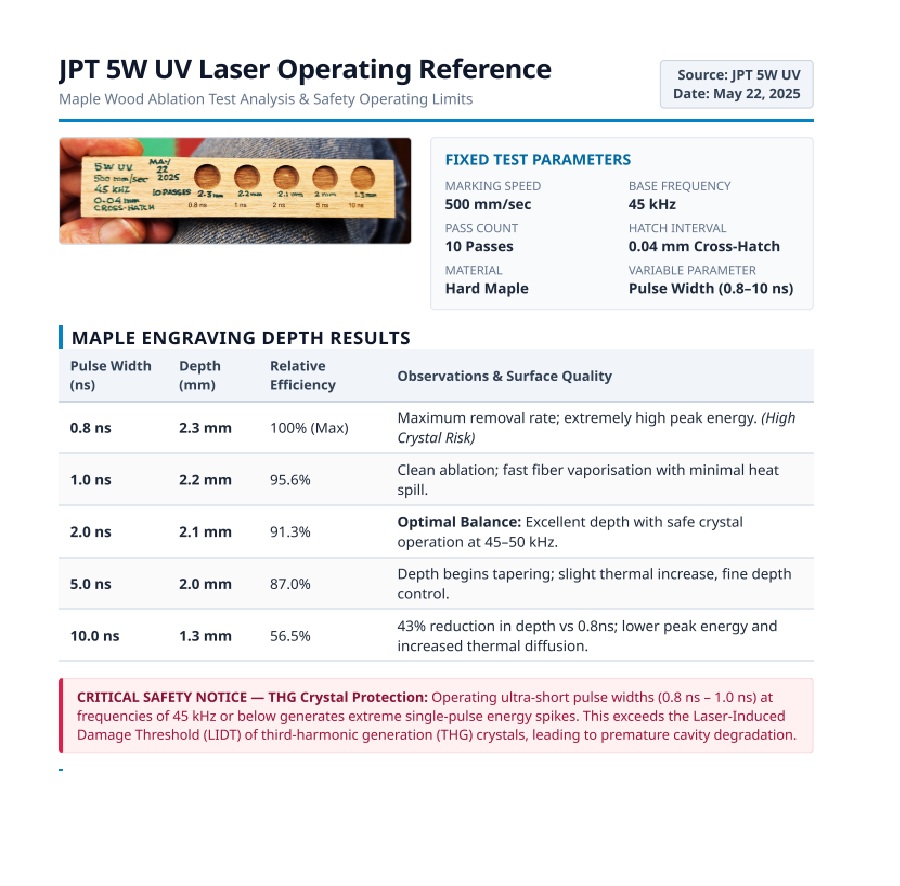
@jkwilborn My JPT 5 watt UV Lost 50% “power” after 3-4000 hours
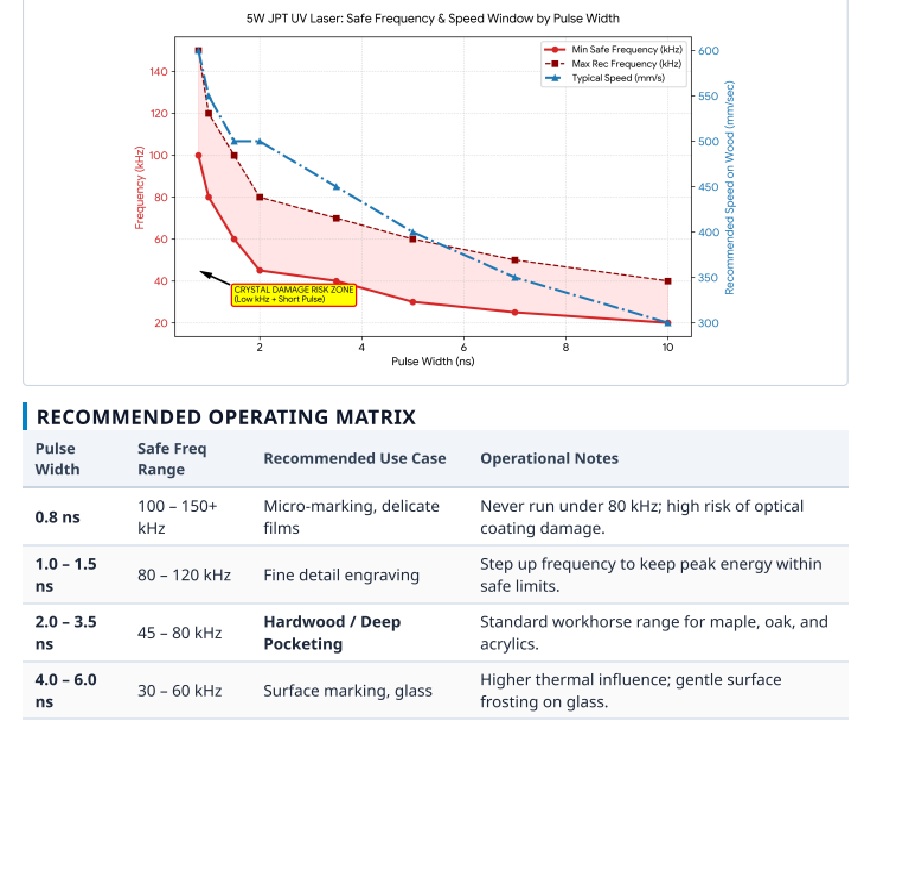
I did not realize That with my settings for engraving wood was slowly killing the crystal
85 mm/sec/45kHz/0.8 ns
Apparenting it has no self Protection
Its shipped back to china 6 weeks ago under warrenty..no response from JPT
It appears it uses the standard 1064nm signal generation and gets it’s third harmonic (354.6667nm) via a crystal lattice.
I’ve been looking at one, but the finances are not really there, so I’m negotiating with Cloudray for something I can afford. Their source is not JPT and exists in the box connected to the galvo, as far as I can tell.
I don’t know if it’s the third harmonic or not, but wouldn’t surprise me. They did tell me the manufacturer and model, but I have yet to see a manual or anything written down.
I appreciate you advising us of the power issue with short pulse rate damaging the crystal in the multiplier stages. Nice it’s actually documented.
UV appears to be another animal, unlike the previous lasers I’ve owned.
I’m a bit puzzled as to why this machine costs so much, it’s a 5 Watt machine without any accessories… I’ve looked at a “no mame” which costs less even though it’s the 10 Watt version. But on the other hand you know what to expect with Cloudray… and it’s always a bit of a lottery with the others…
I really don’t know these machines as I don’t own one. One thing that increases price is that it’s UV and creating the source is difficult to maintain proper output and TEM resonance, at least that’s what I’ve read.
It’s also water cooled, so start up times are less than 5 minutes, some of the air cooled models take up to 45 minutes to stabilize. How long it actually is, I have no clue. They also mention that a UV machine eventually consumes it’s own lenses and mirrors in the optical path. Clueless on how much time it takes but my fiber has a MTBF of over 100k hours, whereas this is only warranted for 2 years and they don’t specify MTBF. Some of these I’ve seen only have an MTBF of 5k hours.
 , there has been so much new since 1.4.00 … I don’t want to start with a new laser on such an old version.