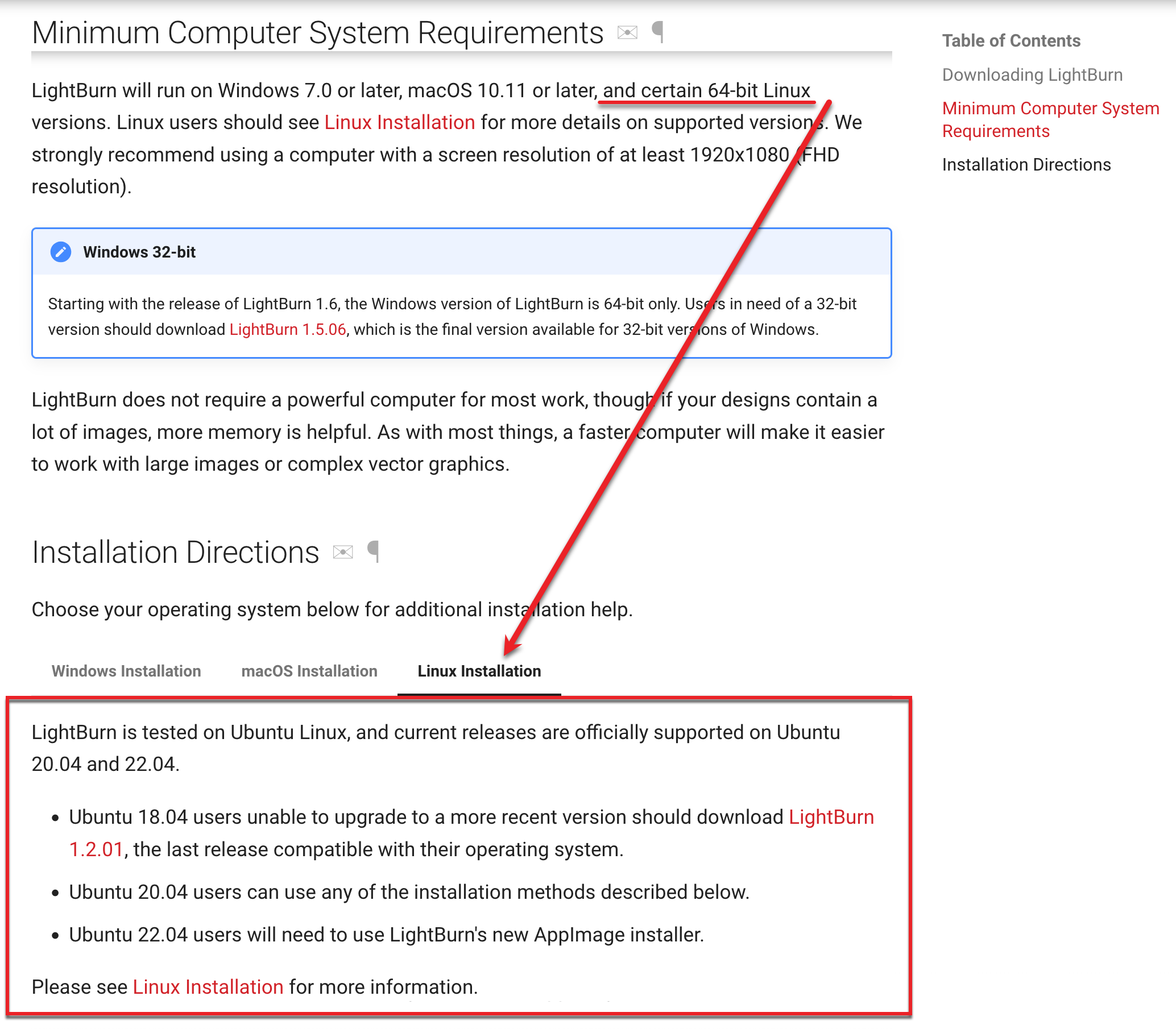
Here is what it says:
“LightBurn will run on Windows 7.0 or later, macOS 10.11 or later, and certain 64-bit Linux versions.”
That is not very clear and probably means different things to different people.
Oh dear, another very disappointed Linux user here. I can see the reasoning but it’s a hard pill to swallow. I only use Linux and would not consider going back to Windows since I left it back in 2005. I’ve been meaning to upgrade Lightburn for ages and will do but I will also have to accept that it will be my last new version.
Thanks for developing a great bit of software and for supporting us Linux users, at least in the beginning.
Today marks a sad day for Linux users. I wish you well with this business roadmap.
I’ve had an eye on LightBurn for many years after struggling with E’s stability. I was enthusiastically waiting for a fiber galvo version because it supported Linux. Once fiber was officially supported our company bought the software. Currently LightBurn is still missing a few essential fixes/features.
Our company is mainly using the fiberlaser to mark internal tools with a department/location name/number or employeename.
@lightburn Could these be added/fixed before 1.8?
-
Job Origin center-center for galvo · LightBurn
Marked as ‘Started’ in Fider -
Multiple Pages within a work session · LightBurn
Marked as ‘Planned’ in Fider -
Bug: Variable Text not aligning correctly
A really annoying bug.
How much would it cost to merge these before the last Linux release?
An apt analogy. I purchased a lifetime Eagle CAD license way back when. I still use that version of Eagle CAD for designing PCBs to this day and it works great, even though I can’t get updates for it.
LightBurn will continue to do the same. We all have lifetime licenses on the current version that will continue to work in Linux. We haven’t been ripped off in the slightest, even though many people won’t be incentivized to buy future updates.
Incidentally, I’ve seen Oz state that the DSP version of LightBurn is more expensive because it takes so much more work to support Ruida beyond what the normal LightBurn version requires. I wonder if that could be a future option for Linux. And I wonder if Linux users would still be supportive if a Linux license were to cost $200 (or whatever the support cost would need to be) instead of $60.
Since we are being forced back to Winblows, will Win7 still be supported? I have no want or desire to deal with 10 and no way in Hell am I ever using 11.
Honest question…
As a Linux (forever!) user, what is my upgrade path to LB 1.7.x from current LB 1.3.01?
Previously, I’ve been happy with LB 1.3.01… it meets my current need. I’ve seen no compelling reason to renew my license… as many of the later releases seemed primarily for adding functionality for newer lasers: galvo, fiber, etc… which is of no current interest. Right or wrong, that was my understanding/perception.
Now, with Linux LB sunsetting at LB 1.7.x and my current license good only up to LB 1.3.10… it seems that I’ll probably want to feature/upgrade freeze with the last Linux version of LB. Who knows, maybe a fancy new laser is in my future? 
So, will a single license renewal now get me all the way to LB 1.7?
Or, will the release dates of all the in-between versions need to be examined, and renewed as many times as necessary to get to 1.7.x?
– David
Yes. Renewing gets you access to the latest version irrespective of when you first purchased.
Thank you!
I have recommended LightBurn to people looking for Linux-based laser control solutions. I also initially trialed LightBurn on Linux before purchasing. My intention was to build out a dedicated setup for my new laser based on a computer running Linux. For my temporary setup, I am using LightBurn on a Mac and connecting to the laser over Ethernet.
Looks like I will be stuck using Mac over the network, and that I won’t have a nice local computer next to my laser to help with jogging, homing, material positioning etc. Because I don’t want to get a whole additional Mac just to run LightBurn, only for Apple to stop supporting that hardware eventually.
I’m probably not going to buy another update for LightBurn, and I will also no longer consider purchasing MillMage for my CNC when it is released. That was always going to be a Linux shop computer. I’ll continue to limp it along on an aging install of CNC.js.
You have to be cautious with statistics. I agree with the user that said this was a sales problem. With all of the widely publicized Windows failures, there’s never been a better moment to encourage Linux usage for computers that need to do one thing well and with complete stability.
Basing it purely on a percentage is questionable. Of course the hordes of people buying cheap diode lasers will push the majority in another direction. But they may lose interest and be one-time buyers.
You should pay attention to the distribution of users who make recurring purchases. Linux has made you a million dollars at minimum already.
I largely agree with what you write and am myself saddened by the situation that LB stops development of Linux versions.
However, LB is an economic enterprise that must generate money and it does not help to earn 1000 dollars if it costs 1001 dollars to sell its goods. I don’t know if LB has researched whether there will be a market for a Linux product (or milling program) that generates enough money by raising the price of these versions that give a deficit. The price structure is already differentiated today, so it might have been an option.
It will be interesting to know how the actual servicing for the different versions of LB is distributed. If we take the forum alone, I think the “load” is definitely not on the Linux part, on the contrary, a lot of Linux geeks have actively relieved LB on this front.
It has been a few years since I cautiously pointed out that the forum might turn out to be a purely problem/service platform for LB customers, in the same style as e.g. Eleksmaker’s user page (I don’t want to call it a forum).
Many of the positive tests, inputs and suggestions to improve LB, which came from serious users over the last several years and also have a part in LB being where it is now, will probably no longer be interested in the same way contribute as before, because the part that was most important to them is no longer there.
The feeling and spirit of the users, who should preferably identify with a product, is a very important aspect in a business. There have been many examples where major changes were successful, but also where they turned into business disasters.
What’s a bit funny is that I’ve always been a bit afraid that LB would just be sold when it was big enough…, but that wasn’t the case this time 
Practically and pragmatically, I think that life goes on. I will probably run LB 1.8 on my design machine, the finished projects will be sent over LAN to my Linux machine in the workshop, which will hopefully run problem-free with 1.7 for a few years. Or I buy a cheap used Mac for the task.
When this thread here is only to show the Linux people’s feelings and opinion regarding LB’s decision to drop Linux and not intended as part of the consideration of whether the decision is the right one, I think that thread should be closed soon, it only hurts
I’m not sure why, whenever I express a concern with this decision, people feel like they need to explain to me how a business works. I’ve been employed for 30 years and have been operating a business I started for 15 of those years. If I’ve learned anything it’s that focusing too hard on the books is like driving while only looking at the rear view mirror. It also matters to set your business apart, to have some orthogonal goals and principles. There needs to be something you want to do other than get money, because if you want that you can just work for someone else.
I have gotten distracted and clung to the status quo and tried to shave costs. All it does is cut out the risk, the fun, the soul, and finally the success.
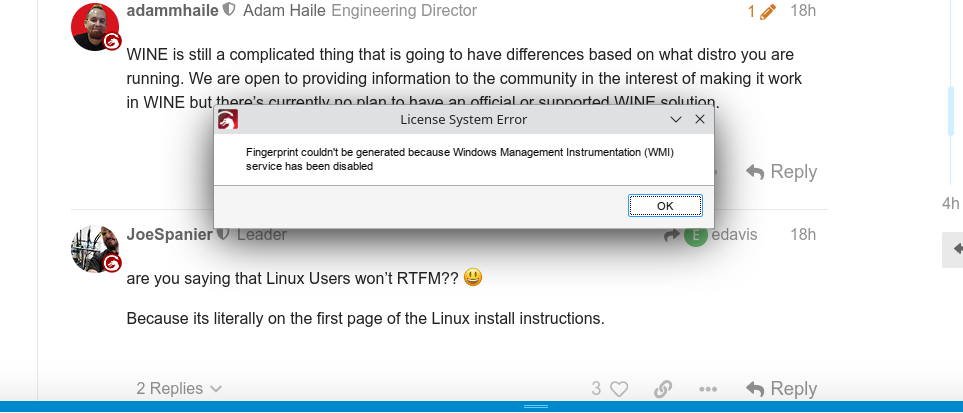
This was already answered, Linux does not provide much money, nowhere close to millions… Especially Linux users don’t seem to do recurring purchases, another reason to drop them…
I also don’t like the decision, but I can understand it economically, and it seems the Linux users themselves put them into that position 
And why is that?
I was referring to the statement that Linux users usually don’t renew their license (“less than half compared to users on the other platforms”). So if you have a small community that does not even generate a continuous income, it’s very difficult to argue to keep it, in an economic perspective. If Linux users were top of renewals (small, but supportive group), it might have been harder to argue for dropping them.
(not saying it is like that, or judging people, it’s just a possibility)
Add me to the gutted list 
Reading between the lines, the packaging of a Linux version is only part of the problem. LB seem to be saying that they are moving to a different development system that doesn’t support Linux.
If that isn’t the case, LB could consider supplying a Raspberry Pi system image which gets around the many versions of Linux packaging issue and would allow those of us who will not entertain MS Windows to move beyond version 1.7
This is very sad for the older workshop computers which can’t run Windows 11; I wonder how many will have to be thrown out and replaced with Windows 11 computers just for LightBurn, once Windows 10 ends next year.
I know I am not the typical Lightburn user, so my views are more regarding the general use of operating systems and CAD/CAM software.
I started doing computer aided design in 1981. We were using a computer manufactured by Micromation, and the operating system was a multi-user system called MP/M. The OS was very similar to DOS, and the CAD program had no graphical interface. The program was called Cartonline, and it was specifically designed for folding cartons and steel rule die shops that used industrial lasers. Our graphical interface was a Data Technology plotter
All designs were command line driven. We graduated to graphical monitors in 1982. They were slow to draw. If we had a design with 50 circles, we could smoke 1/2 of a cigarette waiting for a screen redraw.
In 1985, we upgraded CAD systems to a program called Interact, and it ran on a Data General MV4000. The operating system was called AOS/VS and it was command driven with what was called CLI or command line interface. We had 6 designers running on green screen Digital Equipment monitors, and the graphics redraws were pretty fast. The OS allowed us to write macros to automate a lot of mundane processes.
In 1992, we switched to a CAD program called CimPACK. This was another program that was geared to steel rule die shops and folding cartons. This program ran under DOS, and we switched to PC’s that were networked. I won’t get into MS-DOS, but we had a lot of BAT files that automated the processes for backups etc.
I used CimPACK thru 1999, and then got out of CAD for 3 years and worked for a software company, but still using Windows PC’s.
I went back to CAD in 2002, and back to CimPACK, but their Windows version. Skipped around between 3 companies, but all were using Windows.
The last 12 years as a “worker” - 2005-2017, I had 2 computers. One PC for CimPACK and one Mac for graphics. In 2015, my company was bought out by a large company, and we had to switch CAD programs to ArtiosCAD. It is basically the graphic version of Interact, which I used in 1985-1992.
Long rambling post, but my “working life” was never defined by an operating system. It was always defined by the application. I didn’t get into all of the apps I used or wrote macro code for, but there were plenty. Does anyone remember RBBS-PC
I view Lightburn as a CAD/CAM program that drives a laser. You can design in it, or just use it for the laser interface. I kind of get why people are loyal to a certain OS, but if I had to earn a living using Lightburn, I wouldn’t care what OS it supported. I never had a loyalty to an OS. I did have Ubuntu on an old laptop, but it was just for “entertainment”.
If Linux is 1% of the LB user base, it doesn’t make business sense to continue to support it. If the 1.7 version is pretty much bug free, I could see a Linux person using it for at least 7-10 years. I use 1.7 beta, and IMHO, the scissors tool is the best tool added since the beginning of LB.
I get the impression many of the Linux customers are already doing something similar ie using the Linux version at the machine while doing the design work on a desktop and not purchasing updates. It was stated that the Linux customers are upgrading annually at 50% the rate of the other platforms. And that the Linux customer base was twice what it is now. There’s the 50% thing again and I think the Linux user base is still quite different from the Mac and especially the Windows users.
This is a couple years old but it really shows the Linux user base is ‘different’:
https://www.reddit.com/r/gamedev/comments/qeqn3b/despite_having_just_58_sales_over_38_of_bug/