Jack,
I just had a thought… Have you replaced the mA meter? It is possible it is sticking or not labeled properly.
Based on what I read in the other reports, you are doing nothing wrong. That means it has to be in the equipment.
Jack,
I just had a thought… Have you replaced the mA meter? It is possible it is sticking or not labeled properly.
Based on what I read in the other reports, you are doing nothing wrong. That means it has to be in the equipment.
Unlikely, the ma meter I use is a completely mechanical device. There is also a ma meter on the display of the lps, both read the same value. I also have a voltmeter on that circuit, so I can see the voltage values.
My new tube produces 50W@15ma, maximum, that’s where my internal pot is set to 100% voltage current control to be that 15ma value. My settings are based on watts out, pretty much on watts out, not current in. 100% pwm produces 15ma for a full 50W.
Thanks for chiming in, it’s appreciated.

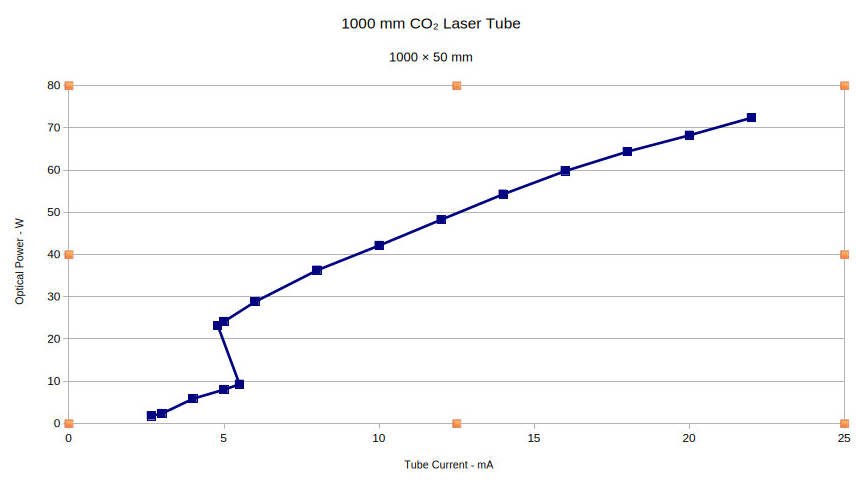
We conducted a data collection using a 1000*50 laser tube and would like to share the results with everyone.
The service life of a laser tube mainly depends on the changes and degradation of the gas inside, meaning the tube must not have any leaks. Once a leak occurs, the laser tube will cease to function. Other factors include using deionized water and properly cleaning and maintaining the mirrors, which help ensure normal power output.
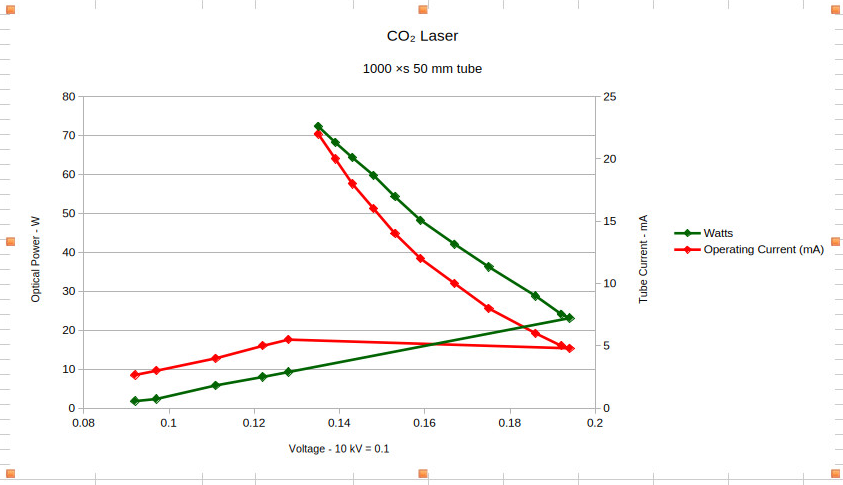
Converting the image to CSV, with a bank shot off LibreOffice for some quick graphs, seems more useful.
Apparently the test was done with a voltage source, not a constant-current source:
I thought gas tubes had negative-resistance behavior after firing, but the lower part of the red curve shows positive resistance. What causes the change in behavior at 12.8 kV? Does the tube switch modes or something like that?
It does suggest the spiky current I’ve measured for low PWM values comes from operation in that region:
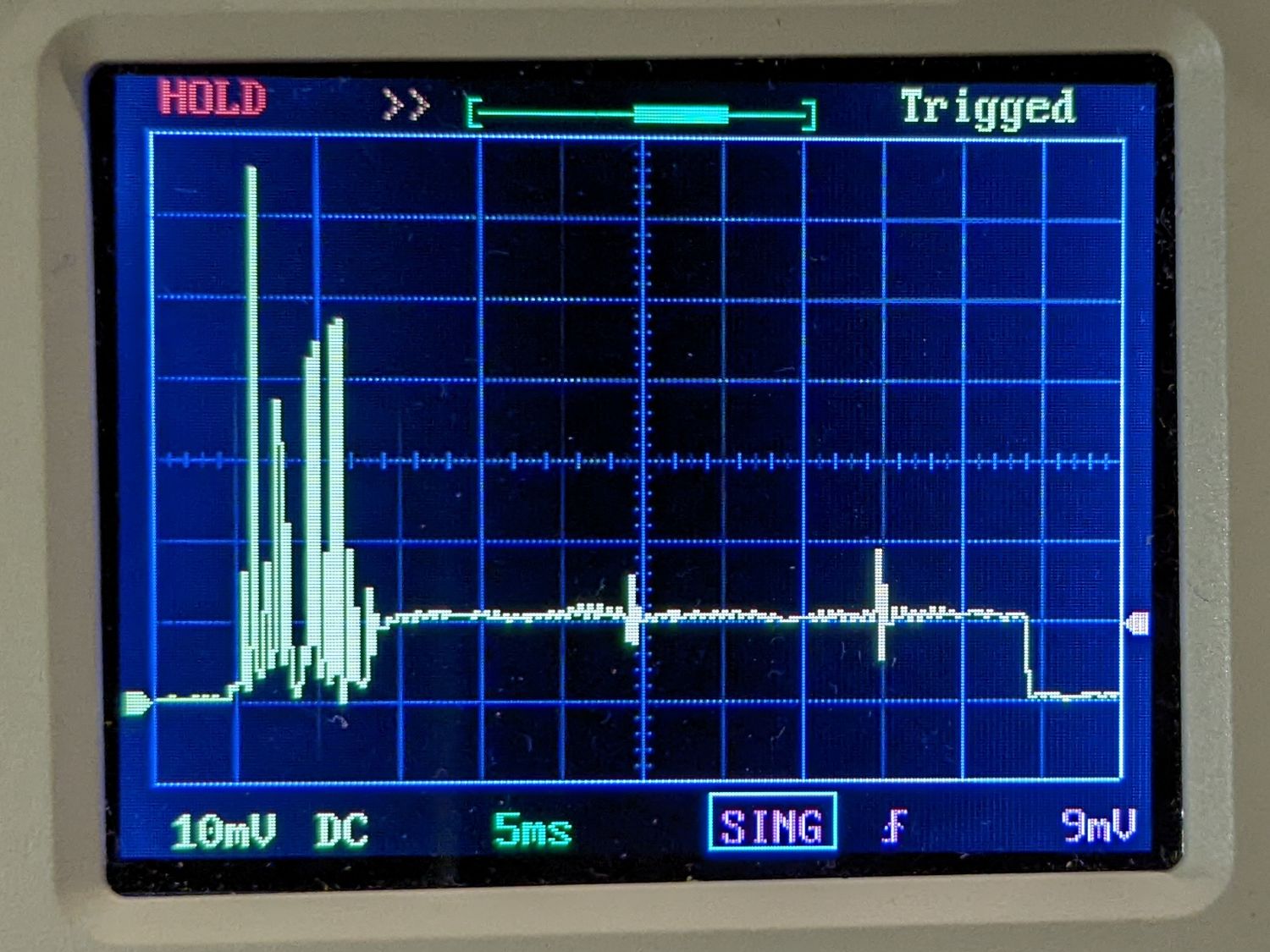
That’s the tube current at 5 mA/div for a 50 ms pulse at 25% PWM, with the peak tube current pulse near 35 mA.
A negative resistance device only means it doesn’t follow ohms law. Usually it means something like, within an area of operation, current-voltage characteristic where an increase in voltage results in a decrease in current.
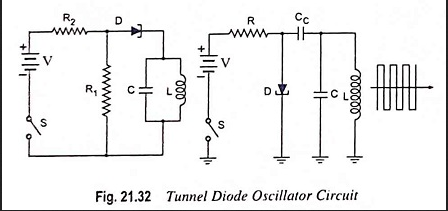
There are a number of devices, such as a tunnel diode, that’s considered a negative resistance device. Use them for oscillators and use the negative resistance as a type of current control for it to oscillate.
It could be you are not in the proper region of the tubes operation for it to exhibit a negative resistance device.
It’s biased with resistance to operate within it’s negative resistance region of it’s supply curve. They also switch very fast, so you can use them in high frequency, such as microwave oscillators.
If you’re curios about negative resistance devices used in oscillators, try here…
At least you can get measurements… 
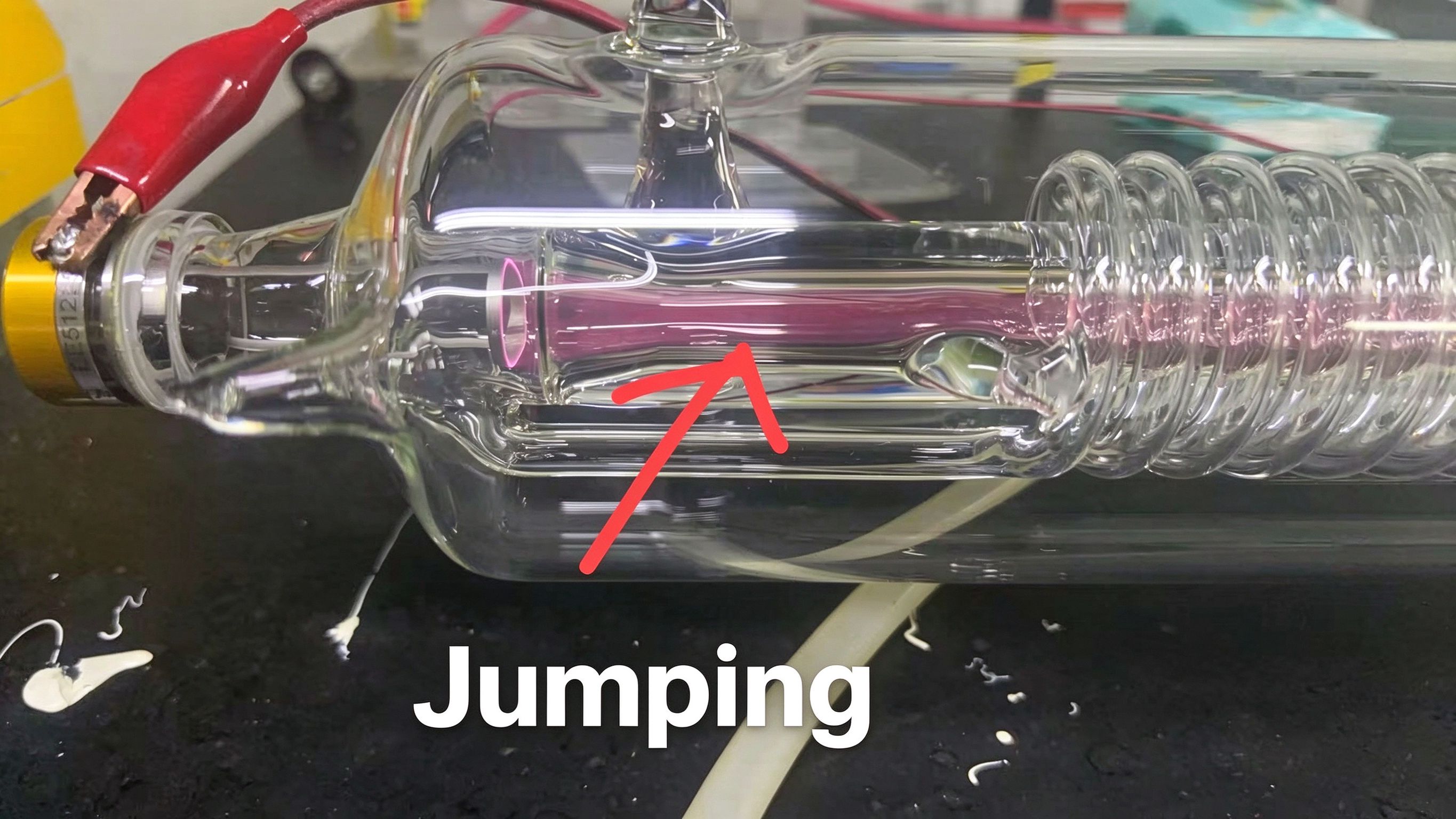
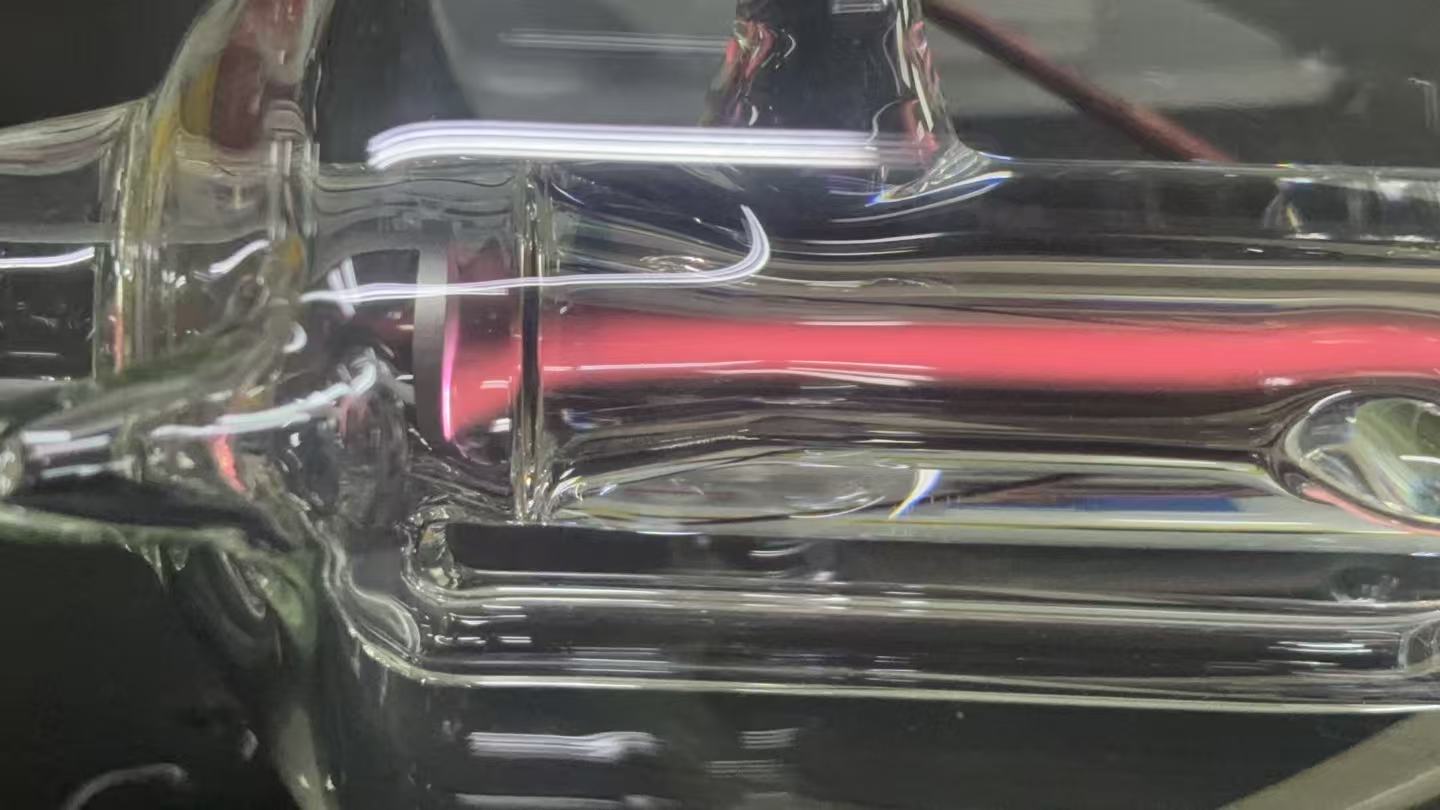
The laser tube has two ignition stages. The first ignition is unstable and typically occurs below 5 mA: light appears only at both ends of the discharge tube while the middle stays dark, and the discharge arc flickers and jumps inside the tube, causing highly unstable laser output.At 5 mA, the tube enters the second ignition stage, during which the entire discharge tube becomes uniformly illuminated.
Below 5 mA, the discharge is concentrated near both ends with little to no glow in the middle. The discharge arc flickers and jumps inside the tube (as indicated by the red arrow), and the output power fluctuates sharply.
At 5 mA, the tube enters the second ignition stage. The entire discharge tube glows red uniformly along its full length, the glow stabilizes and stops jumping, and the output power becomes steady.
That seems to explain the huge current spikes as the tube fires, before the discharge stabilizes.