How Long Does a CO₂ Laser Tube Actually Last?

Hey all,After the “is my tube dead” question, the next one we hear constantly in our workshop is “How long will my CO₂ tube last?” Everyone wants a number, but the honest answer is: it depends almost entirely on how you run it. A good glass tube run properly can outlast three tubes that get abused.

Tube lifespan depends on several factors, especially:

  • Operating current
  • Cooling temperature and flow
  • How often the tube is run at high power
  • Optics and beam alignment
  • Tube quality and storage conditions

I don’t think there is a single number that applies to every CO₂ tube.

Also, a weak cut doesn’t necessarily mean the tube is reaching the end of its life. Dirty optics, poor alignment, cooling problems, or a failing power supply can produce similar symptoms.

So I’m curious about real-world experience:

How many hours did your last CO₂ laser tube actually last?

If you know, please share:

  • Tube wattage/brand
  • Approximate operating hours
  • Typical current
  • Typical power level
  • How you cooled it
  • What finally made you replace it

It would be interesting to compare real-world tube life rather than relying only on the number printed on the specification sheet.

This smells like a market survey… :roll_eyes:

1 Like

I know what you mean, but as long as there is no attempt to sell your own products or disparage competitors and there is interest value in the content, I’m fine with it. (just my personal opinion)

1 Like

Check out his profile… Great if he collects this information, and tells us of the results.

This is the company.

Maybe both @bernd.dk and @MikeyH are correct…

Someone is making money here.. I still think, if it walks like a duck a quacks like a duck… it’s likely a duck.

:grinning_cat:

But fairwise we must also acknowledge that no one has tried to sell anything, yet :wink:
It’s hard sometimes, try to imagine that a controller manufacturer comes forward here, with useful info that we otherwise wouldn’t have access to or someone else who explains laser alignment or something specific to “their product” on a higher level for those who struggle with it, it will be welcome information…

I believe, and hope, that LB’s wise moderator and leader can find a nuanced balance and separate the wheat from the chaff.

Yes, it’s really out of our :folded_hands: anyway.

For the record, I still think both of you are right. :thinking:

:grinning_cat:

3 Likes

I have a tendency to mistrust marketing disguised as helpfulness.

Like as stated above, if the total research results are freely shared, I will not resist.

1 Like

I’ll dig in.. it’s a survey so I think there’s a policy to halt it.

1 Like

Fair point, I totally get the concern. This is not for sales pitching. I just want to collect real-world field data from laser users. Most datasheets only list lab-rated hours, but actual working lifespan varies wildly with daily operation, cooling and current settings. All collected data will be shared openly in this thread once enough replies come in. There will be no product promotion at all — this is purely technical discussion for anyone wanting to learn more about CO₂ tube maintenance. If anyone still has concerns, I will not post this kind of survey thread going forward, and I only wish to have technical discussions with everyone.

1 Like

Your profile says you represent a “Manufacturer of industrial sealed CO₂ glass laser tubes”, which suggests your QC department has an extensive database of results from both in-house testing and customer experience.

I (and many others!) would be very interested in seeing that data, if you’re willing to share it. :grin:

You surely know consumer-grade machines tend to have anonymous tubes with minimal specs, sometimes claimed to produce more power than is physically possible for a tube of that size. Replacement tubes with specific, well-regarded brand names may be low-grade test rejects or straight-up counterfeits. All of them will be operated under uncontrolled conditions for unknown durations, because consumers do not track that information.

Which means a “survey” here will collect garbage data, simply because non-industrial users are unreliable sources of information. If this is new information for you, then your QC department needs improvement.

You’re not saying this is garbage in → garbage out are you? lol


I firmly believe that part of the equation is how hot it is when it’s not operating. Not a chemist or a physicists, but I get about 2 years out of a tube. When it’s not running, it can sit in 100F+ heat at rest, many times going above 110F I’m on number three now, the first two lasted about two years each.

On my Ruida, I can check it’s stored timer for power on and actual lase time.. Too bad you can’t reset it when you change out a tube. That doesn’t help and it tells me that run time may not be critical as the Ruida would allow a reset of these timing values. Since I’m always testing things, I run the machine a lot without the lps enabled, so the numbers are off in any useful relationship.

That would be nice, but you have posted nothing to back up what you are doing.

Such as some of this information for us to evaluate.

There is no way to make heads or tails out of consumer data from a categorized type of laser operations the different environments.

This seems more common than not. My OMTech was rated as a 50W machine, but the tube was only 880mm in length, so it only produced 43W.

If you want to help, show us what you do have, and I think you’ll be more acceptable to the group.

:grinning_cat:

Hi ednisley, I agree controlled factory QA data is far more reliable. My survey is not designed to compete with or replace lab test results. It only serves as supplementary data, to observe those messy real-world user conditions that factory test chambers cannot fully simulate.

I don’t expect perfect lab data — I’m trying to learn about real-world conditions we can’t simulate in factory tests.

I totally get your suggestion that I need to show solid expertise to earn trust. If you have any technical questions about CO₂ laser tubes, feel free to ask me anything at any time.

You may have some insight into this situation …

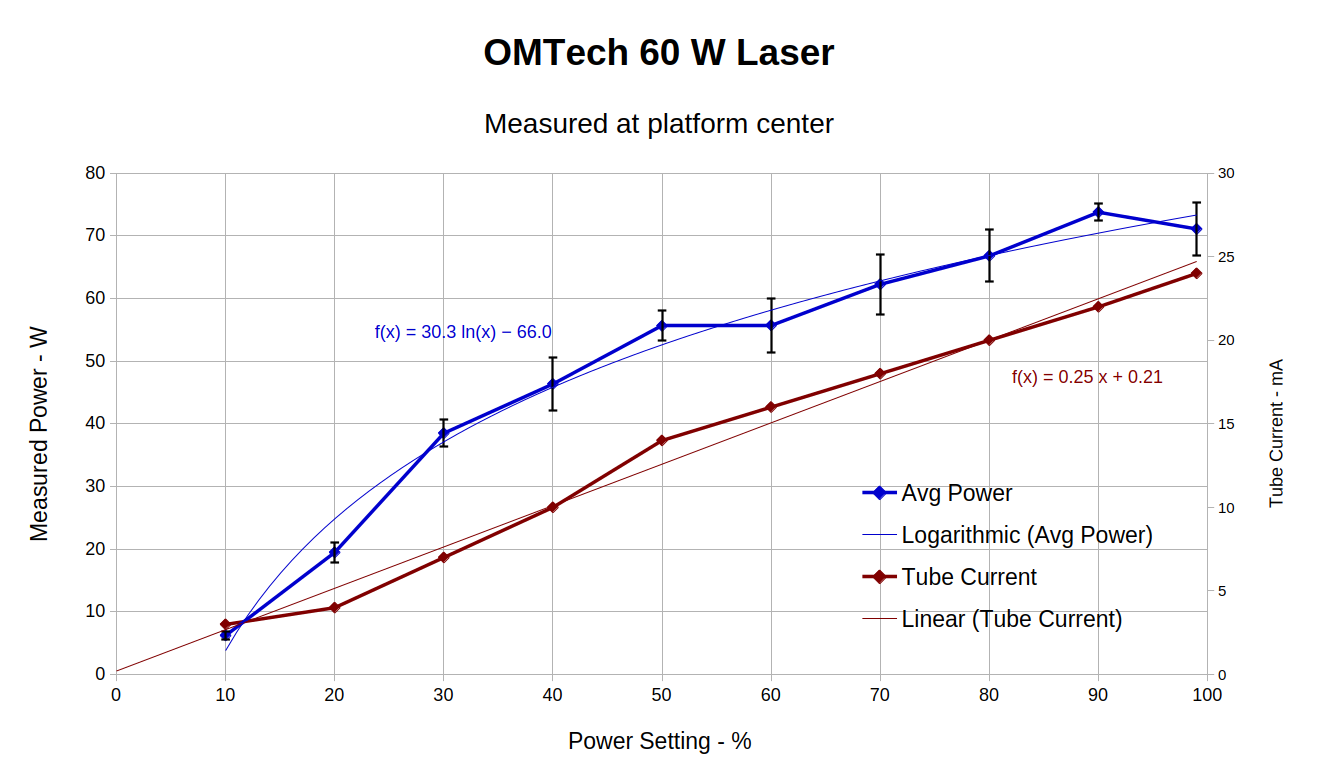
I have an OMTech CO₂ machine sold as 60 W, with a tube 1000 mm long and 50 mm OD, labeled “60 W”. The accompanying paperwork has “21 mA” handwritten in one spot and the 10% and 95% test currents noted as 2 and 20 mA on the QA report. There is no indication of the optical power at those test currents.

Based on various charts and articles found in various places around the web, it seems to be a 50 W tube overdriven to claim 60 W.

I measured the optical power output and tube current as a function of the PWM percentage:

In contrast to the QA values, 20 mA tube current (80% PWM) produces about 67 W of optical power, which is obviously far too much for a 60 W tube. The tube hits 50 W at 12 mA (45% PWM).

Various sources recommend not exceeding about 70% PWM on a regular basis, which would coincidentally drive this tube at 60 W. Although the PWM limit is intended to drive the tube at less than its rated power, that isn’t the case.

The controller reports this tube has been used rather gently, despite some high currents: :grin:

  • 3200 power-on hours
  • 121 work hours
  • 70 laser-on hours

Based on your company’s experience and measurements:

  • What is the correct power rating for the tube in my machine?
  • What is a reasonable tube current for normal use?
  • What maximum tube current should I use?
  • Do you recommend setting the power supply’s internal trimpot to limit its output current to that maximum value?
  • What tube lifetime would you expect under those conditions?

Thanks …

1 Like

The problem with the Ruida, is you can’t reset or zero the numbers. If you change tubes, you can’t start it over, at least no way I know of.


This K40 is supposed to put out 45W..

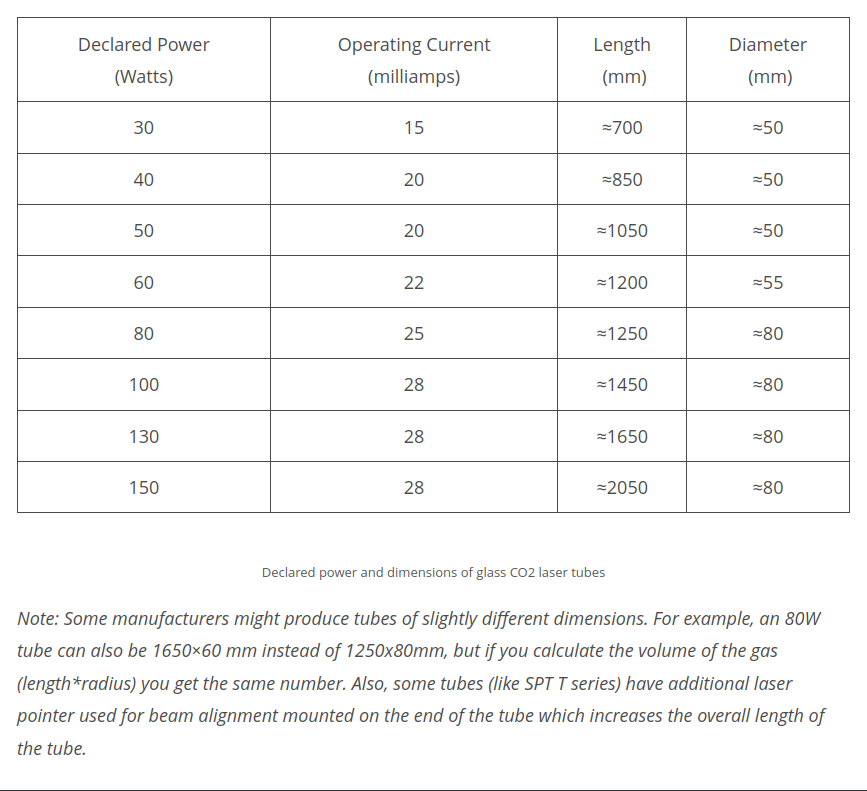
If you look down the advertisement, it tells you tube length of 720mm. Using this table, it’s pretty clear it’s just capable of creating a bit over 30W. I’ve used this chart for the 6 or so years I’ve been using a laser.

My OMTech 50W actually had a tube that was 880mm in length and 50mm in diameter. Notice that 40W is about 850mm. Mine at it’s maximum could produce 43W, so it seems about right.

If the tube in your machine is 1000mm in length and 50mm in diameter, that’s what’s in mine for a 50W tube. It produces 50W at 15ma and will hit it’s do not exceed current (don’t recall that) at about 64W, if I recall that also.


That’s ignoring the fact that a glass tube laser is an analog device, not digital. How would that effect tube life?

Most of the K40’s have a pwm line to control the laser tube. The enables and disables the tube, operating it in digital mode. The tubes current level is adjusted with a pot, the users sets to 100% current. They then run it, it switches on at 100% power then switches off. Can you take an average current, as the meter shows, or are you actually damaging the tube/gas mixture?


I figure, so far I’ve gone through about a tube every two years, so I’ll be happy with that.

I figure there are so many people dealing with these differently, don’t have a clue how you could even keep up with user changes.

:grinning_cat:

Jack, I certainly don’t want to be rude, but I don’t quite understand your explanation for the lifespan of your tubes.
I don’t know anyone who uses their laser within the recommendations of the manufacturers, who change the tube every 2 years.
There are only 3 possibilities, as far as I can see, to make a tube change necessary in advance.

  1. Excessive use of the tube for mass production (plus 250 production days/year of 8 hours.
  2. Misoperation, lack of cooling, frost burst, mechanical instability, using the tube beyond its limit,…
  3. Extreme bad luck.

I know that the climate where you live plays into the equation, on the other hand I have seen primitive workshops in Asia that run mass production under significantly bad conditions.

So I mostly assume that it is bad luck that is pursuing you, but that you think it is ok, that is what I have a hard time understanding.

You’re not being rude, I don’t know what to change. I ran my first tube and was very gentile with it, most of my engraving is very low power and with that tube, I kept it under 14ma, if I recall the value. It went out of TEM00 mode with no use over a 3 day weekend. I had to re-align it every time I started it up.

The second tube, I ran whatever I need to cut thicker, over 5mm. I stayed under the maximum advised values, but still ran it very hard. It went out of TEM00 mode rather slowly, but I couldn’t do much to correct it’s alignment.

The only thing unpredictable is weather and it’s been really hot.

I don’t know where else to go, I’m more than willing to listen to any suggestions you have if I can improve tube life. I’m all ears.

I run the chiller at 18C and give it at whatever time it needs to stabilize.

:grinning_cat:

My personal 130W CO2 laser is on the same tube it came with, in 2017, with little drop in power. I attribute it to always having the tube at room temperature before firing, and regular coolant changes. I ran an in-line aquarium water heater before the chiller to bring the whole system up to 20C before firing the tube.

There’s people here and at other sites claim they have gotten 7 years out of their K40, so far. Others claim, in an industrial environment, they’ve got over 8 years on it with daily use. Much more than I put on it.

Again, any suggestions would be appreciated… :man_shrugging:

:grinning_cat:

Then it’s probably that you’re just very unlucky.

We all know that our fine standard OMT and company lasers don’t get A1 quality tubes, it’s fair enough for the price to get a No Name tube, as long as it’s a “normal” B product.
And I’ve assumed that you don’t run a predatory operation and that you know too much about laser machines that it could be an “operating error”.

My K40, which was a fine starter machine, lost a little power relatively quickly, but it was definitely also a C rated product, but still managed to produce at an 85% level (I think) for a long time.
With my nominal 60 Watt tube, on the other hand, I have been extremely “lucky” or more correctly said, got a machine with a proper tube. Both the beam quality and power are as one would expect. In the 6 years that I have had the machine (I mean I bought it shortly after you bought your laser), the tube has not lost any significant power, when I compare old projects and their settings, it is perhaps barely 5% that the tube has lost, but it is still very sharp in the spot.
The machine is cooled in a range between 18-20 degrees (the temperature never drops below 20 degrees Celsius in my workshop). I change the water very rarely. There is no reason to change when the water is still clean and the cooling machine and hoses are in a dark place. I only use demineralized water, because “we” made it ourselves at my old workplace where I still have some connection to.
My power range is at a maximum of 16mA and occasionally up to 18mA, but very rarely. Primarily because I get no more out of the tube when I reach about 17mA, I have tested that thoroughly.

I hope you have better luck with your current tube.

If my tube says goodbye tomorrow, I will not be dissatisfied with its performance.

Greetings
Bernd