Laser queima placa de madeira

Olá

Tenho um Sculpfun S30 Pro 20W, que até agora sempre funcionou corretamente (tenho-a à muito pouco tempo). No entanto, nas últimas tentativas de corte surgiu um problema: ao tentar cortar uma moldura numa placa de traseira de melanina branca de 3 mm, a máquina está a queimada o material, e a deixar a madeira totalmente escura/queimada.

Já testei várias configurações (potência, velocidade, número de passagens e foco), mas o problema mantém-se. Em alguns testes fica com menos queimaduras, mas ao repetir o mesmo processo volta a queimar.

Queria também acrescentar que já fiz limpeza completa e inclusive substituir a lente, mas o problema continua.

Gostaria de saber se existe alguma configuração recomendada para este tipo de material e ajudar-me a identificar a causa do problema.

Agradeço desde já a ajuda.

Cumprimentos,

Celeste Rocha

Hello

I have a Sculpfun S30 Pro 20W, which has always worked correctly until now (I’ve only had it for a very short time). However, in recent cutting attempts, a problem has arisen: when trying to cut a frame on a 3mm white melamine backing board, the machine is burning the material, leaving the wood completely dark/burnt.

I’ve already tested several settings (power, speed, number of passes, and focus), but the problem persists. In some tests, you get fewer burns, but repeating the same process causes it to burn again.

I would also like to add that I have already done a complete cleaning and even changed the lens, but the problem continues.

I would like to know if there is any recommended setting for this type of material and help me identify the cause of the problem.

Thank you in advance for your help.

Regards,
You should not use this with a laser. The glue/resin inside will not allow a clean cut. Additionally, white is the worst color to use. Better use a different material.

Is it the Pro Max? The S30 Pro is only 10w.

Português:
Como já referido pelo @Misken melanina branca é um mau material devido a cor, colas e resinas.
De lote para lote, as concentrações mudam e as definições que eram funcionais para um lote podem ser desastrosas noutro.
Basicamente, se pretende continuar a trabalhar com esse material com esse laser, mentalize-se para fazer um teste de material em cada placa ou lote de material.
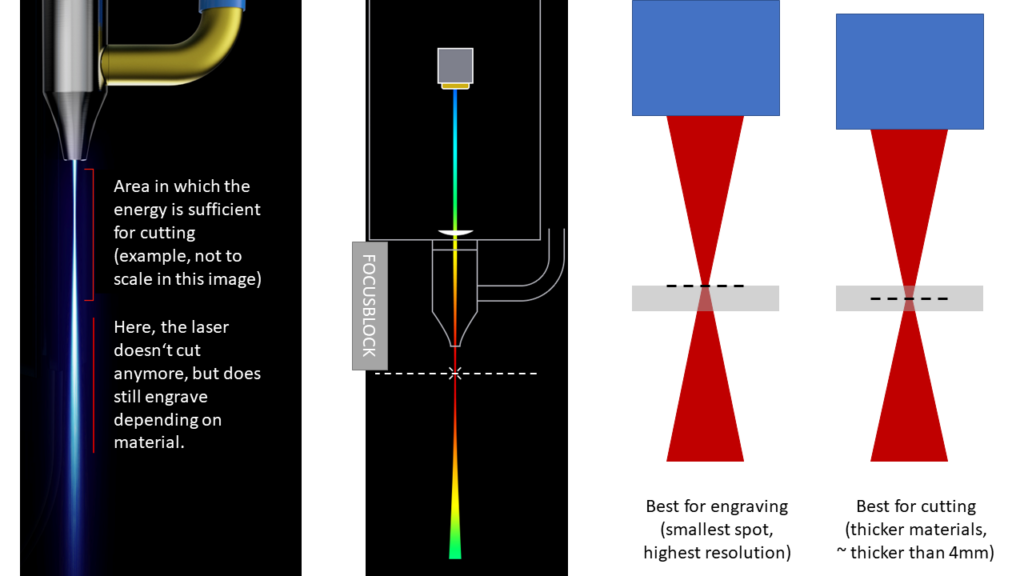
Verifique que o ponto focal (para corte) se situa a meio da espessura do material.
A titulo de exemplo, admitindo que a distancia focal seja 20mm isto quer dizer que da lente a area de trabalho tem de existir uma distancia de 20mm para estar devidamente focado.
No caso do corte deve ter em conta a espessura do material, que no seu caso sendo 3mm, implica que a distancia focal seja reduzida metade da espessura do material (1,5mm). Então na vez de 20mm passa para 18,5mm desde a face do material á lente do laser. Desta forma a distancia focal do laser passa a ser no centro da espessura do material.

Ainda existe a questão referida pelo @MikeyH que é a potencia do laser
Na minha laser de 450nm (laser azul) de 5W para cortar contraplacado de 3,8mm preciso fazer 8 passagens a 800mm/m e 65% potencia para conseguir um corte aceitável, limpo e sem zonas queimadas. Mas é frequente aparecerem zonas que o laser não atravessou completamente precisamente devido as colas e emendas internas do contraplacado.

Segue uma imagem ilustrativa que retirei da net que demonstra o ponto focal.

English:
As already mentioned by @Misken, white melanin is a poor material due to its color, glues, and resins.
From batch to batch, the concentrations change, and settings that were functional for one batch can be disastrous for another.
Basically, if you intend to continue working with this material with this laser, plan to do a material test on each plate or batch of material.
Verify that the focal point (for cutting) is located in the middle of the material’s thickness.
As an example, assuming the focal distance is 20mm, this means that the point from the lens to the work area must be 20mm away to be properly focused.
In the case of cutting, you must take into account the thickness of the material, which in your case being 3mm, implies that the focal distance is reduced to half the thickness of the material (1.5mm). So instead of 20mm, it becomes 18.5mm from the face of the material to the laser lens. In this way, the laser’s focal distance becomes the center of the material’s thickness.

There’s also the issue mentioned by @MikeyH, which is the laser power.
With my 450nm (blue laser) 5W laser to cut 3.8mm plywood, I need to make 8 passes at 800mm/m and 65% power to achieve an acceptable, clean cut without burnt areas. But it’s common to find areas that the laser didn’t completely penetrate, precisely because of the glues and internal seams of the plywood.

Here’s an illustrative image I found online that demonstrates the focal point.

1 Like