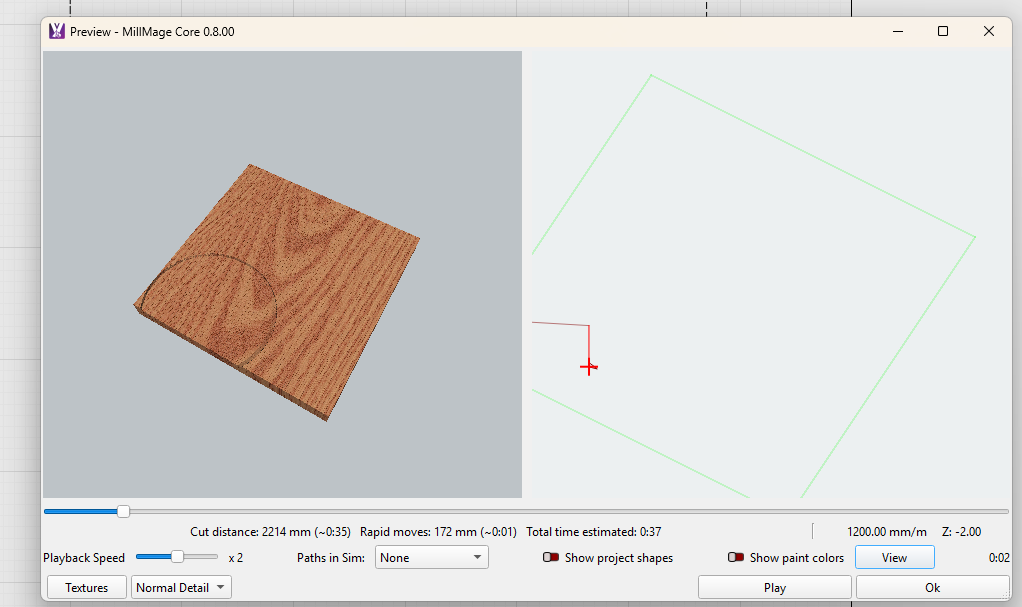
I did a little wood planing tonight, which overall worked out quite well. I missed the lack of a final pass, but I guess that’s just adding another layer and a new op, no big deal.
The major problem I encountered was lead in. I was using a indexable 4 insert 60mm planing bit, and used the pocket OP. I couldn’t work out how to make it lead it from the side, rather than just plunging in. I did try a zigzag entry, but it didn’t make much difference. This set to big visible entry circles on the wood, and a risk of damaged inserts.
Usually I would program this to plunge and start from 20mm or so away from the workpiece, and gradually increase my chipload that way, rather than plunge in with 100% chipload. Changing the toolpath helped somewhat but it was still plunging in rather than gradually increasing load from zero.
Also had the issue of the program running itself twice, as in the gcode was duplicated (getting to maximum depth and going again)
The hack for this would be to pretend the workbit is longer, and let it plunge in thin air, but it would be nice if we could define entry and exit points. This becomes more important with complex fixturing.
Have you looked into the ‘Face’ operation discussed in greater detail here:
Additionally, for the “final pass”, one can set the depth per pass a little short. Meaning, if you want 2 passes + a final, you can do something like 10mm depth, 4.5mm depth per pass - the 3rd pass will only go 1mm deep.
We do have ‘adding Lead-in and/or Lead-out paths to shapes.’ on our list for future enhancements but cannot provide a timeline for release.
The face operation seems to handle it the same or a little worse than the pocket operation for some reason. (Or I may just be remembering it wrong and we used face all along.)
It’s essentially taking a 2mm plunge with a 60mm endmill at 16k rpm instead of starting outside the workbit to progressively increase load. It also forces me to plunge very slowly (1200mm/m and run the spindle faster than I’d like at that diameter because I don’t want to crash the inserts. Which causes some burning.
What is your “Clearance” value set to for the facing op? That specifes the amount of overshoot, as a function of bit diameter. If you use 100% or better, it should do what you want.