Hi all,
I’m having issues with swapping lenses in my 60w Mopa fiber laser. I have been running a 174mm. I bought a 110mm (f160 110 1064) from the manufacturer of my laser but I never got around to installing it until today. I cleared the cor file for 174mm and ran the lightburn calibration which went just fine. I wanted to fine tune my focal distance so I made a 15mm square engrave on steel. Speed 100, power 80%, frequency 30. It framed but no output. I increased and decreased the all settings still nothing so I tried the lightburn calibration again. It worked fine. I deleted all devices and reinstalled and still same result. I’ve spent hours trying to figure this out. What am I missing?
Are you importing the supplied configuration file? This has the controller information setup.
I usually load the markcfg7 file, then do the lens correction. You have to ensure it’s focused.
So did that fix it?
Most of the time the focus is off, seems odd you can use the lens calibration, which engraves, but won’t work…
I’d suggest the sound method of focus.

The laser worked fine with the 174mm lens, its only when I swapped lenses that I had issues. In Lightburn, I duplicated the original 174mm device. It had been setup with the original markcfg7 file. The duplicate calibrated but no output when creating my own object. I removed the original device and the duplicate and allowed lightburn to find my laser which it did. Again the laser fired during calibration but would output my object. I focused it based on the info supplied by the manufacturer but I wanted to fine tune it. I can’t get any output to focus it other than during the lightburn calibration. I can hear the head change pitch but there is no mark on the steel. I tried raising and lowering the head to see if it just was too far out of focus but still no results.
If it works for calibration it’s likely working.
If you go from an F100mm to an F210mm (160x160mm) the spot size changes from the F100mm of 10 microns (0.010mm) to an F210mm with a size of 40 microns.
You have effective doubled the size of the spot, twice. Each time you double the spot size the apparent power drops by 4 times or 1/4 the original.
You have doubled it twice, so I’d suspect your output will appear to be 1/16th of what you generally are used to.
This is normal, but you really see it with a fiber. Same power over an area 16 times larger, your machine appears weaker. I run an F254mm, changing to a shorter lens, I notice the changes I have to make.
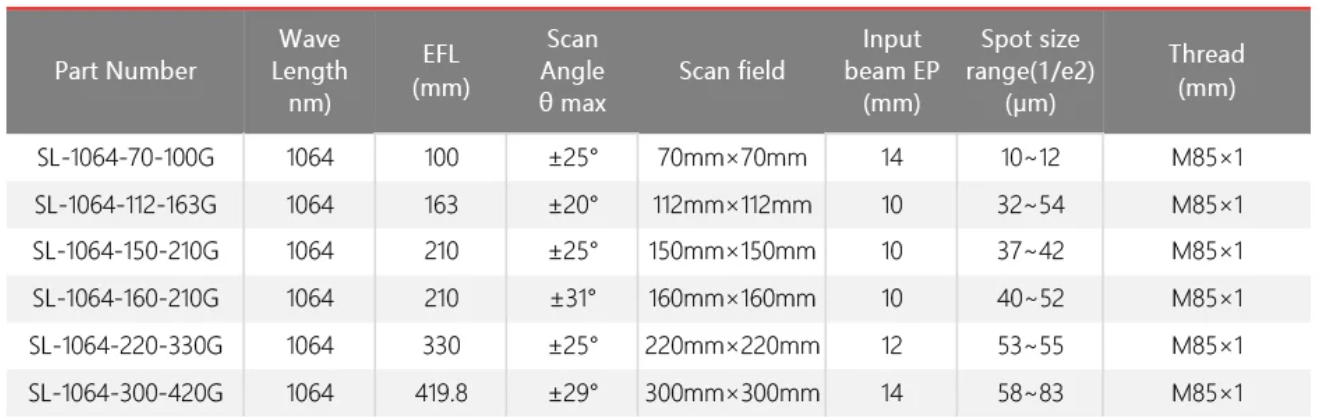
I’m not sure what to tell you as the scan head and lens combination isn’t going to break your machine, just change the settings for same type of work.
If it’s really an F163mm, it’s still produces a 32 micron spot, three times your original F100mm.
Make sense?
It does make sense. Thanks for the explanation! I didn’t even think about that. I’ll make the adjustment today and respond back to the thread on my results.
You got me thinking about things a little differently so I started going through all settings tabs again and there it was right in front of me…the setup picked the wrong source. My laser has an IPG_YLPM source and the setup chose Raycus. Without changing any other settings, it fired as it should. Now I’ve recalibrated and focused and its working as it should. Without your explanation of spot, I don’t know that I would have arrived at the solution. Thank you!
No perspiration  … we try to help other keep their machines running as they expect.
Suggest you hunt around for a copy of the manual for your source. It might not make much sense to you initially, but you’ll find it invaluable when you hit what you think are dead ends.
The spot size game is just optics, works the same with my 50W co2 when I change from a very small spot from my compound lens to a much larger spot with my 4" (101.6mm) lens. I think we don’t notice it as much because most natural materials, such as wood are not really thermally conductive compared to metals.
I use my F420mm lens (~50 micron spot), for rocks.. It has a depth of focus (dof) of over 13mm.. so it works well for rocks. Mother nature doesn’t have any quality control and some of the rocks she produces are not flat enough for lasing.
50 microns is smaller than most visible light led lasers.
Keep in mind that a fiber has to be pumped up before it can lase. That takes time. A MOPA will allow you to produce pulses, faster than the fiber can be pumped up. This results in pulses that are not at full power.
The advantage of a higher wattage fiber machine is how fast the fiber can be pumped up. A 100W fiber will pump up the fiber in half the time as a 50W. The pulses/s are usually any greater than a lower wattage unit…
In my JPT manual this is referred to as the threshold frequency, where a selected waveform can’t be produced at that frequency or pulse rate.
This is a great video by JPT on how a MOPA works… at least it’s a good visual of it’s operation.
The payback for this fix, besides helping others, is for you post some of your work for us to see. 
Take care, have fun.