After months of trying to cause my E80 module to fail due to overheating because of non working fans, I’ve decided to just accept the fact the thing is indestructible and quit running it at 95% power all the time.
I have two CO2 Thunder lasers I use for most things but I like playing with the NEJE so I’m about to order their new IR module - I’m also interested in their new water cooled 50W module when it comes out.
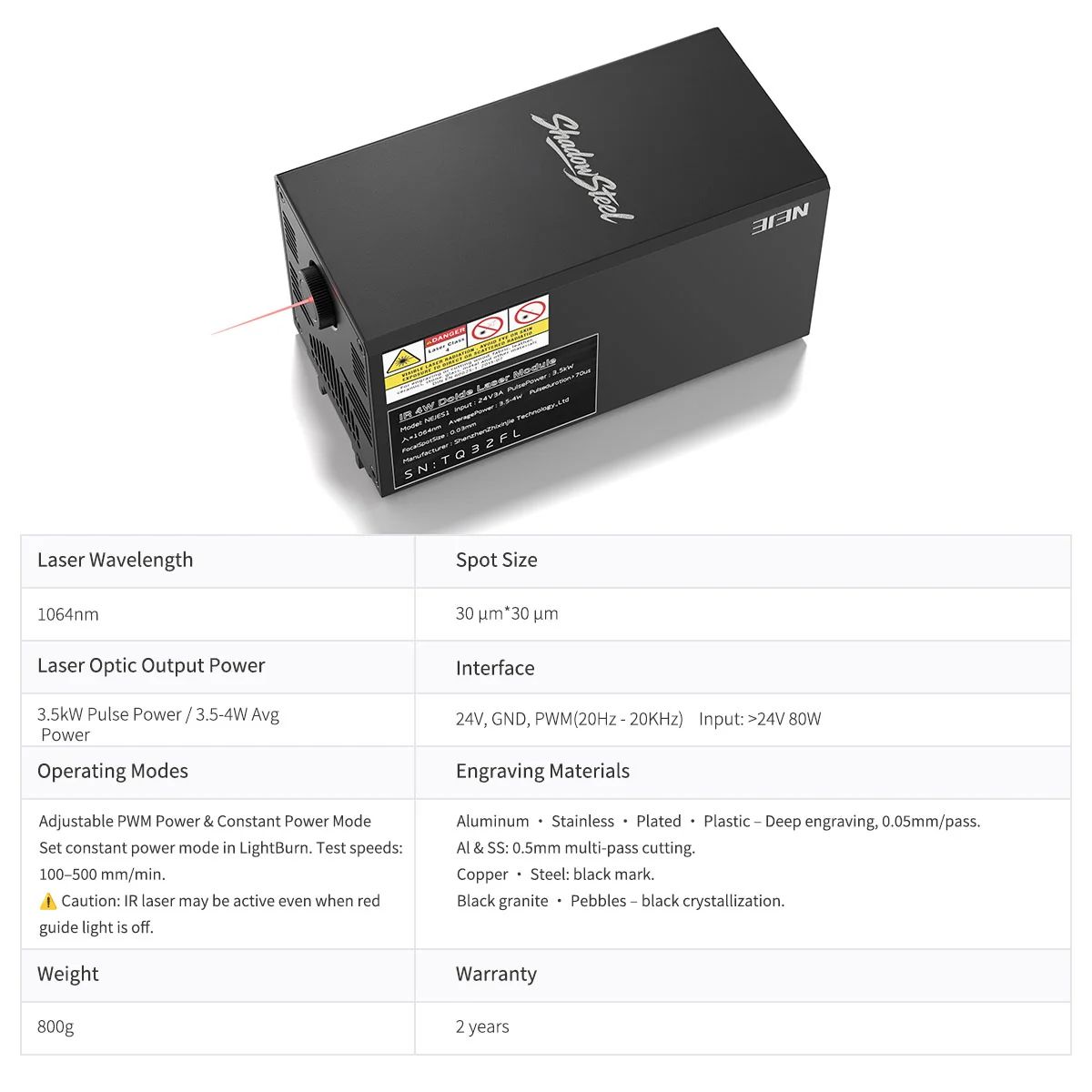
The listed weight of 800 g, plus internal water, plus relatively stiff & heavy hoses, suggest reducing the X and Y axis maximum acceleration values by a factor of four will be prudent.
The weight may also require reducing the X and Y axis maximum speed values.
The hoses will require careful management to prevent snagging & dragging.
If it’s larger than whatever you’re using, reduce the X and Y axis maximum travel size.
Verify proper home switch actuation.
Verify the machine’s power supply matches its (presumably higher) current requirements.
You might also consider the 20W IR module from Sculpfun (Sculpfun IR20 20W Fiber Laser Module Kit). It’s a different price tag, of course. But 20W already can be used to cut brass, etc. And due to its construction, the head is very light and can be moved fast.
Might be worth exploring. Although the head might be some type of lower mass than the led, it’s also dragging a fiber optics cable through all the drag links, on both axes, that’s got to increase mass. If it’s a fiber, it’s takes up space and it increases mass, that could be an issue.
One of the issues with IR output on a gantry, is that some kinds of work requires you to use a smaller interval than the machines spot size. If you use 1/2 the interval, your job time doubles.
The spot size on these are pretty small, so you have to decrease the interval to have complete coverage, meaning longer job times.
I’d suggest for a few hundred more, get a galvo type, not a gantry type..
However I understand that money doesn’t grow on tress … unfortunately. So I do understand there are practical limitations that has to be applied.
Similar concept with a galvo co2, you must have an RF or metal tube co2 to make it useful.
A glass tube is likely too slow in it’s response time to make good use of the galvo. Even many gantry machines can outrun the response time of a glass tube. I know mine can.
Great suggestion and I’d give you an for bringing up that option.
just got one. mounted to one of our old and heavy Newing Hall Frames that i had started to retrofit with new motors and a Ruida controller a while ago. Still need to get some screws to have things properly fixed (these alien UNC in a DIN world.. ), but generally the setup seems to work.
Not having had a ‘metal worthy’ Laser module yet i’m still not sure how to and if i’m using it right. Still exploring the basics - as the module came without a manual and there’s no wiki page yet. It had a thick plastic tube in the accessories, which i assume is a focus guide - but in other places it says one should trust the red laser (which don’t quite align for me)..
When all else fails, try the on-line documentation. Some prefer to examine this…
If you read the docs, it states explicitly that your Ruida is not covered by this option, this shouldn’t show if it’s setup as a Ruida. Ruida computes overscan internally. You can force it by setting both min/max power to be the same.
This only applies to a scan type of operation, not a vector. A dsp will vary the power between min/max values when doing vectors.
 for bringing up that option.

 ), but generally the setup seems to work.

