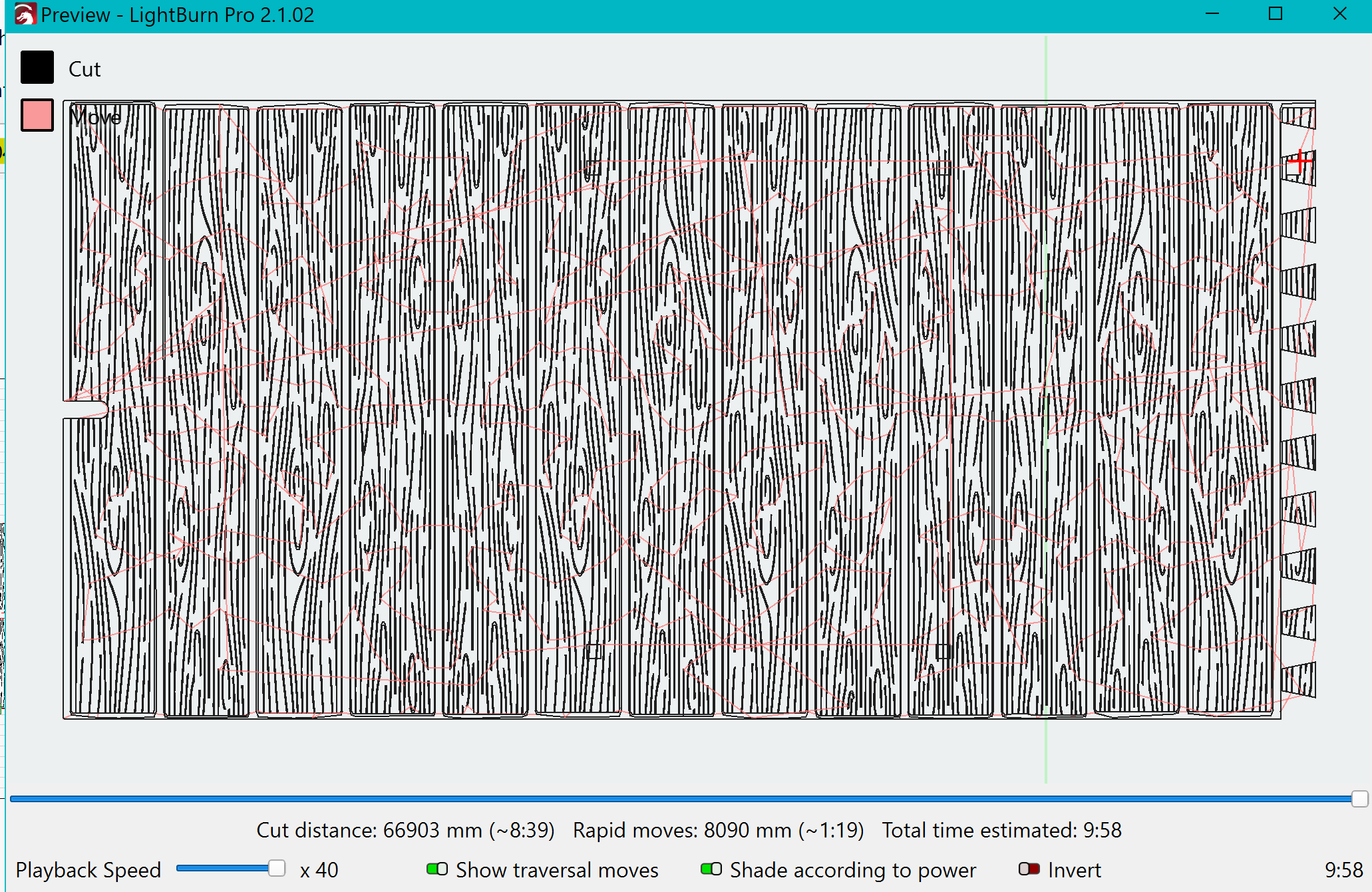
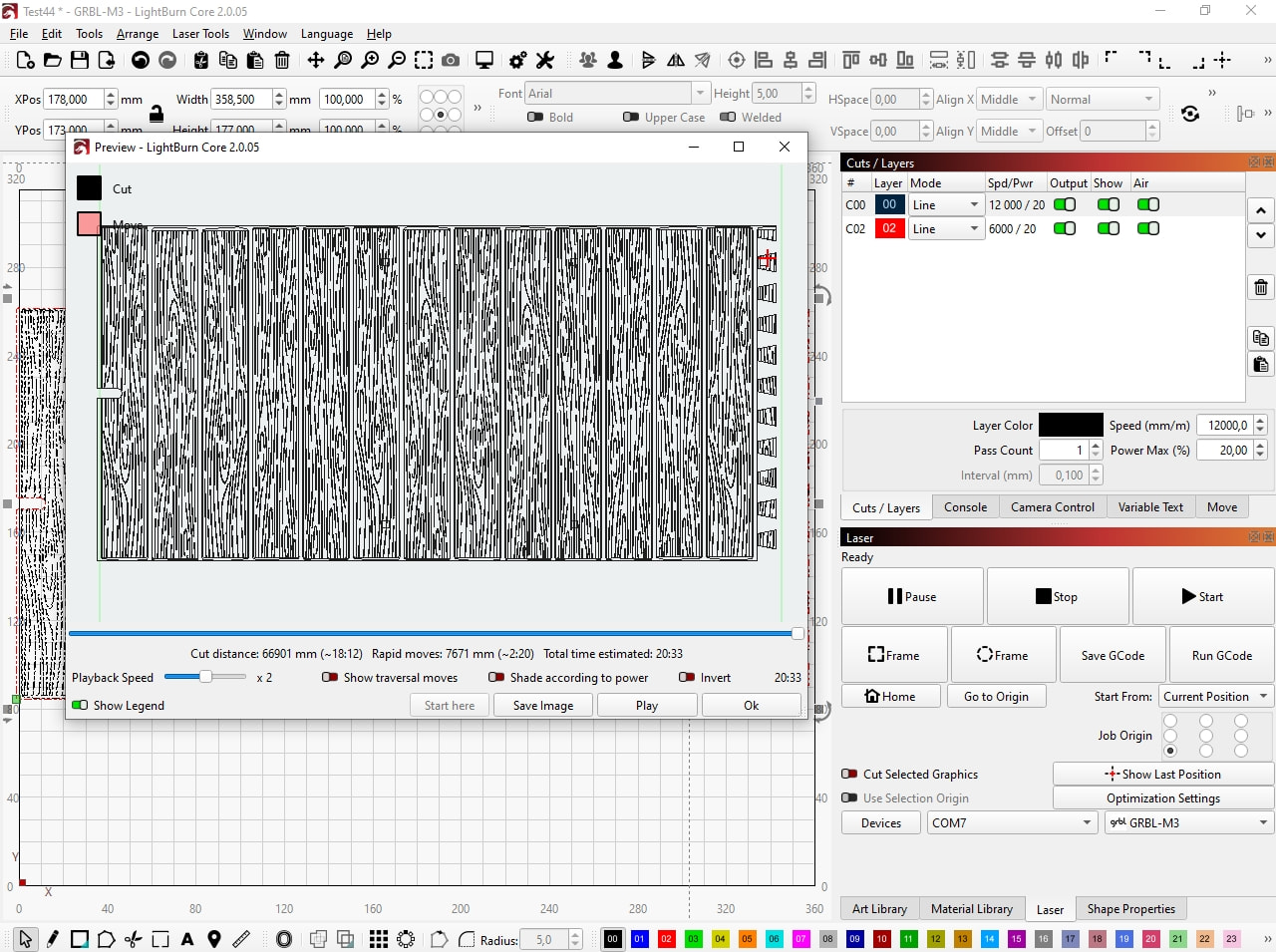
Does anyone want to look at the attached file to see if “Rapid moves” can be brought down further from the 8499mm, I think it should be possible to do better, but I’m a little stuck.
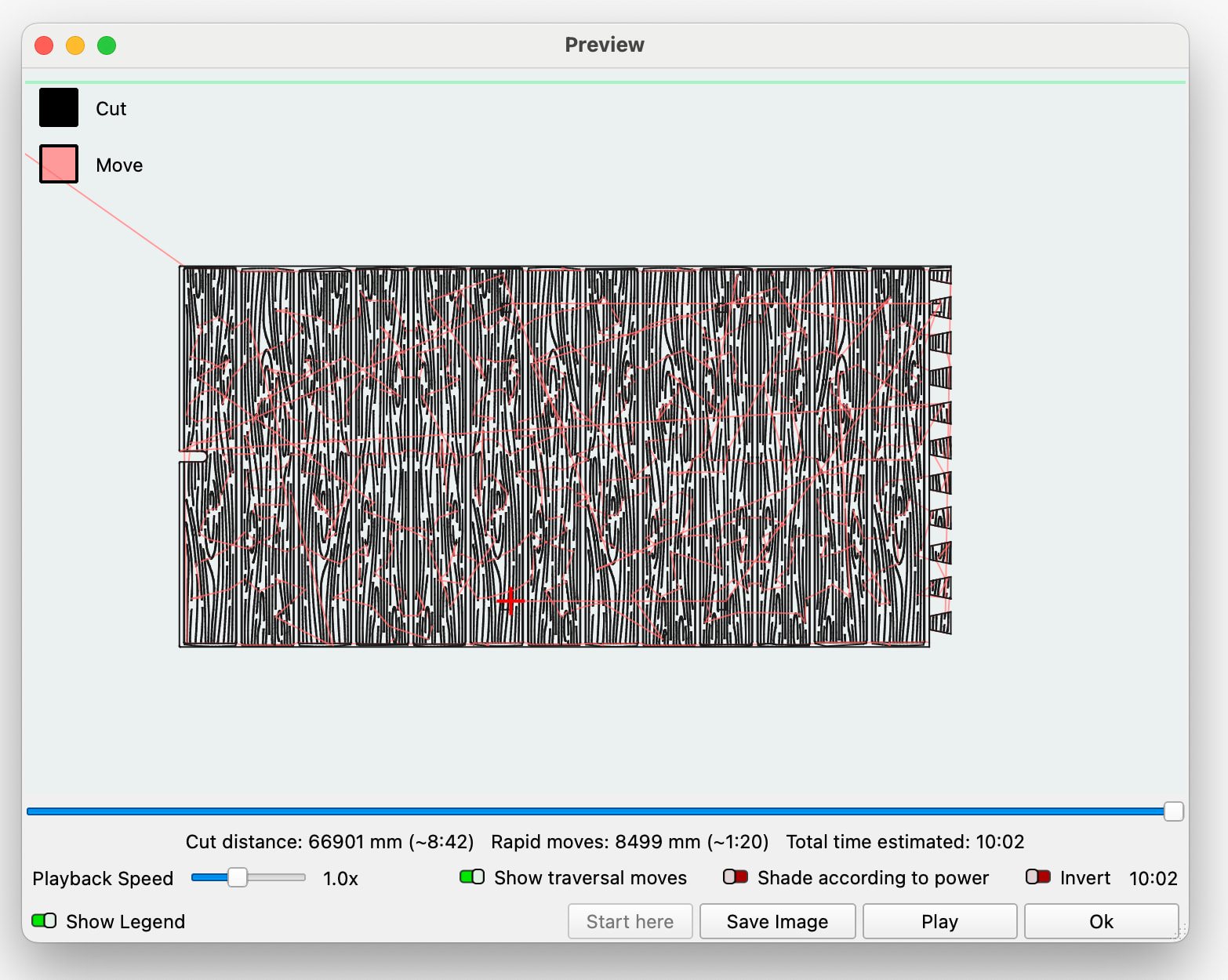
Test44.lbrn2 (532.7 KB)
Does anyone want to look at the attached file to see if “Rapid moves” can be brought down further from the 8499mm, I think it should be possible to do better, but I’m a little stuck.
Test44.lbrn2 (532.7 KB)
Respect 
Thanks for that, but I’m still surprised that there are so many mm “rapid moves”
Must be overscan.
No matter how it works, if somethings changing directions, it takes time, one way or the other. There are timings involved with a fiber.. overscan with a gantry…

That’s not what I doubt or regret, it’s the logic of the movement that seems a bit illogical. (at least to me)
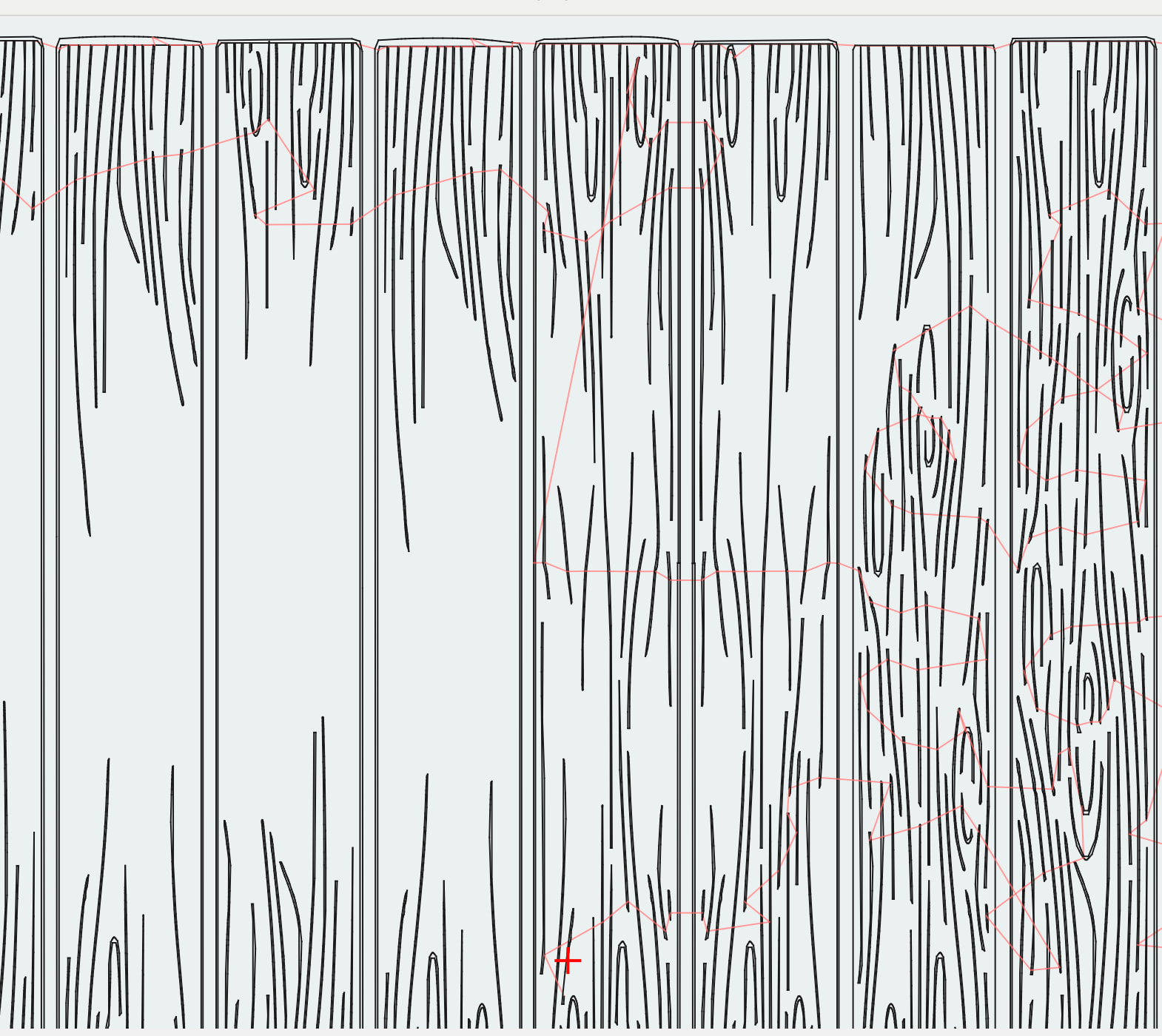
With a pattern set up like in my example, the laser/program “should” go from one side to the other while processing the individual shapes, without “distributing” the work almost evenly over the entire project. It’s the long idle stretches that I think are a “waste of resources” 
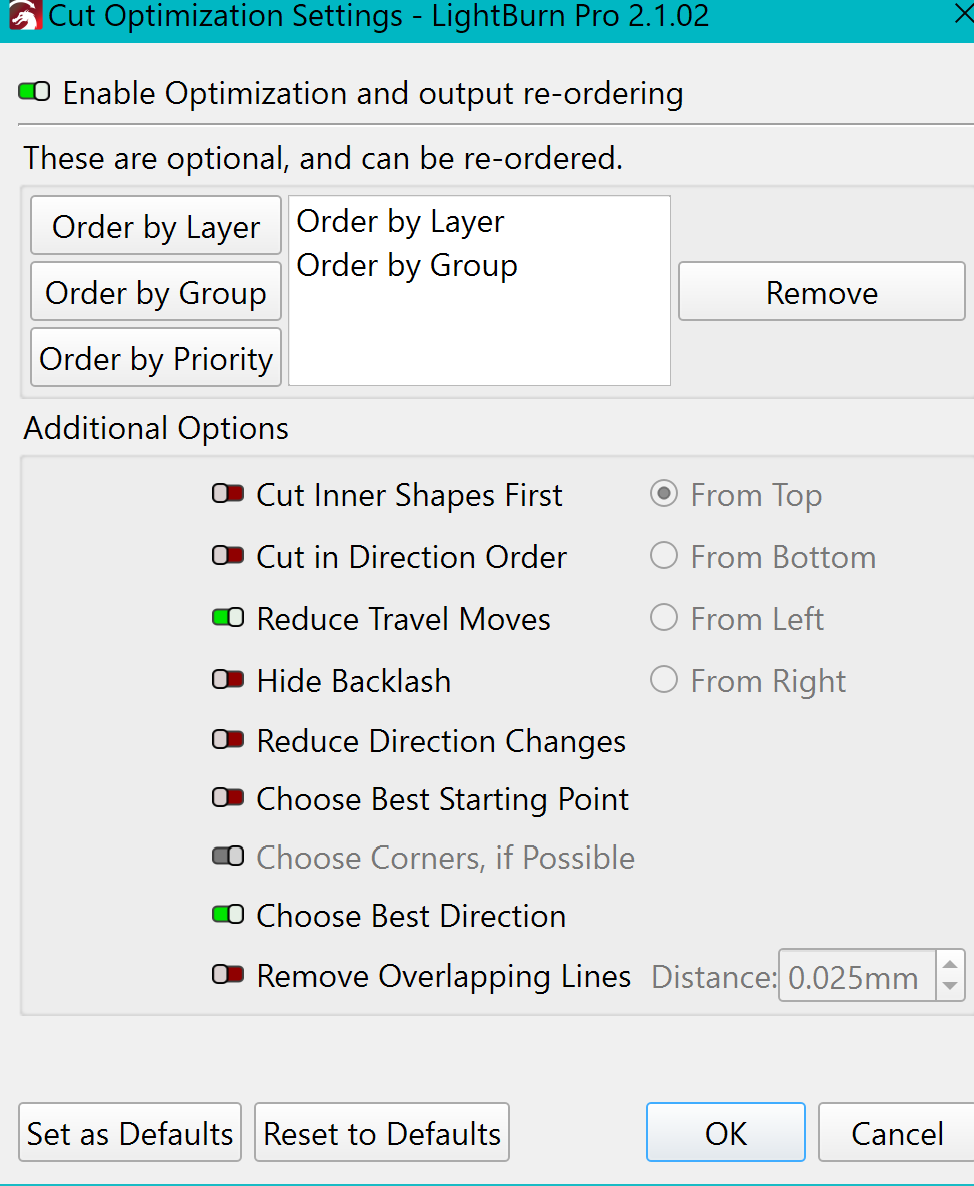
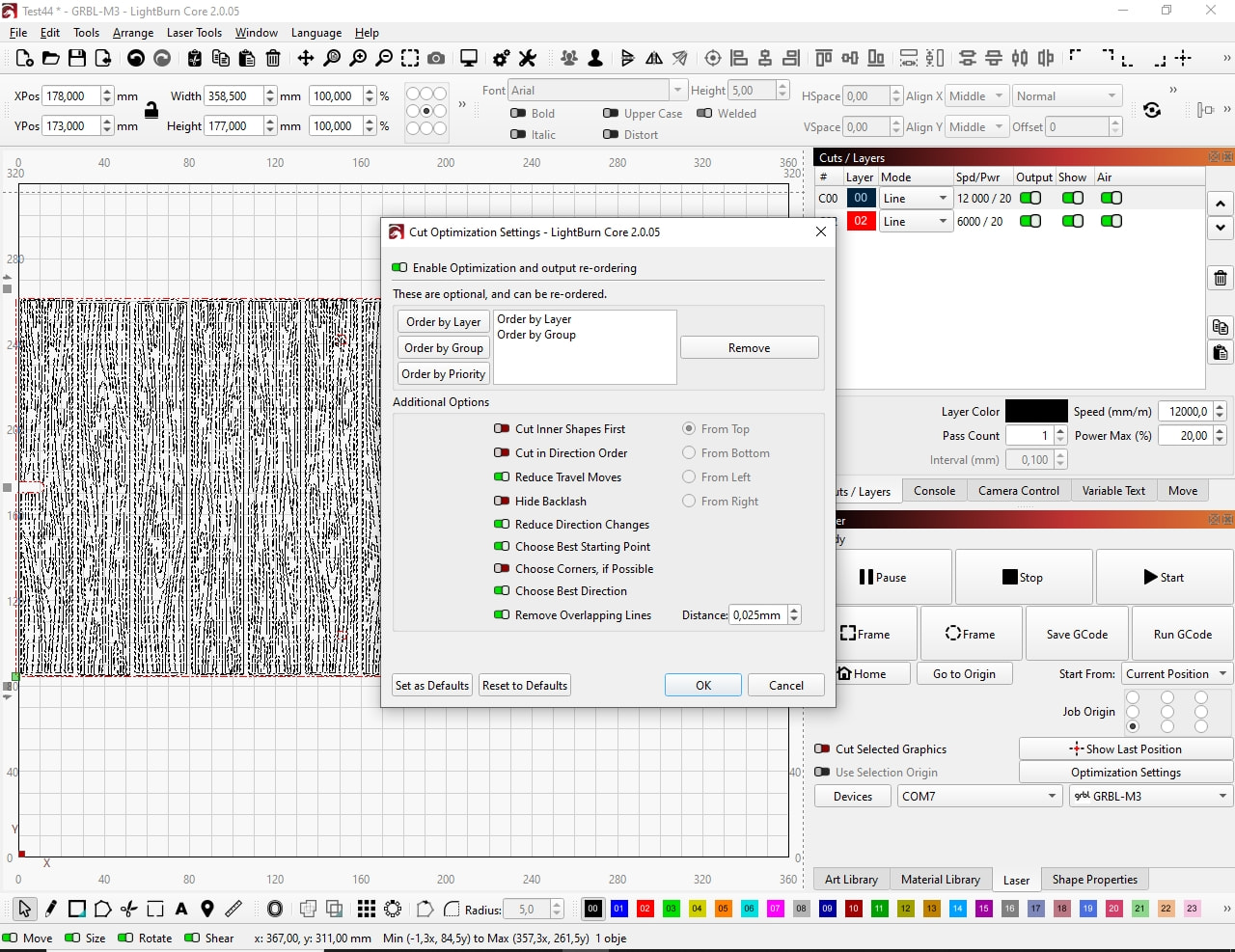
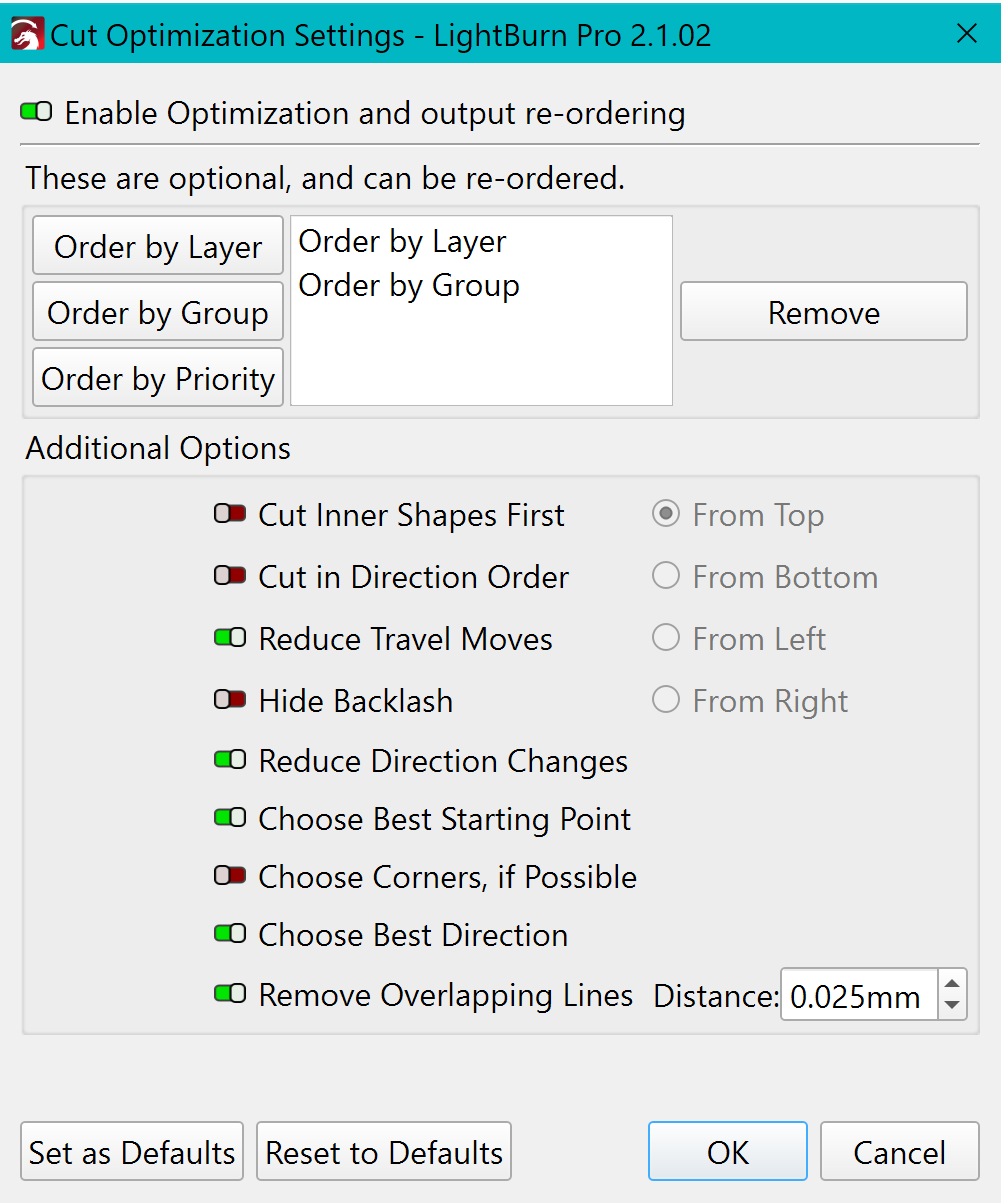
I wasn’t sure if I was using “Optimization Settings” the right way and would like a professional explanation why LB has chosen to process this project in this way.
Thank you for your feedback.
I agree looking at the preview. Might be a good question for Lightburn themselves.
I hear it’s been unseasonably warm over there?
Yes Jack, for people who have never been to Australia or Arizona it might be a surprise that it can get so hot.
Here for me it’s not so bad though because we live by the coast and the Baltic Sea manages to cool the coasts down a bit. But yes, even here they have measured 36.6 degrees Celsius, in the middle of the island. Some parts of Europe are having a hard time right now.
Nb. the coolest and best place for me right now is my workshop
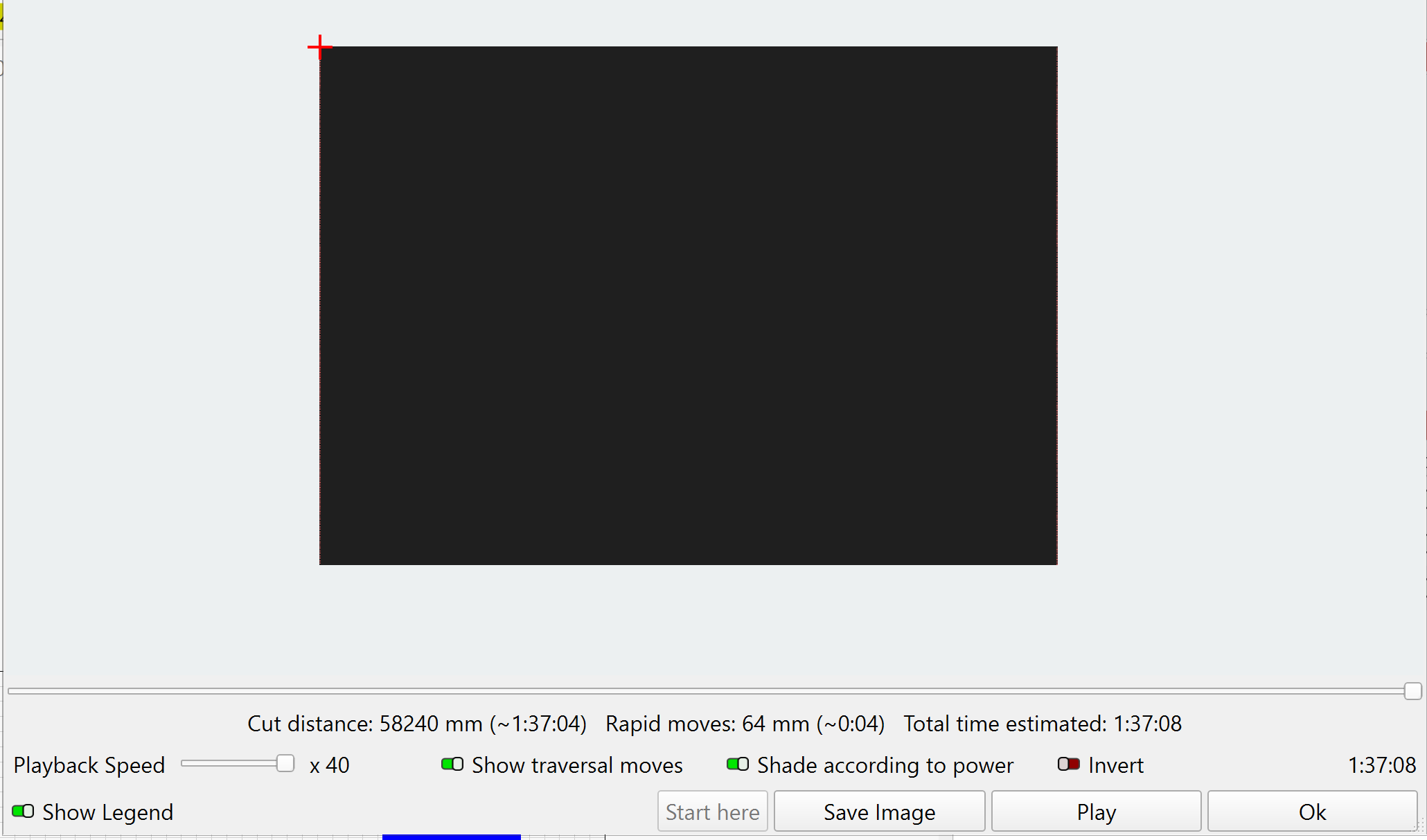
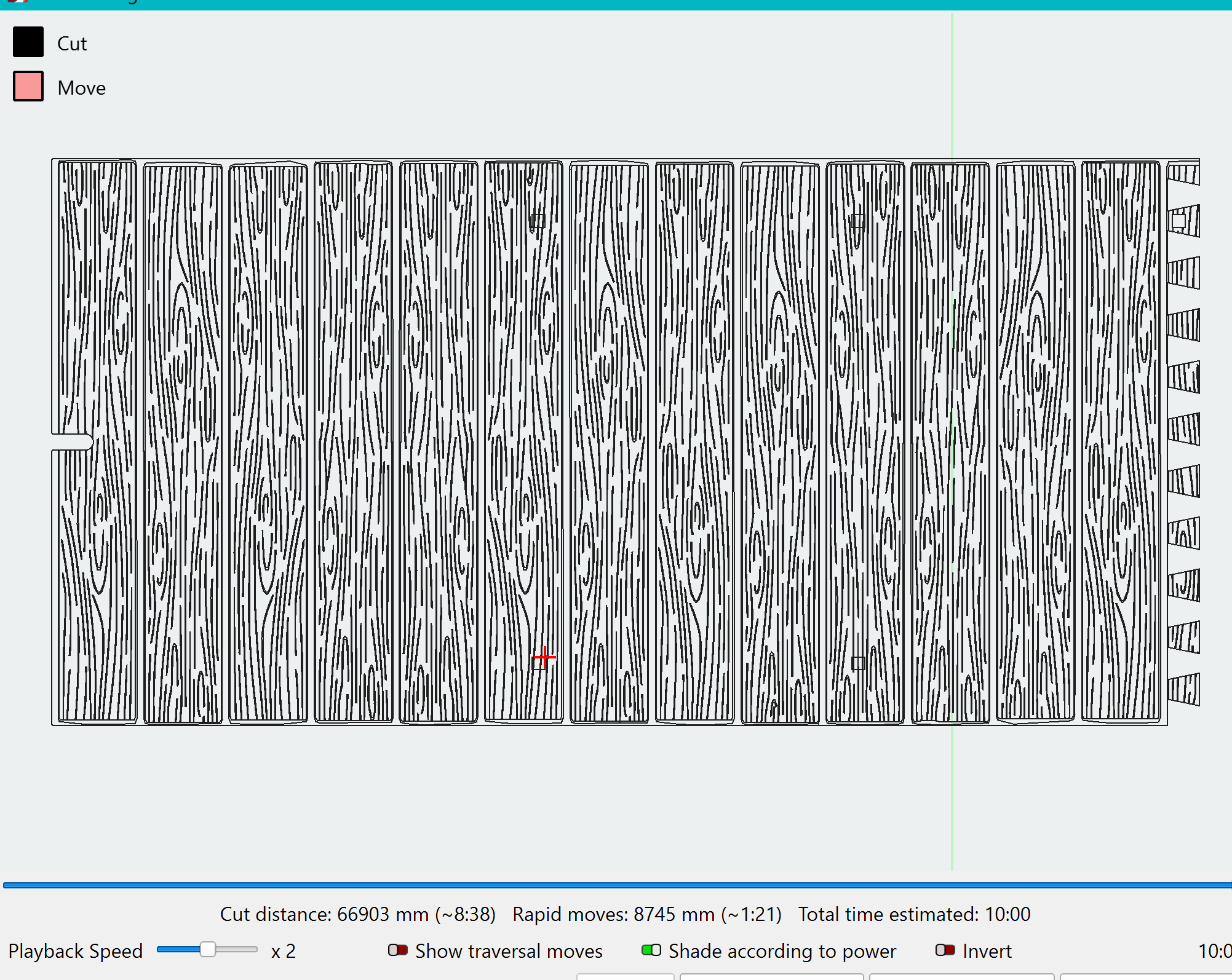
Since saving time on “unnecessary” movements is usually a priority for me, as soon as I opened the file I got this result which is apparently the lowest so far. In fact, I didn’t even try to make any other changes. It’s still a very high number, or maybe not because I didn’t analyze the laser path.
Without optimization, the value goes to 5 digits. 
Would it speed it up if the shapes were single line? The actual score time would be cut in half. The width of the shapes is pretty narrow. If you did a single line and defocus the score, you would probably end up with the same score “look”.
You’re in first place right now, congratulations
But how do you get 828mm less Rapid Moves, with the same settings - that’s interesting.
@LightBurn could enlighten me (us) here a bit?
Of course, the design is not optimal, to put it mildly.
But that’s not really the “problem” right here in this example.
Even in such bad designs, LB’s optimization should be able to make it better. And the difference in the result on 2 different computers (with the same settings) makes it even more ambiguous.
Ps. it’s not the time that’s the problem, it’s the “not optimal” process that’s puzzling me.
One thing I admit could interfere is the code. Whether it’s for a diode laser or a CO2 laser machine. 
How would path generation be different for the two machines? Maybe I’m missing something.
I use the same optimization settings as Luis on the same file and vice versa.
I don’t think so, the starting material for the calculation is the same and both machine types are gantry style. I don’t know about fiber lasers, but even here it is the LB that determines/optimizes the direction of the movement.
@jkwilborn
You probably won’t be missing anything. In my head, where fertile imagination abounds, considering that CO2 machines are more geared towards industrial use, are faster, and generally move more mass (I’m referring to the bridge because I believe the lens support is lighter than a diode laser module), they could have a different coding (a management policy) of movements to handle mass differences.
I may be wrong, but in my view, a diode laser machine is more “intended” for projects that require greater detail, and CO2 machines for less detail and more speed.
I have never worked with a CO2 machine. The information I have and my opinion are based only on what I am reading.