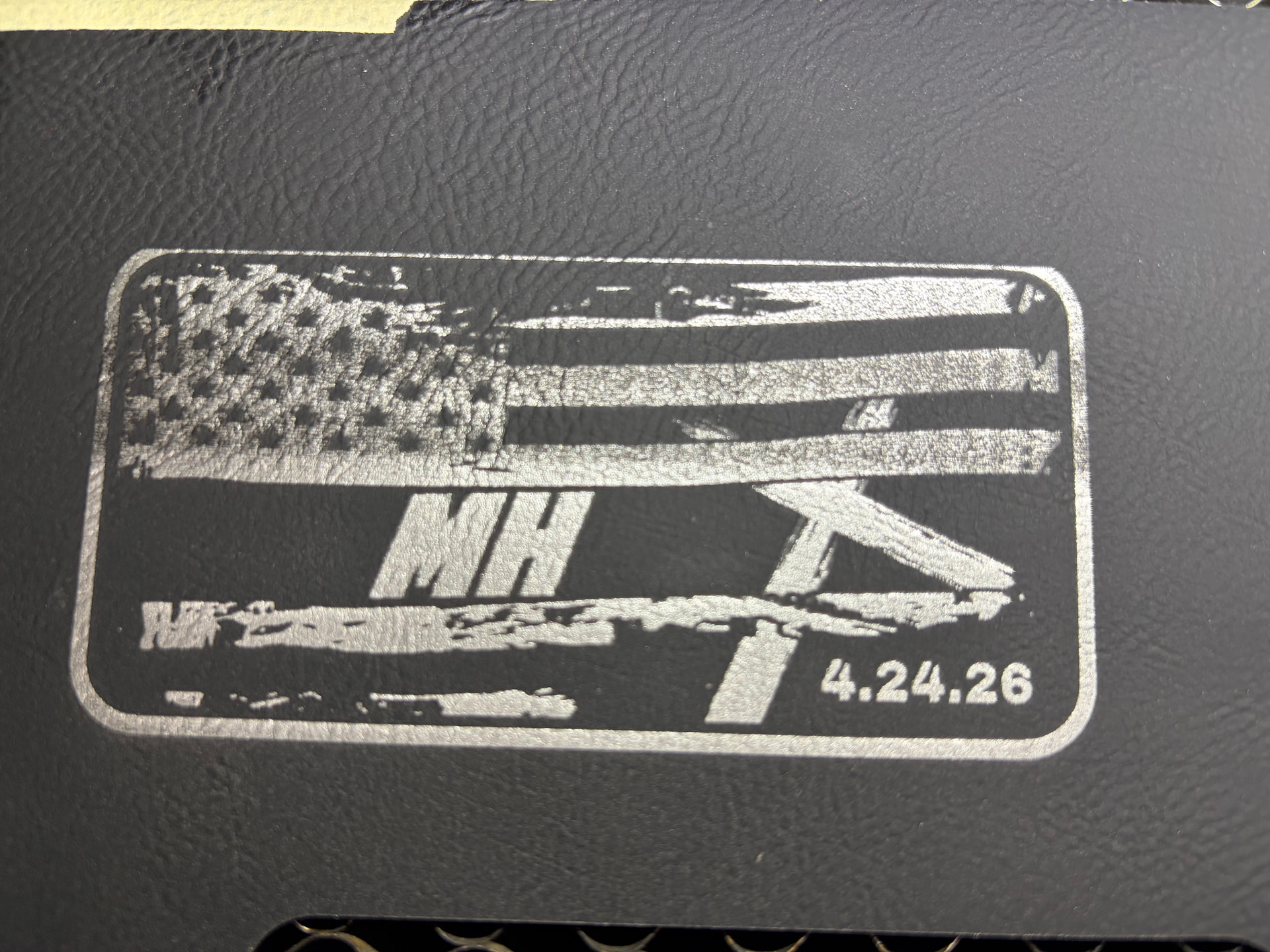
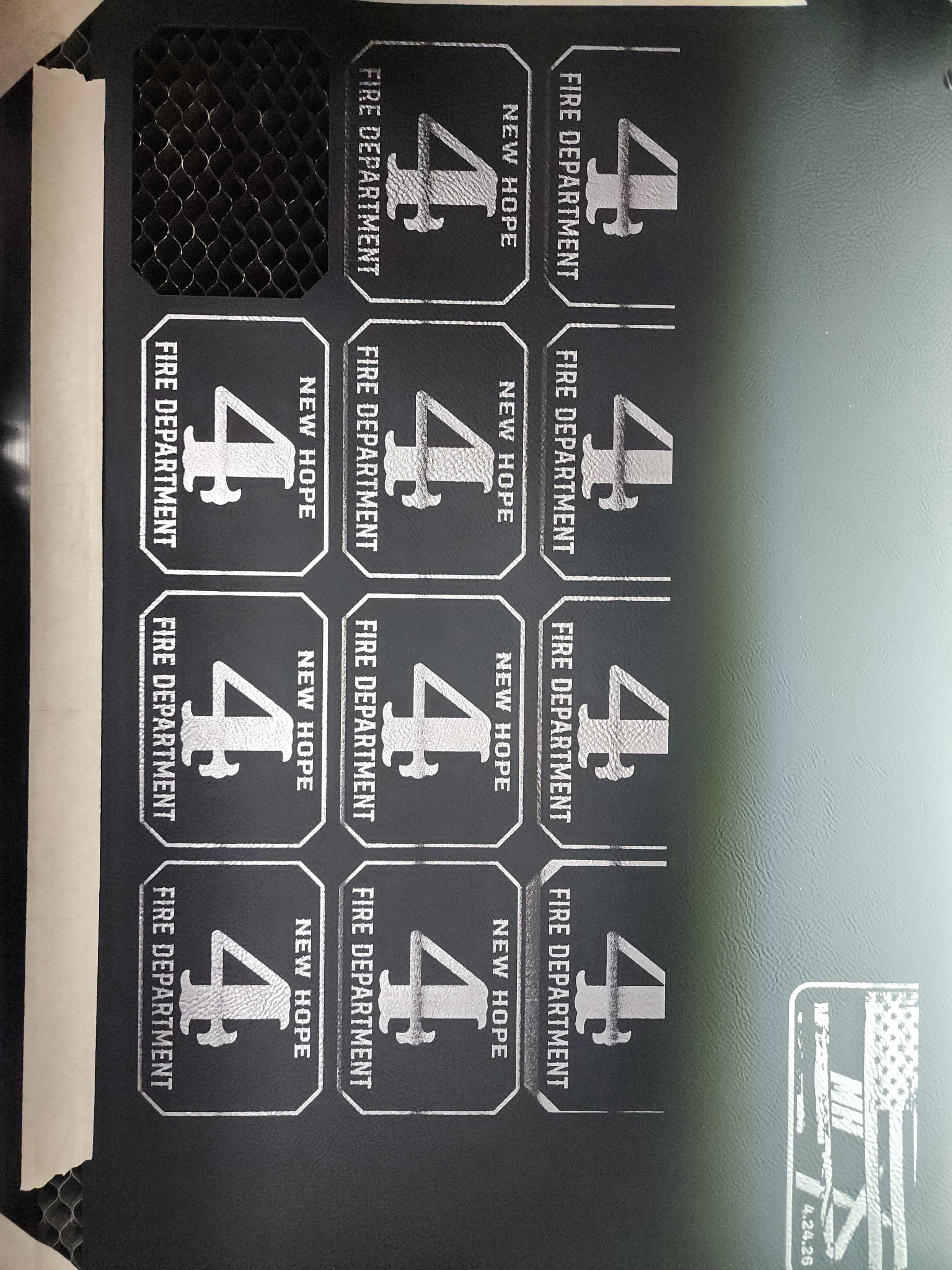
Hello all! I have a bit of a baffling question and I’m hoping someone can point me in the right direction. A client of mine is engraving this dual layer leatherette with silver under black. On one of his machines, a 70w Boss 1420 that’s several years old, he’s getting the strange dark banding you see in the image. I can’t for the life of me figure out what may be causing it.
I have been able to eliminate the possibility that the problem has to do with the chiller. He uses a system that keeps the temperature quite steady, and the Boss has a temperature readout that never varied more than a small fraction of a degree.
Also, this is a vector image, not a pixel image, so there is no chance there’s a grayscale issue causing the problem.
I checked the bed to make sure it’s level and cleaned all the optics I can reach, though it’s nearly impossible to reach the nozzle, mirror 1 or the beam combiner because Boss over-engineers that corner of the machine and the cover is very difficult to remove. So that means there’s still an x-factor there. Not that dirty optics or an uneven bed would cause this kind of variable effect anyway.
There does seem to be a pattern where the fading happens in areas where the laser is on for longer periods. So on the first image, it’s showing up where the flag’s stripes are. In the second image (which is rotated 90º) it’s showing up where the crossbar on the 4s is. I figure that’s too consistently correlated to be a coincidence, but I don’t know what to do with that information.
The material is Black/Silver Laserable Leatherette Sheet Stock from JDS Industries.
Considering that the tests were carried out on different parts of the material, I believe that a material defect is not an issue.
Since it’s a CO2 machine, I don’t know to what extent problems with the power supply could result in what you see.
However, CO2 machines have an ammeter (or usually have one; I’ve never worked with CO2, but that’s what I’ve read in the forum) that indicates a consumption value. Does this ammeter reading vary simultaneously with the problem?
Since it’s a CO2 machine, the tube has a lifespan (I have no idea of the useful hours of each tube), but do you have any idea of the tube’s usage time in the machine, considering it’s a several years old machine?
Your power supply suggestion seems like it could be a possibility. If the tube were failing, we’d simply have an overall drop in power. But I could imagine a failing power supply getting overstressed on those longer periods of being on. Not sure how I could go about testing that idea, however.
In power circuits, something else commonly happens: connectors or connection points lose conductivity, resulting in power loss at the end of the line.
Until other opinions emerge from someone with experience in this type of laser machine, check the wiring and connection points. Look for darkened spots, connection points with looseness; some may have appeared due to the machine’s movement over the years.
Enlarging the posted photos seems to indicate it’s not lasing at the power you need. Doesn’t makes sense and I understand how it’s an issue for you.
If it’s working at all, unless it’s the heat issue you suggest, I doubt it’s tube or lps related. At least so far.
Anytime you’re using material that is man made, it can vary. Ever get a box of cereal that you can’t open without ripping it? Cream bottle they super sealed? That’s part of manufacturing, so don’t write off that aspect. Many times during manufacturing, some defective items to get through before they know it’s an issue.
It appears to be loosing power, unless you’re each as a separate entity and there isn’t time to cool down, I’d look elsewhere.
It could be old enough to need a new tube, but I’ve gone through three tubes and find the last about 2 years each in the hot sw desert of Arizona. Some people I’ve spoken to, one claims over 7 years on his K40 and another that over 10, both still operating.
Believe what you want about tube life, it’s hard to determine. I’m still running on my original lps.
Might be worth a $100 USD to purchase a watt meter and you can measure the beam between mirrors and hopefully from the tube itself.
Any chance you could post the .lbrn file so we can get a better understanding on how this is supposed to work? I understand if it’s proprietary.
Thank you for stepping forward and sharing your opinion.
What I mentioned regarding the material problem refers to this specific case and not in general.
Generally, it’s as you say; in this specific case, since it involves different areas of the same material and the defect is very similar, it seems unlikely to me that the material has so many defects. (Perhaps I say this because in my country, even more so in the region where I am, leather is a product that usually has quite a lot of quality.)
But I agree when you say that a lot of material goes to market before it’s noticed that there’s a defective batch. If I interpreted what you wrote correctly.
Thanks so much for the suggestions. Of course, because this is a client who has to pay me by the hour, I’m not sure how much trial and error I will be able to do on his dime. (He’s got three other lasers operational, so if this one remains offline for a while he doesn’t seem particularly urgent about it.) If I get any more information or solutions to share, I will do so. Thanks!