Using cheap lenses on 100w JPT MOPA laser?

Hi people.

“What if” question.
I know that 100W+ machines run quartz lenses, but what if i used regular cheap lens (up to 60W) and limit my machine to 60% power ? I have a 100W JPT galvo and don’t plan on doing it, just a passing thought i got yesterday that begs for answer.

Tried looking into this, but my google-fu failed me…

Any thoughts on this ?

Best answer is, “That would be cheaper than what the Chinese use. You still think it would work?”

1 Like

The difference seems to come down to the fact that quartz doesn’t absorb as much of the laser pulses’ energy as glass. The quartz lenses having higher optical precision is an advantage but seems secondary.

So, average power would seem to correlate to the thermal environment in the bulk of the lens. If uneven heating causes lens failure (cracking, for example), limiting average power could be relevant.

Another consideration may be pulse energy. If the 60W source has a maximum pulse energy of 0.75mJ but the 100W source has a maximum pulse energy of 1mJ or even 1.5mJ, each individual pulse hits harder without regard to average power. I don’t know whether individual pulses would damage a glass lens, but the few things I’ve read used words like “crack”, which seem more like thermal issues (average power) than pulse energy issues. Also, there exist 60W sources with higher maximum pulse energy.

Yet another consideration would seem to be beam diameter. If pulse energy were a consideration, a larger input beam diameter would seem to spread the pulse energy through a greater amount of lens (area or volume), but it would have minimal effect on absorbed average power. I haven’t heard anything about beam expanders and lens choices being connected, but perhaps that’s because larger beam expanders are not really necessary with fiber lasers vs. CO2 galvos as the wavelength is so much smaller nobody really cares about reducing spot size. I don’t think this provides much evidence for this engineering thought experiment.

I my no-skin-in-the-game armchair engineering opinion, I would also say that there is a step change in lens properties being prescribed based on one parameter, average power, and held as gospel. It seems to my engineering-degreed brain that real life is certainly more fuzzy than that. Perhaps at 100W average power, 75% of glass lenses would survive just fine, but 25% would fail due to internal stresses or defects. As a manufacturer, I would find that a totally unacceptable failure rate and spec only lenses that would certainly survive, but as a user, if I break one cheap lens, I’m only out a little cash and I can accept that it was my own fault for playing with the edge of the envelope.

I mean, what is the worst that can happen? A bad job? A broken lens? A seemingly very unlikely lens failure that somehow damages the galvo head? Something else? As a hobbiest, if I had a 100W, I think I’d be comfortable taking on the risk profile for the potential savings, as I personally expect the potential failure modes would be acceptable.

2 Likes

Ooh, constructive. :smiley: Thanks

Here’s the funny bit, though - JPT M7 E2 60w hits at 2mJ while 100W at only 1.5mJ.
All the sources i find state the same, i was a bit surprised by this.

So if glass survives 60W 2mJ (100% power) it would stand to reason that 60% of 100W at 1.5mJ would be fine and then some. Not doing math now but i’d guess 80% of 100W at 1.5mJ would be about 100% of 60W at 2mJ (ish ?) ?

If glass survives 2mJ pulses from a 60W running at a commanded average power of 100% of that 60W, it would logically survive 1.5mJ pulses from a 100W running at a commanded average power of 60% of that 100W, as pulse energy would be less and thermal stress considerations should directly correlate with average power.

As purely an anecdote, I’ll note that Monport Laser specifically calls out “Upgraded Quartz Lens” on their 200W GT-series product page, but notably, their 60W and 100W GT-series product pages are basically identical to each other and do not call out the lenses. On omtech’s lens pages, on the other hand, they make their cut at “60W and below” vs “80W and above”.

Basically, I think I wouldn’t be scared of throwing 100W through a glass lens, but I’d accept that I’d be stepping nearer to the hypothetical edge of the envelope. If I often ran extended-duration jobs with 100% commanded power and high duty cycle (engraving vs. jumps), I might feel closer to the thermal edge and value quartz more, but my general jobs are usually much less intense. Then again, it’s all moot, as I only have a 60W, anyway.

I believe there’s a lot more to consider when doing a lens selection. One of the issues, is the simply stated threshold value.

The problem I have, and I think I understand them, is that when you are doing a higher frequency you’re limited in q-pulse.

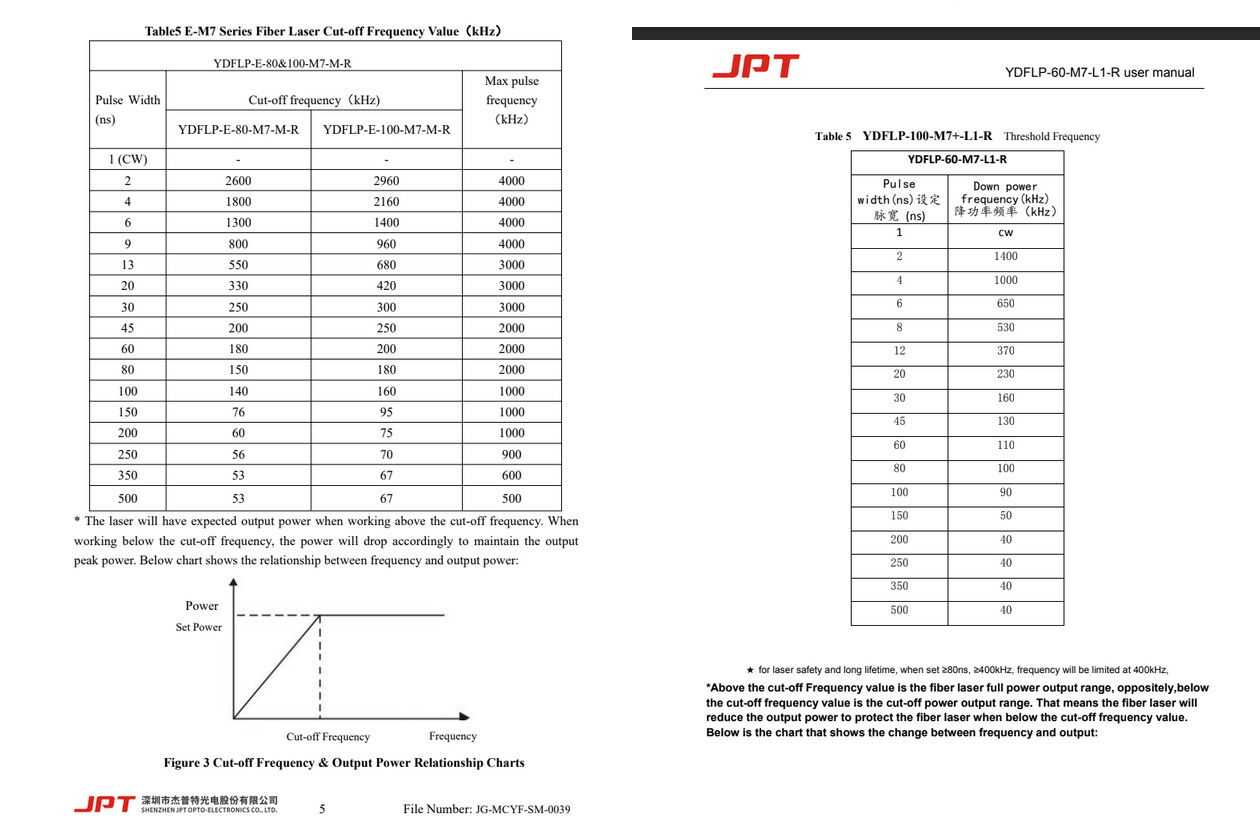
If you look at both of these, left for 80/100W models and the right which is my 60W, although similar the note is a bit different. The left states it wants to maintain pulse power

  • The laser will have expected output power when working above the cut-off frequency. When
    working below the cut-off frequency, the power will drop accordingly to maintain the output
    peak power.

The right 60W documents states

★ for laser safety and long lifetime, when set ≥80ns, ≥400kHz, frequency will be limited at 400kHz,
*Above the cut-off Frequency value is the fiber laser full power output range, oppositely,below
the cut-off frequency value is the cut-off power output range. That means the fiber laser will
reduce the output power to protect the fiber laser when below the cut-off frequency value.

I don’t think I know enough about lower level operations to make a good decision. One of the reasons I got a 60W machine is because of lenses for larger machines are about 8 times more expensive.


It was explained to me that the only real difference between a 50 and 100W machines are the pump diodes. They can pump up the fiber quicker.

Neither of the documents really cover how these work at such a low level, at least to know which lens is at it’s maximum.

The fiber is the only machine, between the hobby diode and the glass tube co2, that has really surprised me by it’s operation. It’s the only machine I’ve had multiple fires with. Beam hits a support or something, that I wouldn’t think would be an issue… then there’s flame and smoke.

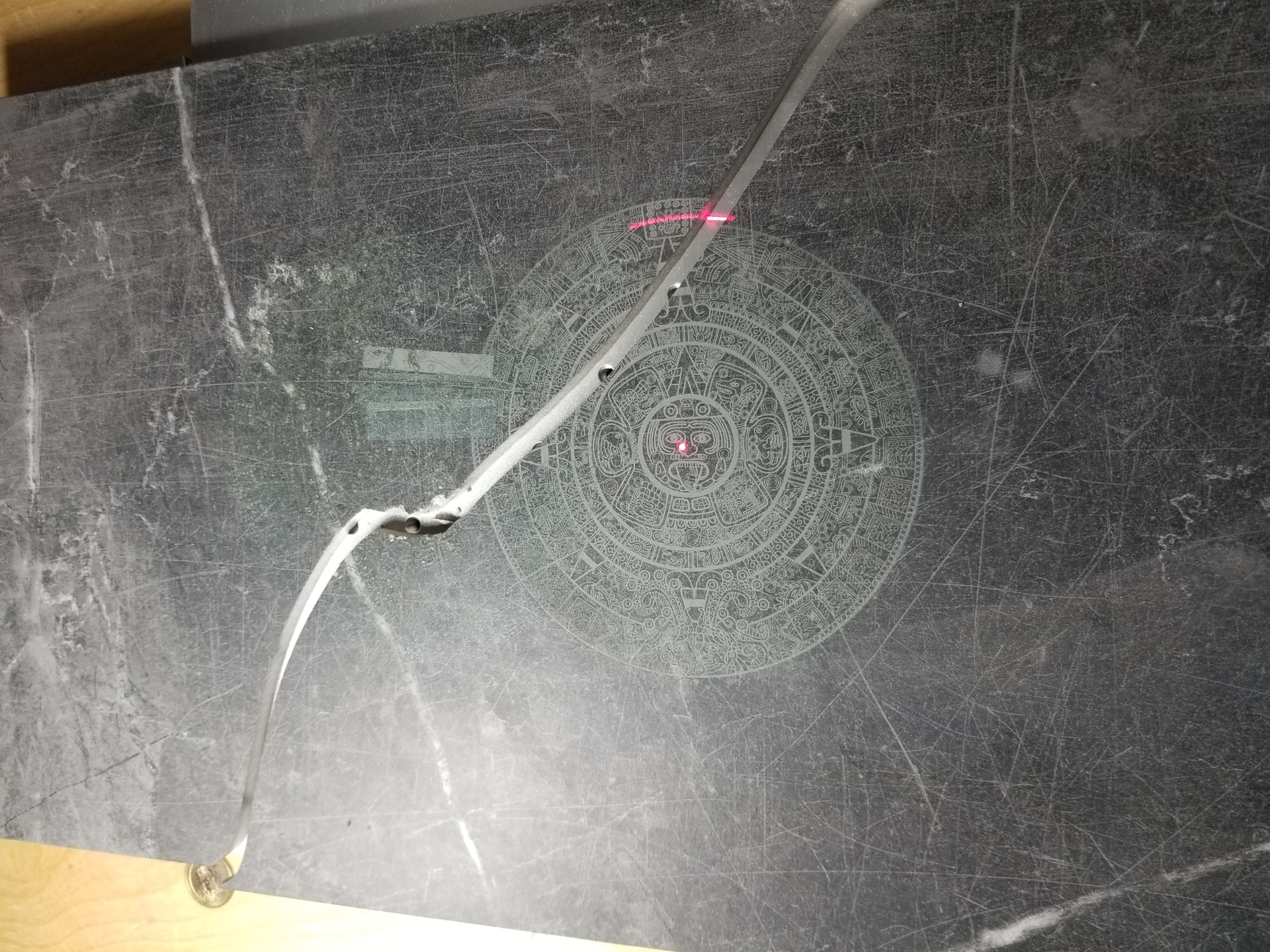
I have some 1’X2’, I think is the size, pieces of slate flooring. Attempted to lase a design on it. After it was done. I shut down the machine and went to dinner.

While at dinner we heard a loud pop and the slate flooring has busted, apparently from heat.

So I guess I don’t know what actual kind of information you need to make that decision… At some point, it’s trust me, why would I lie?

I think @MikeyH comment is pertinent.

The lens could just explode, when we expect, maybe a crack..?

:grinning_cat:

1 Like

At the bottom of the threshold/cutoff frequency charts, the numbers simply show you reach the average power limits. All three charts are for lasers with a 1.5mJ maximum pulse energy.

40k pulses/second * 1.5 mJ/pulse = 60 J/s = 60 W
53k pulses/second * 1.5 mJ/pulse = 80 W
67k pulses/second * 1.5 mJ/pulse = 100 W

Below the cutoff frequency, per-pulse energy (not “power” as the Figure 3 labels it) decreases linearly because your average power is split over more pulses. You only have a certain average power being pumped into the fiber, and that’s just not enough to fully “fill the tank” between pulses. Taking the 60W as an example, if you asked for 80k pulses/second:

60W / 80k pulses/s = 60 J/s / 80k pulses/s = 0.75 mJ/pulse

Twice the cutoff frequency means you only have time to pump half the energy per pulse into the fiber.

So, what about shorter pulse widths and their higher frequencies before you start tapering off? Q-switched (non-MOPA) fiber lasers dump all the energy stored in the fiber every pulse, and I’ve seen that customarily shown as a fixed 200ns pulse width. For a MOPA fiber laser, on the other hand, you can control how much of the stored energy you dump. If you select a long enough pulse width, you’ll dump all the stored energy, just like a Q-switched fiber, but for shorter pulse widths, you’re basically closing the valve on the hose before the tank’s empty.

So, if you’re only dumping, say, half the energy before shutting off the pulse, you can get twice as many pulses before you run into the limit of not being able to pump enough energy fast enough. Looking at the charts and doing the math, it’s not quite as simply and obviously linear as the threshold (cutoff, “Down power”, whatever) frequencies, but I’m going to suggest that’s just rounding and the real world (efficiencies, etc.) doing the usual.