CO2 laser instability diagnosis – tests completed and request for your technical opinion

Hello,

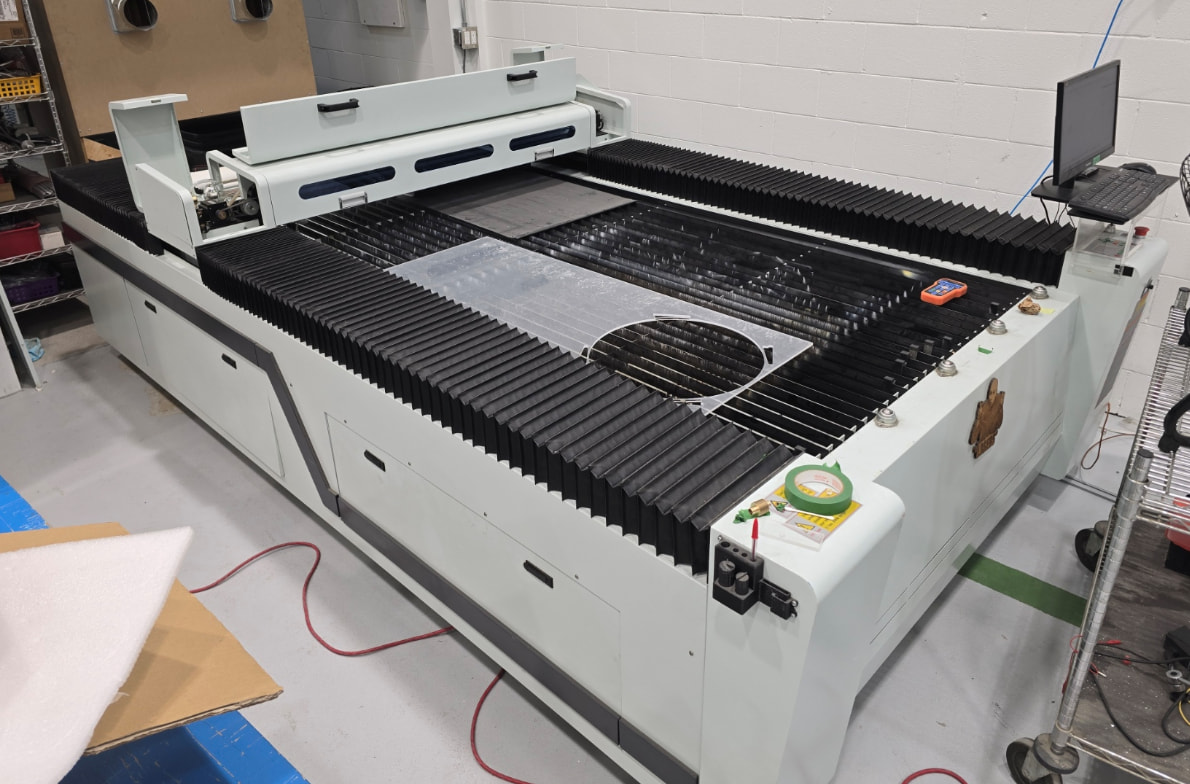
I am contacting you regarding an unusual issue on my CO2 laser machine bought in 2020 and I would appreciate your technical opinion before I continue replacing parts unnecessarily.

Note that I changed my original RECI W8 because I tought the tube was the problem, by a MCWLaser M150 tube and W150 Power supply. I also got another new M150 tube since the seller was suspecting a faulty tube initially.

The problem is mainly an electrical/acoustic instability during laser firing. Sometimes the laser starts and runs normally: the tube is quiet, the power supply is quiet, and output power is good. But 9 times out of 10, or after a few seconds of firing, both the tube and the laser power supply begin producing a noticeable high-pitched / buzzing / crackling sound at the same time. When this happens, laser performance drops. Once the noisy state appears, it does not go away by itself while firing continues. I must stop the laser and restart it, and occasionally it will return to a stable silent state. In some cases, the laser starts silent and stable, then after about 5 seconds the noise appears. If it starts noisy, it stays noisy for the whole firing cycle.

At first I suspected the tube, then the power supply, then the controller, then grounding, but after extensive testing I am no longer sure where the root cause is. What is especially confusing is that I can sometimes obtain perfectly stable and quiet output, but only intermittently.

Here is a summary of the tests performed so far:

Test / Observation Result
Original tube behavior Intermittent noisy/unstable firing
New replacement tube installed Same behavior as original tube
Additional new tube tested Same behavior again
Original power supply tested Noisy/unstable behavior present
New power supply tested Same behavior as original PSU
Tube connected directly to PSU output (anode and cathode), eliminating internal extension wires No change
Controller signals checked No obvious abnormality found
L to G at rest ~4.52 V
L to G during firing drops to ~0.257 V, both in silent and noisy firing
P to G No meaningful change observed
IN to G at rest near 0 V
IN to G during firing rises to about 4.24 V, both in silent and noisy firing
Comparison of controller command signals between stable and noisy firing Same values in both conditions
Conclusion from Ruida signal tests Controller does not appear to be changing state differently between good and bad firing
Ground continuity between signal G, PSU casing, machine chassis, and main machine ground Confirmed
FG terminal connected directly to main machine ground Confirmed
AC input measurements at PSU FG-AC1: ~117 V, FG-AC2: ~115 V, AC1-AC2: ~201 V
Building supply type 120/208 V system, so these readings appear normal
Sound source localization Noise comes from both the tube and the PSU simultaneously
Silent state Tube and PSU are both silent together
Noisy state Tube and PSU become noisy together
Behavior once noisy state begins Noise remains as long as firing continues
PSU local TEST button behavior LED on the PSU goes ON
PSU local TEST button – very low/very high knob range No significant noise but no light from the tube, it seems shut down, no power measured (0.01W)
PSU local TEST button – roughly mid-range (about 1/3 to 2/3) Crackling / buzzing appears from both tube and PSU but no light from the tube, it seems shut down

Based on all of the above, here is what seems unlikely now:

  • bad laser tube alone

  • bad PSU alone

  • Ruida command issue alone

  • missing FG bond

  • internal anode/cathode extension wire issue

  • building supply voltage issue

What seems most suspicious now is either:

  1. an instability of the PSU under a certain load range,

  2. an incompatibility or bad interaction between the PSU and the tube under real operating conditions,

  3. or another machine-specific electrical condition that causes the PSU to enter this unstable audible mode.

The most important observation, in my opinion, is this: when I use the PSU’s own TEST function, the noise can still appear in the mid-range of the test control, and when it appears, both the PSU and tube make noise together. This makes me think the issue may not be coming from the controller at all.

Could you please review this and let me know:

  1. whether this behavior is considered normal or abnormal,

  2. what component or subsystem you suspect most,

  3. whether you have seen this specific symptom before,

  4. and what you recommend as the next step?

Thank you in advance for your help.

Best regards,
Turn off the lights and look inside the cabinet when the laser is doing this. What you describe sounds like a corona discharge. In other words, the high voltage is arcing to ground somewhere.

  1. Insulation failure
  2. High humidity
  3. Condensation on the laser tube because the cooling water is too cold
  4. All the above

Just to be sure to understand, this corona discharge will cause a noise coming from both the PSU and the tube? Where should I look, in the area of which component, considering that I also tested the tube directly connected to the PSU, bypassing the internal wires of the machine and I got the exact same result?!

I do not have your machine, but I cannot visualize how you would do this without taling the covers off. You are playing with 35KV (+/-) here, so this comment scares me.

The PSU (high voltage power supply, right?) supplies the voltage, and will likely sing like the arc. I am responding as an electronice technician, not a CO2 laser owner.

You need to see both ends of the glass CO2 tube.

Maybe this will help you:

You just confirmed what I was saying. It should not be arcing.

That said, I read several times in the Forum that too much current will drastically shorten the life of the tube. I seem to remember 23mA (@jkwilborn ?) should be the upper limit. I saw that arc first occur at 32-34mA as you cranked it up, which is way above the recommended. That indicates you are cranking the voltage up much higher than the electronics was designed to manage.

We have exhausted my ability to further help you with this issue.

I’m at the same point as you, I also took a look everywhere I can see, light shut down and I was not able to see any arc :roll_eyes:

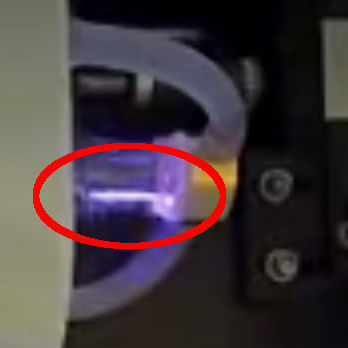
Right side end of the tube in the video. Plain as day!

Wow, it’s making such an odd sound too. It looks like it’s arcing past the ground terminal and actually hitting the end cap. That is super weird.

I wonder if you have a faulty return cable from the negative side of the tube.

Does it still make that sound if you take your current meter out of the loop?

2 Likes

Right here:

The gas discharge intermittently arcs beyond the tube’s cathode connection to the cooling water cap.

Several problems:

  • The tube cathode connection is intermittent, because it should never be more than a few volts above frame ground
  • The cap should be electrically isolated, but the water seems conductive enough to support the arc
  • The cap should be on the other side of the tube’s hermetic glass seal, but the arc seems to be punching through

The first suspect is the cathode wire, which must be continuous all the way to the high voltage power supply. Most likely, a high voltage arc has burned through the insulation when the connection failed, so you may need to replace the entire run with a solid connection to the HV supply’s cathode wire.

I’d also suspect the HV wiring to the anode, because of all the manipulation going on in there: there may be a second arc between that wire and the frame.

The arc may happen between a wire and the frame, where it is a millimeter long and hidden by surrounding metalwork.

You must extract those wires, carefully examine them for damage, and replace whatever you find with known-good wiring. The arc will carbonize a low-resistance track through the insulation, making the next failure more likely at that point.

1 Like

I’ll take some time today to strip down the whole machine and inspect the HV wires but the question that I cannot answer since the beginning is why does this problem is intermittent if it’s an insulation issue, why I have an unstable beam 9/10 but still able to get a good beam (for few seconds) sometime?

If it is carbonization from arcing, I can see a situation where sometimes the lowest resistance flow is intially the “correct” path, but as heating occurs, the path through the insulation becoimes bigger/hotter/lower resistance, so the “arcing” path wins out.

Is there a chance that the problem might come from the water itself if you indicated that the “water seems conductive enough to support the arc”?

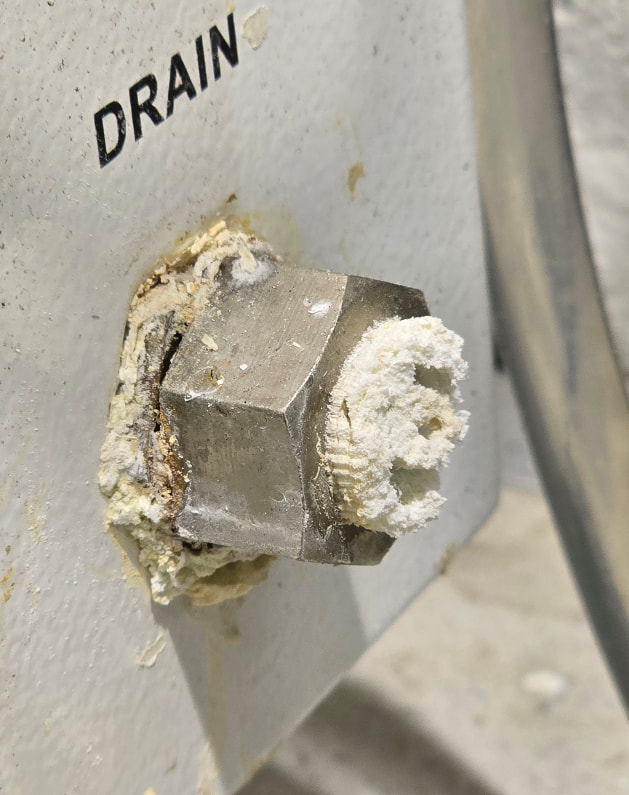
My Chiller is a CW-6000BH filled with demineralized water. I just noticed my drain plug looking like that, minor leak or electrical problem? The ground from the power wire is tested and good.

It might have come out of the jug nice and clean, but after one pass through the chiller it’s thoroughly mineralized. :grin:

Given the undisturbed corrosion on the plug, the water has been in there forever.

However, if that corrosion is new news within a few months, then the arc to the laser tube cooling cap has been driving current through the water and promoting galvanic corrosion inside the chiller. If so, the inside of the heat exchanger has about the same amount of corrosion.

The cooling water loop should be isolated from the laser tube current by a glass wall, so minor differences in conductivity aren’t the problem. The arc suggests a fault in the tube, because it’s punching through two layers of what should be solid glass.

What we’re trying to do is eliminate possible causes for that behavior. It may be due to a minute crack in the glass, but having it happen in two different tubes suggests something else is badly wrong.

You’re asking the wrong question. Stay focused on fixing the problem, rather than trying to make up stories about why it can’t possibly be due to this or that suggested reason.

Because something is wrong with the current going through the tube, which affects the optical power output.

All the evidence so far points to an intermittent short from the HV supply to the frame. That the arc appears on what should be the low-voltage cathode end of the tube suggests a fault in that wiring.

Finding the fault will require careful examination of the wiring and its surrounding, because the arc may have left scorch marks in the paint. If you can positively eliminate the wiring & connections, what’s left is the tube and the power supply.

Based on personal experience, an inspection starting with a muttered “This can’t possibly be the cause” will leave the problem undisturbed … :grin:

1 Like

The most simple way to check this is to replace the coolant. I used distilled water as it’s more pure than deminieralized water.

A couple of years back I switched to OMTech laser coolant, I get from Amazon.

Either should fix it if it’s the coolant.

Usually when it arcs to the coolant, anything that conducts and has coolant contact will be at anode voltage.

:grinning_cat:

Were you able to solve the problem?

Not yet, I’m done stripping all the machine, I changed the HV wires, but I’m waiting for new HV connectors ordered before doing the next tests. Hopefully mid next week!

Did you try to change out the coolant? Even though I doubt it’s your issue, it’s cheap and quick.

:grinning_cat:

1 Like

MikeyH is correct- 23mA is about the max the W8 should be run at.

But, your video is telling- the arcing is occurring under 23mA too.

I’m a bit unsure what’s wrong here.

First off, it’s arcing within the gas envelope (if I’m seeing this right). If the envelope wasn’t completely sealed against the water, the gas would leak our and/or get contaminated and stop lasing completely. That doesn’t look to be the case.

It could have been mfg contamination before the envelope was sealed off, but you say you replaced the tube with no change.

I thought the glass thickness is supposed to be what insulates the HV, but we do use distilled water which insulates. That may be more important with the tube with the water-cooled end mirrors.

I was always concerned about how dangerous that HV is, if it’s arcing to the water end then it stands to reason the current is going through the water to the chiller into ground. Which suggests the water could also kill you- or the chiller- with a grounding problem.

Well, I agree the next logical step would be flushing and changing to better nonconductive coolant. You’ve ruled out other stuff. And it’s a relatively cheap step

1 Like

Once the arc path has been established, it is much easier to initiate the same path (ionized air?) at lower voltages.