The only reason i used a diode i did not know that you can use a fiber to mark with a spray.
Backwards. The diode needs the spray, the fiber does not.
2 Likes
Omtech did offer a diode laser for a brief time; in fact, I have one of the B10 diode lasers, but they dropped the product and left anyone who purchased the unit high and dry for spare parts or support. No notice was ever sent about the removal of the product or where you can find parts, as I doubt they actually built the unit.
Recommend going max heat, lowest speed; start with 80% at 8mm/s, that’s how I get clean, bold engravings with a diode.
Highly recommend CO2 for aluminum though.
Hi Guys
This is kind of an off topic question but when engraving Anodized Aluminum or engraving a powder coated stainless steel tumbler should I be using the diode laser for that instead of the fiber and what settings you you recommend me to start from.
Thank You
Use whatever is easiest for you. The diode can do the job. Without knowing what your diode output power is, suggestions will be of minimal value.
2 Likes
In my opinion, if you have the fiber option available, which engraves directly on any type of color, including transparencies and reflective materials, why consider the laser diode option, which is limited to certain colors, doesn’t engrave (directly) on transparencies, and has as many or more problems with reflection projections on reflective materials as fiber?
The usefulness of this machine, which I’m not familiar with, would be, I’d say, to allow for quick and efficient engraving of any type of material and (here the laser diode function comes in) to cut the piece, which, from what little I understand of these machines, will work better with a laser diode than fiber.
Hi
When trying to engrave Anodized Aluminum with the fiber it takes off the coating and I want to bleach or just make it white.
The product says:
Laser Compatibility – Universally compatible with CO₂ (30W+), Fiber/YAG (20W), and Diode (40W) lasers, offering flexibility across a wide range of laser marking systems.
So you should be able to produce enough heat to bond the material. It might be easier for you to use the diode for something like aluminum and brilliance. Most of the time a 5W diode just won’t do it.
Unless it’s anodized, you must use a marking spray of some kind.
You have a 40W diode that should be plenty of power for removing the mugs coating and not mark the metal. The disadvantage of using the fiber is it will also mark the metal. When I do mugs, I use the co2 as the fiber will do it, but as the coatings change between batches and manufacturers the fiber will usually mark the metals.
As far as a starting place with settings for mugs, I can’t really help you as I haven’t used my 5.5W diode machine in a long while.
Transparencies have always been in my vocabulary as a positive photographic slide, not something you’d lase. Do you mean transparent material? My fiber won’t do anything to clear glass or acrylic, including foods such as hot dogs, baloney and bread.
As was stated above a fiber is great for most man made materials, but don’t work so well for natural materials, including wood. Although acrylic isn’t really natural, it works with the co2.
Good luck.

Will a Diode do the same job on a powder coated tumbler as an CO2? If not what is the difference.On the Anodized Aluminum y do I need a spray if I want it the color white. You can only get sprays that do black.
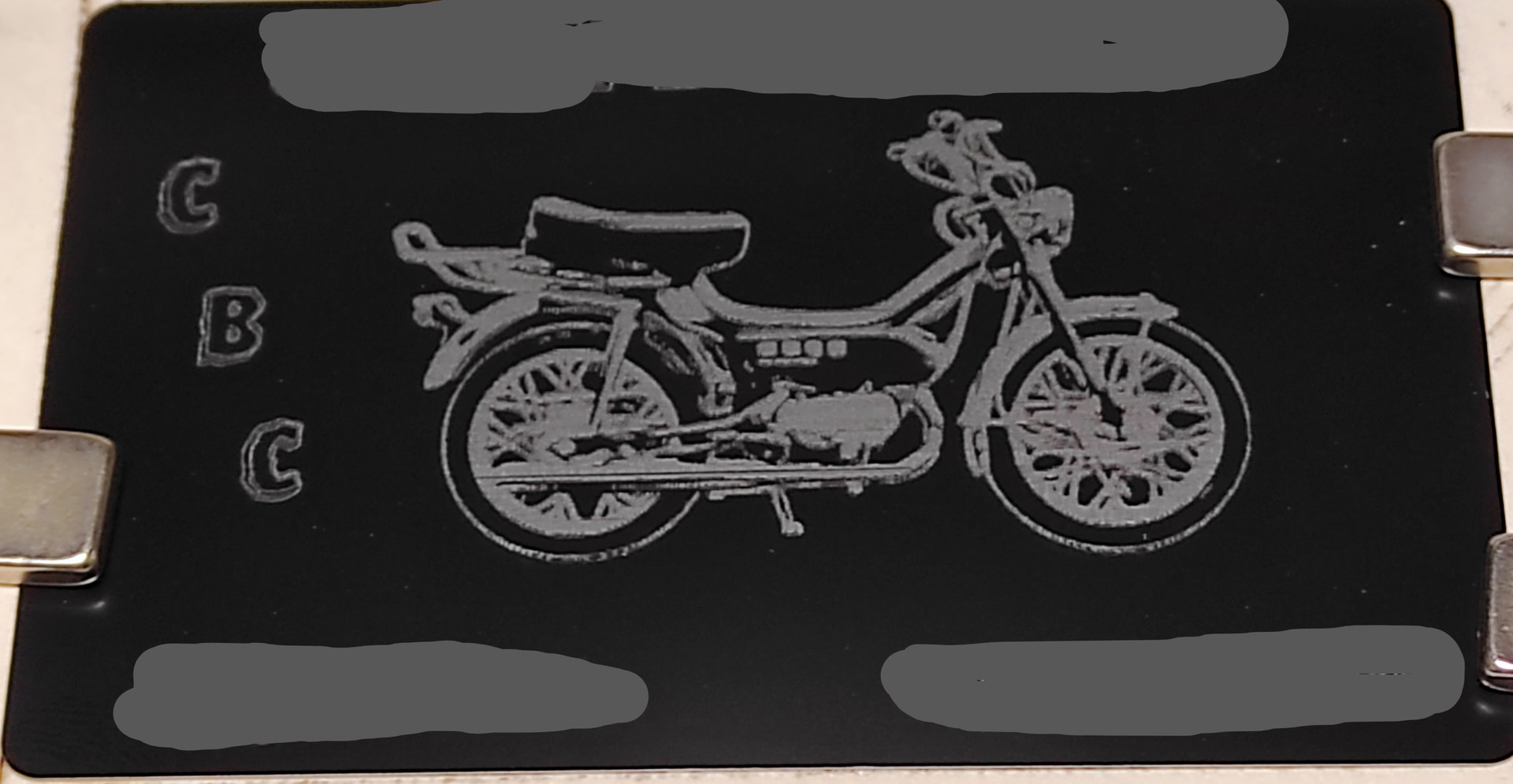
My second aluminum card I did.
On the machine:
After cleaning:
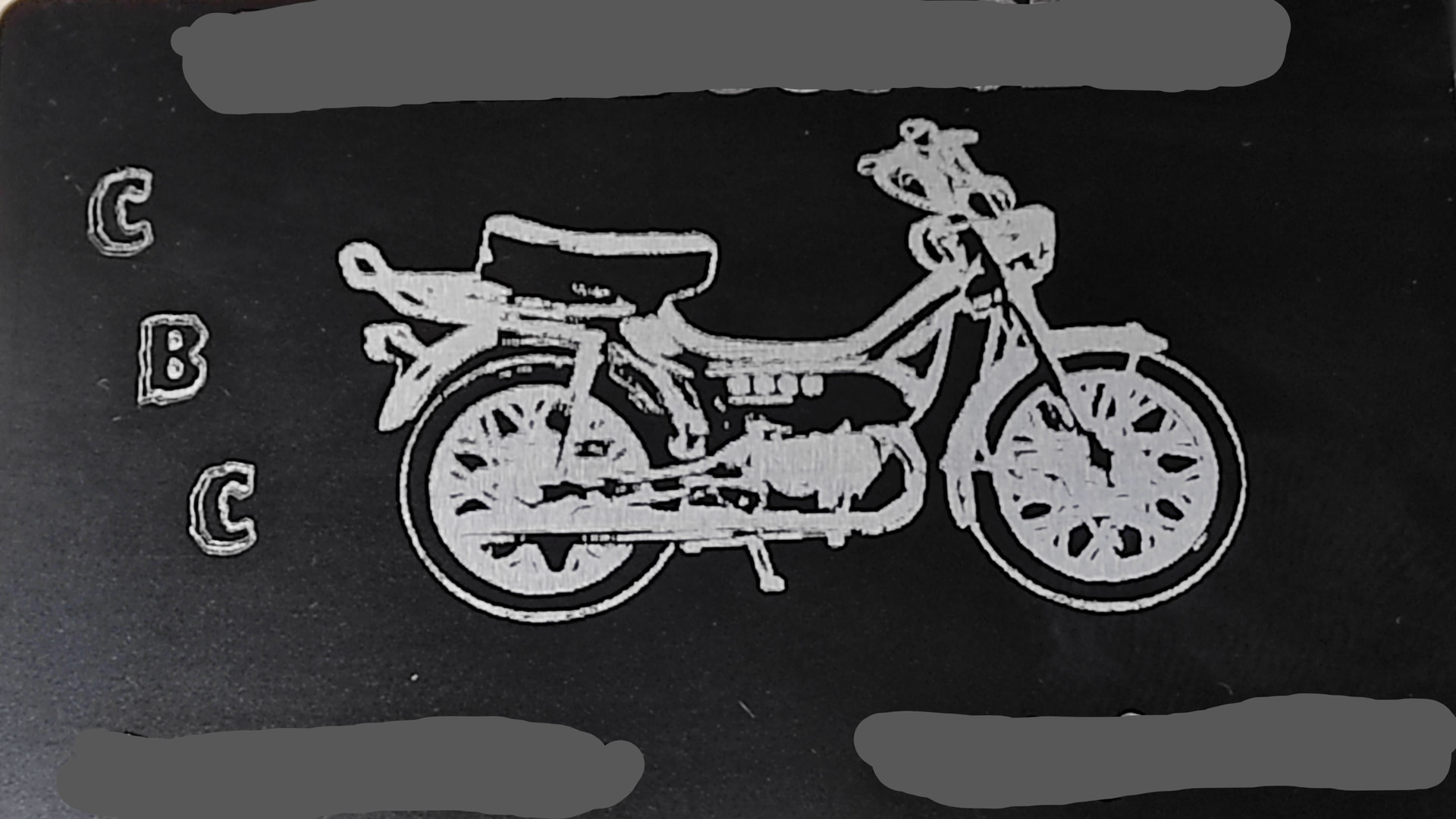
24W diode, 800mm/m 70% Image: passthrough.
Most diode lasers are within the visible light spectrum. They won’t work very well with some colors. If you have a blue color laser, it won’t work with a blue mug as it reflects the laser. Same with a white mug, it won’t work with that either.
The material must absorb the emf emitted by the laser before any effect on the material can take place.
Co2 is absorbed by a lot of things, such as glass but doesn’t work well on metal parts.
You need to look at what happens to the material from a specific wavelength of the lasers emissions.
My fiber won’t mark glass, acrylic, wood or many foods, like hot dogs.
Generally speaking lasers don’t do color. Sometimes you can’t pick. With an anodized piece of aluminum you can take the anodizing off, down to bare aluminum.. can’t pick the color.
Good luck.
Within the context of the topic, it didn’t occur to me that the term “transparencies” could lead to other fields. But yes, I’m referring to transparent materials like clear glass and various clear acrylics.
Since I don’t have experience with other machines besides my small diode laser, I might make the mistake of clueless saying something I see in videos that isn’t actually true. (That’s why I often mention in my comments that I don’t have experience with other types of lasers).
I greatly appreciate the correction, but the truth is I could swear (but I can’t find the video) that I saw one of these more reputable brands presenting a machine that did that type of internal engraving on an acrylic block.
If I had the financial means to acquire such a machine, I would certainly know which one it was. But since I don’t, I’ll stick to videos and to the “supposed notion” of what’s possible with lasers, and I’ll satisfy my curiosity.
Yes, when using a diode laser, the anodized coating is removed, leaving only the aluminum.
Since my experience is only with diode lasers, I won’t elaborate on other types of lasers for fear of making “false statements” 
However, I’m wondering if some type of printer wouldn’t be more suitable for what you specifically intend.
You’re not bruised and battered… we are here to help not criticized your approach to something. If you’re interested no better way to learn that to speak up. If you’re thinking it so are others.
2 Likes
Absolutely not. I appreciate you (and others) correcting me (and others too) if necessary because, in my opinion, there is no worse attitude than letting what is wrong continue.
By pointing out mistakes, we all learn and discuss points of view. After all, sometimes no one is wrong, there are just different points of view that may adapt better to some circumstances than others. 
The only problem is that sometimes the discussion veers off-topic. 
Might have been a UV laser with a glass block:
2 Likes
Hi Guys
Correct me if I’m wrong but then engraving Anodized Aluminum with a fiber laser it will remove the anodized layer but when engraving it with a Diode laser it just makes the anodized layer whitish. Attached is a photo the left circle is fiber and the right is diode. On the fiber laser I can feel it went into the aluminum but on the diode circle its smooth. Let me know
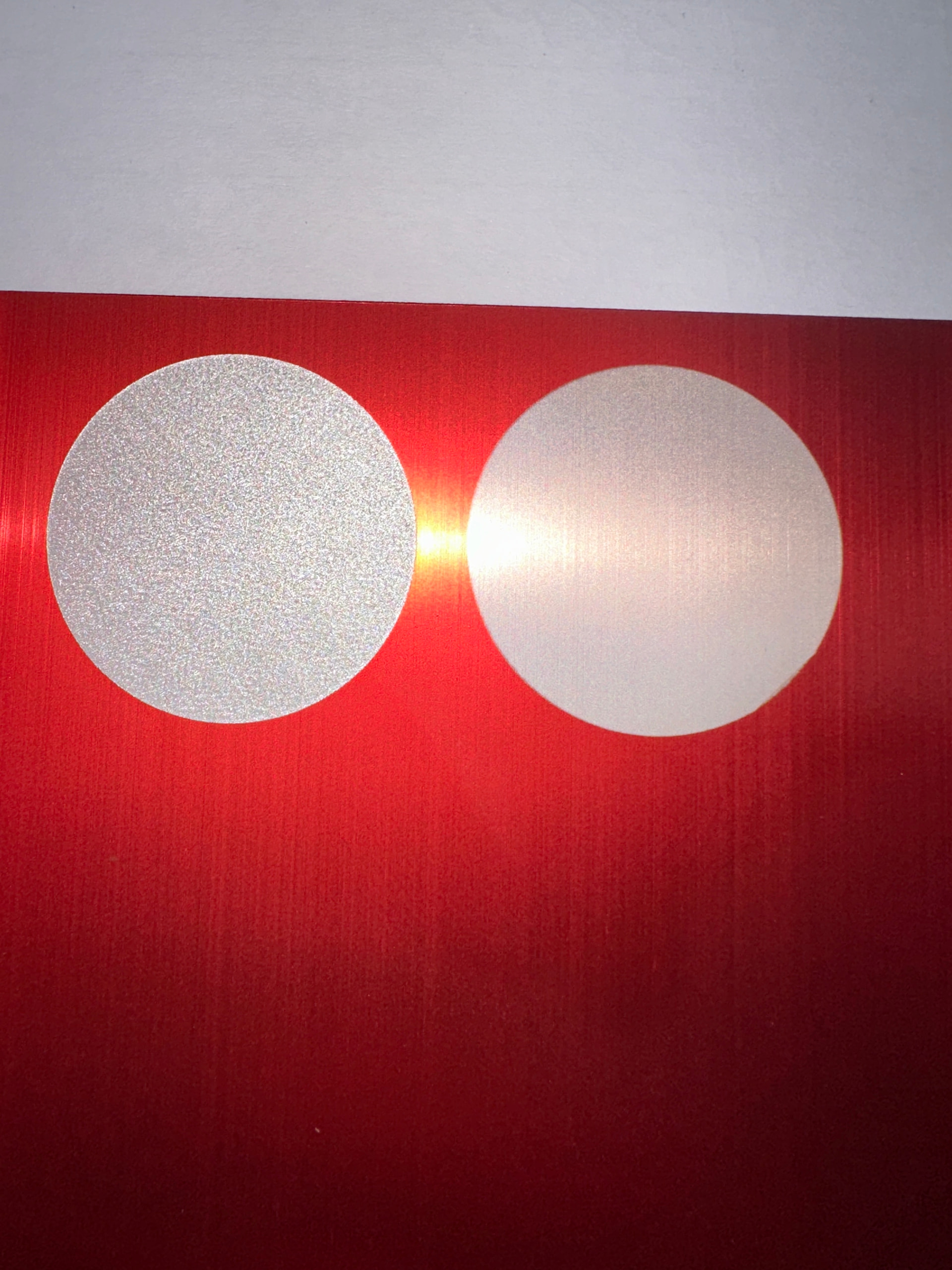
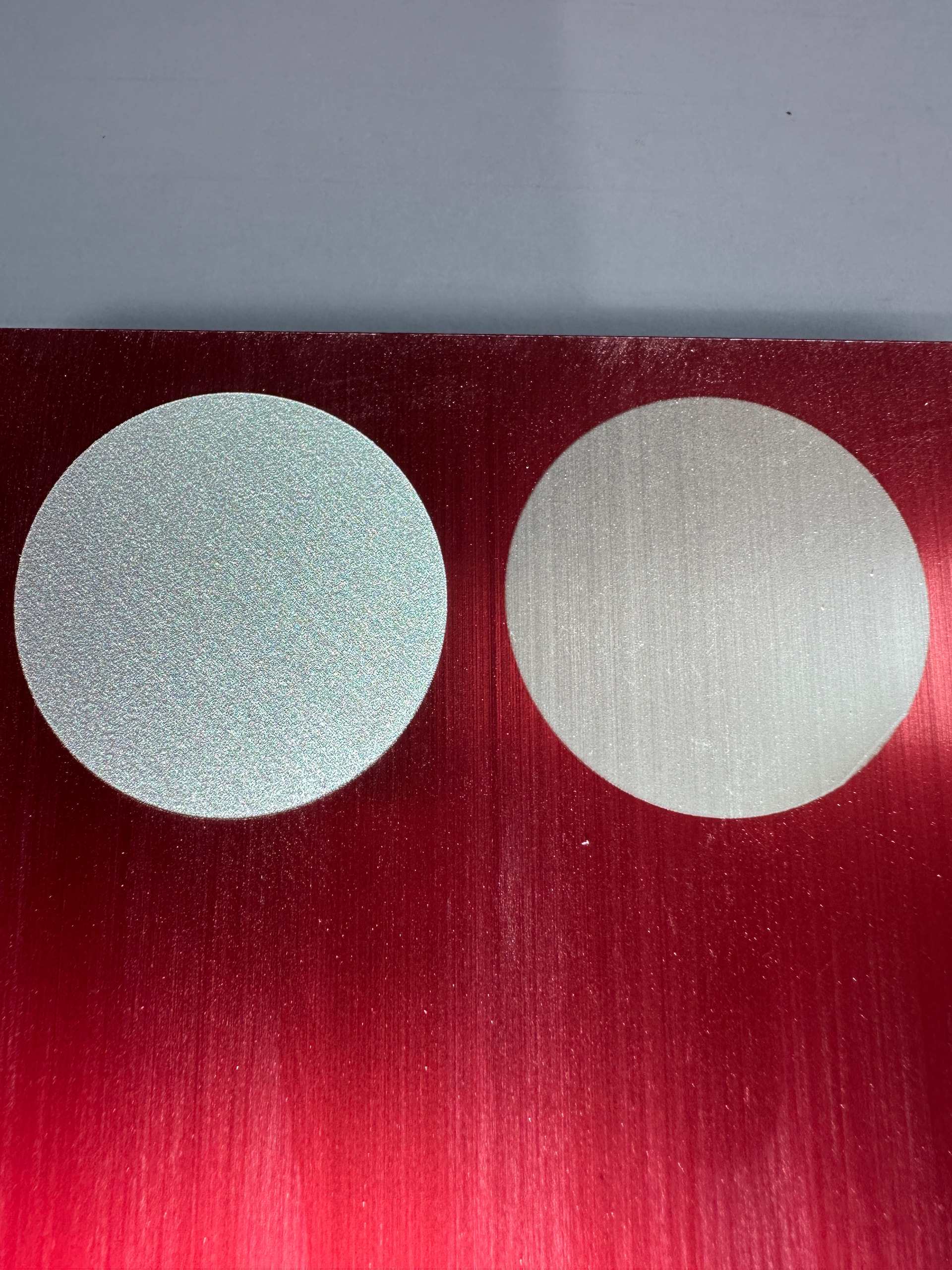
What?
Generally speaking the visible led is not applicable to metals. It only can effect the anodizing so wherever is happening is probably what you get. You could see if someone here a better suggestions for speed and power using your visible light led when using anodized aluminum.
A lot of people have good results with the coated aluminum cards.
The fiber is the right tool to remove the metal and shows you that in the testing…
So, what’s the question?
The question is I have been engraving LED lights for customers and on some when I take the anodized layer off with the fiber the aluminum doesn’t look the best and some look perfect. So that’s y i just want to bleach the anodized layer that way they all look the same. The edges with the fiber look sharper but some backgrounds look pretty bad on some.