Has anyone used the Cloudray HQPI GRBL card on Lightburn? I can't get mine to work!

I have a Chinese 6040 laser that was built with an M2 Nano board which Still works fine with it but I wanted to use Lightburn so I bought a Cloudray HQPI controller card. It is a plug in swap from the M2 Nano to the Cloudray implementation of a GRBL controller card that also has laser PSU power control. I have not connected the PWM power control yet as there are issues in getting basic operations with Lightburn 1.7.08 to function. I have the machine on windows 7 Ultimate because I still have customers’ work to handle and I can then just swap the M2 Nano back in to keep the doors open.

I can’t move to a higher windows because I need Windows 7 to communicate with the M2 nano card. My issue is that while Lightburn 1.7.08 can communicate with the HQPI card for homing and using the frame button to draw a square.

If I click start after doing a frame, the box I drew burns but, in the opposite direction to the frame direction. It burns on the line that frame outlined. When I hit home and just hit start after the homing, the same square burns in the anticlockwise direction, as it did after frame, but; it burns from the wrong starting point and is not on top of the burn that was done after the frame button. Here’s some numbers.

I drew a 30x30 square in lightburn with the top left corner of the square on X20, Y20. The frame button causes the head to trace, clockwise from 20,20 to 50,20, then 50,50, then 20,50 and finally back to 20,20. Start causes the head to go to 50,20 then 20,20, then , 20,50, then 50,50 and back to 50,20. so the burn is anti clockwise. When the home button is pressed, it homes to 0,0 absolute coordinates in the top left corner (4th quadrant), then start is pressed, the head moves to 20,20, then burns to -10,20 then -10, 50, then 20, 50 and back to 20,20.

If I just do a X10, the head moves to the right as expected. Y10 moves the head down, also as expected. I’m at a loss as to what is happening here. As I understand absolute coordinates, means that everything is referenced to 0,0 which it actually is doing. it’s just that the burn appears to be starting 30 to the left of where it should start when Start has been selected after homing. It behaves differently after frame is used. I really expected the burn action to be moving in the same direction as the frame action, clockwise. It’s not flipped axies because when commanded to move in a positive direction,it does move the head in the correct direction.

I know this has been long winded but i don’t know how to make it shorter and i hope it makes sense. I would love to try this on a windows 10 machine with current software but i need to be able to support my customers while I wrangle this issue. I’ve been at it for 3 days now with no progress.

All of my artwork from 2012 to present has been done on Corel so there’s a LOT of artwork. I will need to be able to just save it to a format Lightburn can read but if its going to not be able to handle the drawing, I’m stuck with the M2 Nano and Win7. The cutting appears to think that its in 3rd quadrant while frame is behaving like its in 4th quadrant.

My microswitches are in the top left corner of the machine. I hope someone that is familiar with G-code can offer some assistance because I suspect it might be something to do with that.

Kind regards Peter.

I will respond to part of your story. Lightburn cannot import the native Corel file format. But it can import any of the file types that can be saved as. Preferred would be SVG in my opinion.

I cringe when people say it this way. Is the machine sitting vertical? Common CNC Home position is the front left corner of the table. How does yours compare to this?

Photos are great if you can post them. It would be nice to have a link to the hardware sp we could all follow, without the need to google it and then wonder if you have the same piece of hardware.

My OMTech homes to the rear/left, that’s where the home switches are located.

I understand the Ruida can operate from any corner, if configured correctly.

My grbl machines home to the front left, as does my fiber (doesn’t actually home.)


What do you mean CNC? My wife’s Subaru is a CNC machine. It has no steering shaft to turn the wheel. When you turn the steering wheel, an encoder tell the computer and then the computer moves the wheels in the right direction. It fits all requirements of a CNC machine.

:grinning_cat:

Thanks for the advice on the Corel files. Cringe away but it’s the most common way that people refer to the positions outside of niche locations such as a forum like this.

Using the terminology of this forum, my machine is rear left. For the uninformed, CNC refers to Computer Numerically Controlled machines of any type. Most often referring to Milling machines, Lathes and other machines that are computer controlled. I have never heard of a car referred to having anything CNC, they usually have their own nomenclature. and Yes, I too am a cumudgeon like those that have “answered” an actually serious question.

Exactly. The spouses Subaru has everything controlled by the computer.


I agree they usually refer to lathes or milling machine. IMHO I think we think of them that way because most of us grew up, to some extent, mesmerized by videos of these operating. The technology was so expensive it took decades to see it show up in the consumer end of things where the general hobby population has access to them.

Movement of technology dictate it’s likely we’ll see less analog control circuits as more where they are completely replaced with computer technology.

Call it what you like, it still fits the definition of CNC.

:grinning_cat:

As far as I understand this, you’re concerned that the initial cut direction does not mirror the frame direction?

Framing is just for locating your work on the laser - it does not consider the cut direction whatsoever. I believe we had some other complaints about this, and in 2.0(?) we changed the framing direction.

That’s not a correct conclusion. The framing direction is immaterial, but; should follow from the cutting origin in the direction that the cut should proceed. What framing does is, moves the head to the nearest point from the home position and then outlines the work piece that the laser will cut. If start is selected immediately after framing, and, the cut is in a different direction from the framing operation, the head moves across from the point where the framing operation ended to the start of burn origin and the burn process will proceed as expected. It will be on top of the outline that the frame action outlined; in whatever direction the system needs to move the head and the piece will complete.

If the machine is homed and frame is not selected first, but start is selected only, the head moves to the closest point on the drawing from the home position and uses that as the origin. When the burn begins, and it is in the opposite direction to frame, say, frame moved clockwise, the burn operation will begin and move anticlockwise to try to complete the burn operation on the part. If the part is positioned with the nearest point at 20,20 from the origin (I use absolute coordinates and 4th Quadrant) and the part is 45mm wide (x axis), the head will crash into the endstop and halt the burn action. #X will need to be sent via the console and the machine will need to be re-homed.

This does not happen when frame is performed first, followed by start. The frame process appears to allow the machine to understand that the burn origin is at a different location to the nearest point to the home position on the piece’s drawing on the screen. I drew a box 30x30 and positioned the nearest corner at 20,20 from the home position. The burn origin is at 50,20; even though the box was drawn from 20,20 to 50,50. Lightburn seems to have chosen the burn origin to be 50,20 and not 20,20.

I can change the node origin to be 20,20 and the burn direction really does not matter because the burn origin places the drawing within the work area. The big problem is that I have 14 years of corel draw drawings that I need to use, as requested by customers, and the burn origin will need to be manually selected to ensure that the piece will fall within the work area of the laser. I make keyring sized photo frames with 78 pieces on the work area. This system would require me to edit the origin point of every one of the 78 keyrings to ensure that the burn origin will be in a location that will maintain the integrity of the drawing in the cut implementation.

This is actually a HUGE problem and really makes me feel buyers remorse for believing that Lightburn would be able to perform better than the crappy, cheap, chinese, laser software that I have had to use. I have been using laser machines since 2012, long before the pre-release versions of Lightburn were released in 2018 so I am not new to this field. I am new to Lightburn but it should never take more than 5 days to get software to be able to barely become functional! Note that after I have successfully scored and cut a single keyring, I tried to do a raster engrave of some text that I put in from Lightburn’s own graphics interface.

The line (outline scoring) function worked using firstly, frame, then start but when I converted it to a filled outline, as normal text is expected to engrave, I performed the same process of firstly, frame, then start; the frame performed as expected but the raster engrave moved off to the X-axis endstop and crashed the machine every time I attempted the raster engrave.

I am unbelievably disappointed to find that Lightburn simply is non-functional, even after 8 years of development! How does anybody successfully use this software? I am too afraid to try it on my fibre laser now! What will it do to the delicate galvo mirror controls if it can’t work properly with robust micro switches? How do I proceed? It seems I will have to return to the cheap chinese “junk” that just works out of the box.

Nothing I say will make you happy because I can hear your frustration in your posting, but these two statements are related. Lightburn is designed to work in the 1st quadrant, where all X & Y moves are to positive locations.

@MikeyH is onto something here - LightBurn primarily works in the positive/positive X/Y quadrant. This has been discussed before on the forum: Confused by Home/Origin and Coordinates - #2 by MikeyH

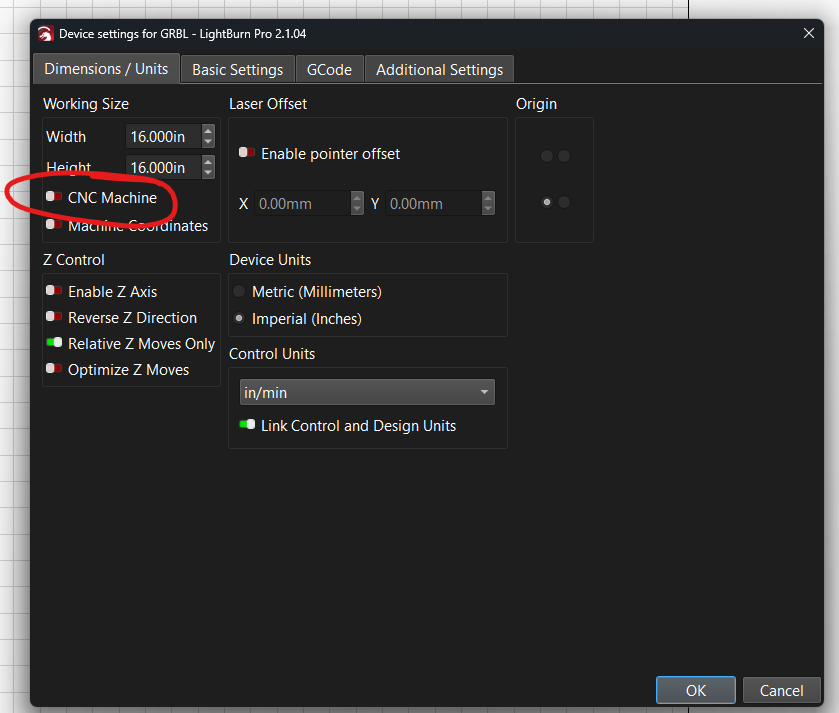
If you’re planning on continuing to work in negative workspace coordinates, you likely want to enable ‘CNC Mode’ and ensure your origin point is set correctly.

Generally speaking the home operation determines which quadrant you are operating within.

:grinning_cat: