Hello all.
I am a new to laser. When I started in last autumn, I looked for plywood of good quality and finally went for baltic birch 3mm and 4mm. The sheets are of nice and even color and they are well dried and not curved. I made some fine creations with this material.
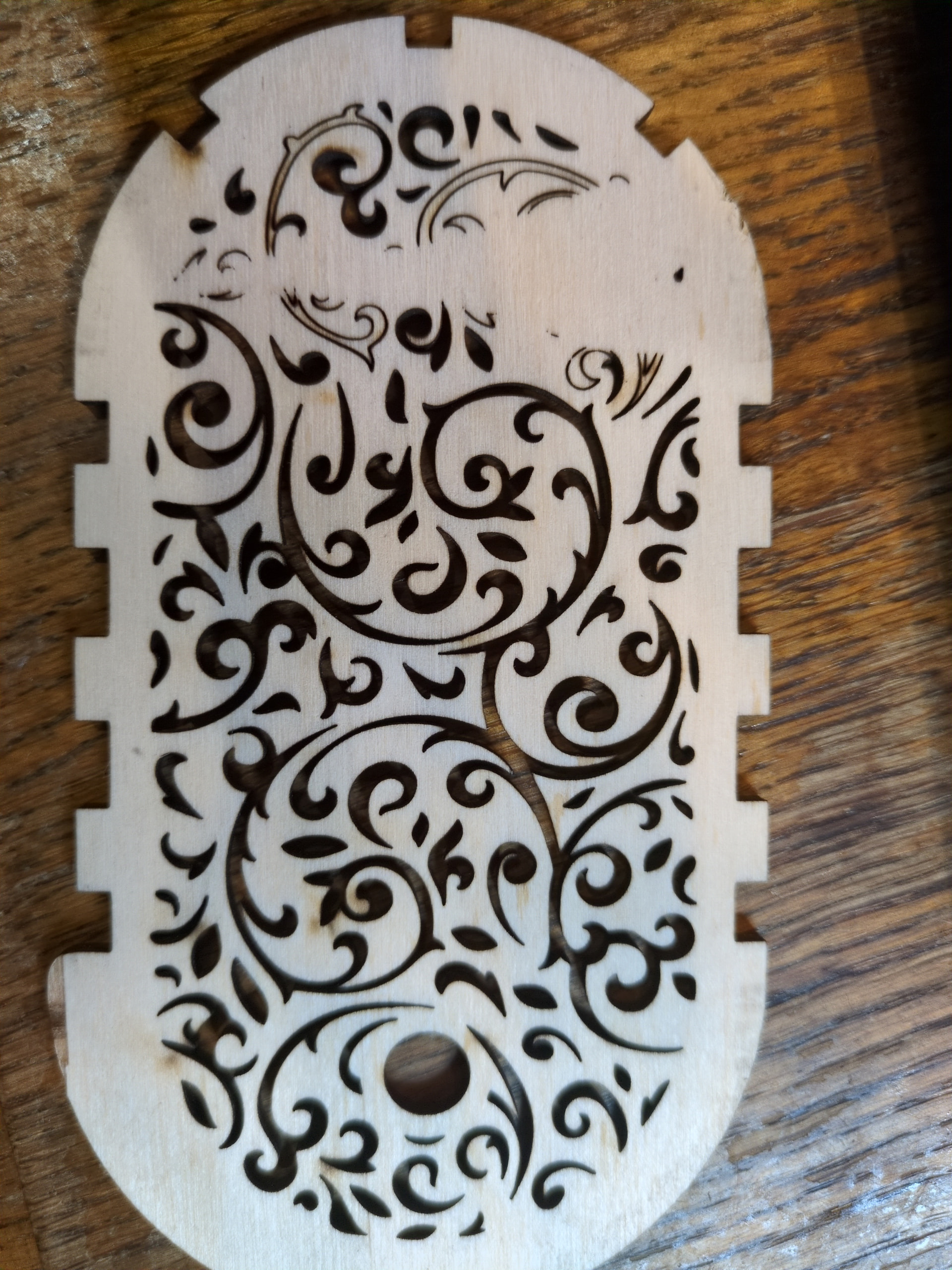
Unfortunately, I produce a lot of trash like shown on the picture below. This is a work piece from the bottom. As you can see, 90% cut outs are even and not burned. The small parts easily fell out at once, or at least with very litte pressure. This makes me beleive, my laser settings (focus, heat, speed, air assist) are OK. Beside that, there is an area, where the laser did not cut trough, and was not even near to do so. No chance to rescue anything with a cutter blade.
I now learned, all layers in the middle of baltic birch are pure veneer instead of soft glue-wood mixture, that make the core of many other plywoods.
Would you agree, that this failed areas are caused by a veneer sheet in the middle of the plywood, that is extremely hard?
Anyone of you using this material? Do you face similar problems?
Any ideas to avoid this?
Today I switched from 5mm birch ply to some strips of 4mm Ash, Mahogany and beech just to get a break from the plywood.
I’ve started considering the time and disappointment of using ply because of its irregularity and the hardwoods cut and engrave so well.
Ply has been great up to now for practicing skills and experimenting but if the design is suited to a particular hardwood the results are really nice.
Laser ply is available here but it’s not cheap and although I haven’t crunched the numbers, when the Go-get and ‘cutting down’ time at the store and again at home and travel cost…wasted by a material failure rate of up to 25% on occasion, plus the increased laser cutting time.
There is also a perception value of being able to say “its cut from Oak, Ash, Mahogany”…and it arrives ready to use.
Hi … I have discovered that most of the Baltic Birch they make now have a lot of voids in the middle layers …. the way to determine where the voids are is to use a powerful Light and hold it behind the plywood and you can see and mark the plywood to avoid cutting in that area.
What you show in the picture has nothing to do with “laser-suitable”. You just have to recognize/accept that you can’t cut this waste wood properly with a normal CO2 laser.
I only buy something called “Aeroplan Birch Plywood, Interior”. The boards here in my country cost cut boards (600x400) $18 for 3mm, $13 for 5mm with larger orders it can be a little cheaper.
The price should be taken into account that there is 25% VAT on it, which is normally passed on to the customers, directly.
For comparison, I pay $3.5 for 3mm and $5.2 for 6mm MDF.
As I wrote before, exterior plywood is made for a special purpose and it is “waste wood” - and not laser-suitable. When a project is ruined because the parts don’t fall out of the plate or everything is dirty black… it quickly becomes expensive in time and doubles up on materials and cleaning time. Not to mention how angry you (I) get when orders can’t be delivered on time and properly.
correction, $9 for 3mm 4 layers BB, $18 is for 6 layers BB
What you say is quite true, This material is not consistent in its quality and was not sold as such..You make a good point about the quality of cut edge and voids, the better materials will also reduce time cleaning etc.
I think there is no market for laser quality plywood locally so I use what I can get or I have a 100 mile round trip with battery skillsaw in hand to find bigger or more specialist supplier but still with no guarantee of what I will find.
For me, I think switching to the hardwoods and having them delivered might improve things in a few different ways and I might also explore the MDF etc materials which I have never used before.
…I highly recommend it, I use it a lot for all kinds of items, primarily in 3 and 5mm. It’s the uniform, controllable process that I really like. I finish some MDF products with beeswax, it gives the MDF a nice warm matte shine.
WBP glue, it is a water-resistant glue (typically phenol-formaldehyde or melamine-urea-formaldehyde) for exterior use (that’s the black charred disc)
MR (Moisture Resistant) glue in interior birch plywood consists primarily of a synthetic urea-formaldehyde resin (UF). It is a thermosetting glue formed through a chemical reaction between urea and formaldehyde - it’s the nice bright slice.
It’s also definitely not healthy to inhale the fumes when cutting and requires proper extraction.
Whow.
I already knew, that I know nothing about plywood.
Thanks a lot for so much and detailled answers. And thank you for telling me, that at least some of you faced the same problems in this or a similar way.
I ordered online from someone who claims to drive a makerspace and to resell material that was bought in wholesale for this makerspace. The plywood was explicit labled as “for laser cutting”.
I now suppose they sold, what they found to be scrap. So buying the right material seems to be a matter of trust too, not only of knowledge.
Fortunately, lasering is 100% hobby to me. So at least I have no stress with deadlines and unhappy customers though using three tries for one workpiece is still frustrating. I will follow the advice to use MDF when my plywood is spent.
When it comes to toxic fumes, I do not care very much, as I use a framed laser with a vent to outside,
I’ve come to think of using the plywood my machine was packaged in when it arrived… there was also plastic residue and trash in there. I would say it looks a lot like packaging plywood of the lowest quality imaginable.
When we talk about “proper” exterior pre-glued plywood, it’s the dark glue and the quality is even, just not laser-suitable. However, I don’t know if the big lasers, 80+Watt can handle the task better. If the soot on the edges is not a problem and the laser can handle it, then it’s probably ok too.
I think the bad smelling stuff is what we in Germany call “water resistant glued” like “Karosseriebauplatte”, the brown plywood, recognisable by the dark glue layers between the wood layers.
The plywood used for packaging is called “Baufurnierplatten” (BFU) should be water proofed, too bc they are designed for shipping machines overseas and for construction sites i.e. concrete housing (I think!). You can see the dark layers of the glue that bernd.dk has mentioned.
The smoke of the glue smells bad like boiling urine.
The other stuff (=good for lasercutting) should be standard birch, poplar or beech plywood for in house use. It’s usually lighter - and the glue layers are not visible bc the “Weissleim” (PVAC) is white translucent.
The smell of the smoke should be close to wood smoke with a sweet touch, as I understood it.
OSB = “oriented strand board” (the large strands are scattered randomly, NOT “orientated”!) contains vast quantities of glue and is not only vapor tight but also water proofed. So I assume it will smell bad and have a dark cut - can anyone confirm this?
Any tricks to cut this?
Your description fits nicely. Only additions are that the Chinese “transport plywood” is outside all categories. It doesn’t have to be bad that they use their bamboo waste for this purpose - it’s just absolutely not suitable for laser processing
I must correct myself: the birch and beech plywood is usally fairly waterproof, but beech itself isn’t, it swells a lot.
There are many glues, some are bright AND fairly waterproof but probably no hassle to cut due to a harmless chemistry.
Conclusion 1: everything with rather dark glue layers is bad for laser cutting, the rest has to be tested, but as long as it isn’t dark it should work acceptabel or fine.
Conclusion 2: an efficient smoke extraction is always recommended, beyond health issues it’s the exposed optics of the CO2 lasercutters.
I’m working on mine, support part is ready, probably saturday will be the first test and films.
I’d like to refer to this video (not mine, not seen yet):
and about scorching in general this one (very helpful, also not mine):