Glass Engraving Question

Hopefully, I’m getting closer to doing a decent job of engraving glass, but I have a different kind of question…

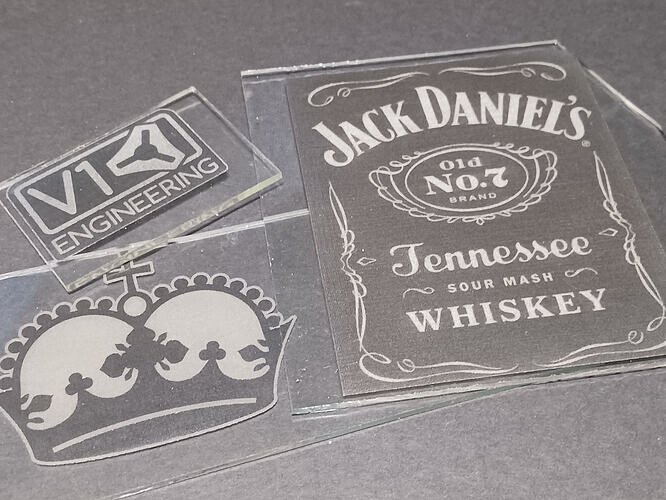
I like the way the engraving looks with the black background…before I wash it off. Is there a way to make that black background permanent and leave the cut glass clear? I was wondering if the engraving would work with some black paint other than tempera.

Thanks for any ideas.

I like this look…

You might try porcelain colors, like these: https://amzn.eu/d/02UN8VfY
After applying and lasering, you put it in the oven to bake it in. Maybe this also works in your use case (I never tried).

Any idea whether they would prepare the glass like the tempera paint?

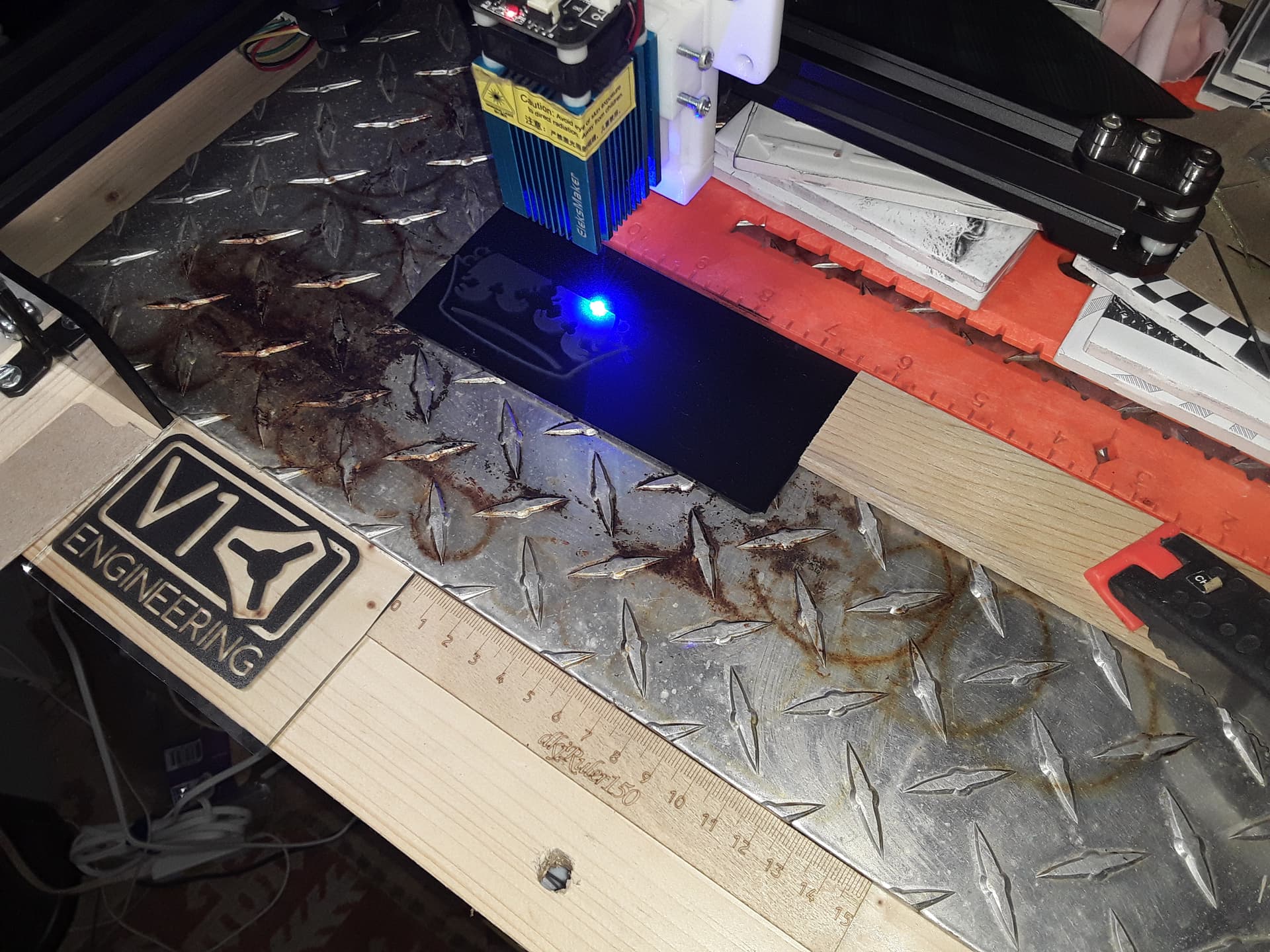
In my experience with flat glass sheets and a 10W diode, prep just like with a tile and TiO2 paint will fuse black into the glass surface. So as simple as setting up so your laser burns the background.

This was to put the fused black on the surface, but “in theory” due to the way it works one could try with the paint on the underside (interior).

Testing advised of course since doing a background will take some time versus just the image parts.

You need to think about whats occurring where the laser and material meet, along with how it damages the material.

With a visible laser, you can’t lase clear objects because it goes right through. That’s why you use an indirect method of engraving by putting a layer of something that you can heat up with the laser.

Normally using this method you can only heat the coating hot enough to shatter the underlying glass. At that point, most if not all of the lasers energy will pass though the glass. Anytime you shatter glass, it leaves a rough surface.

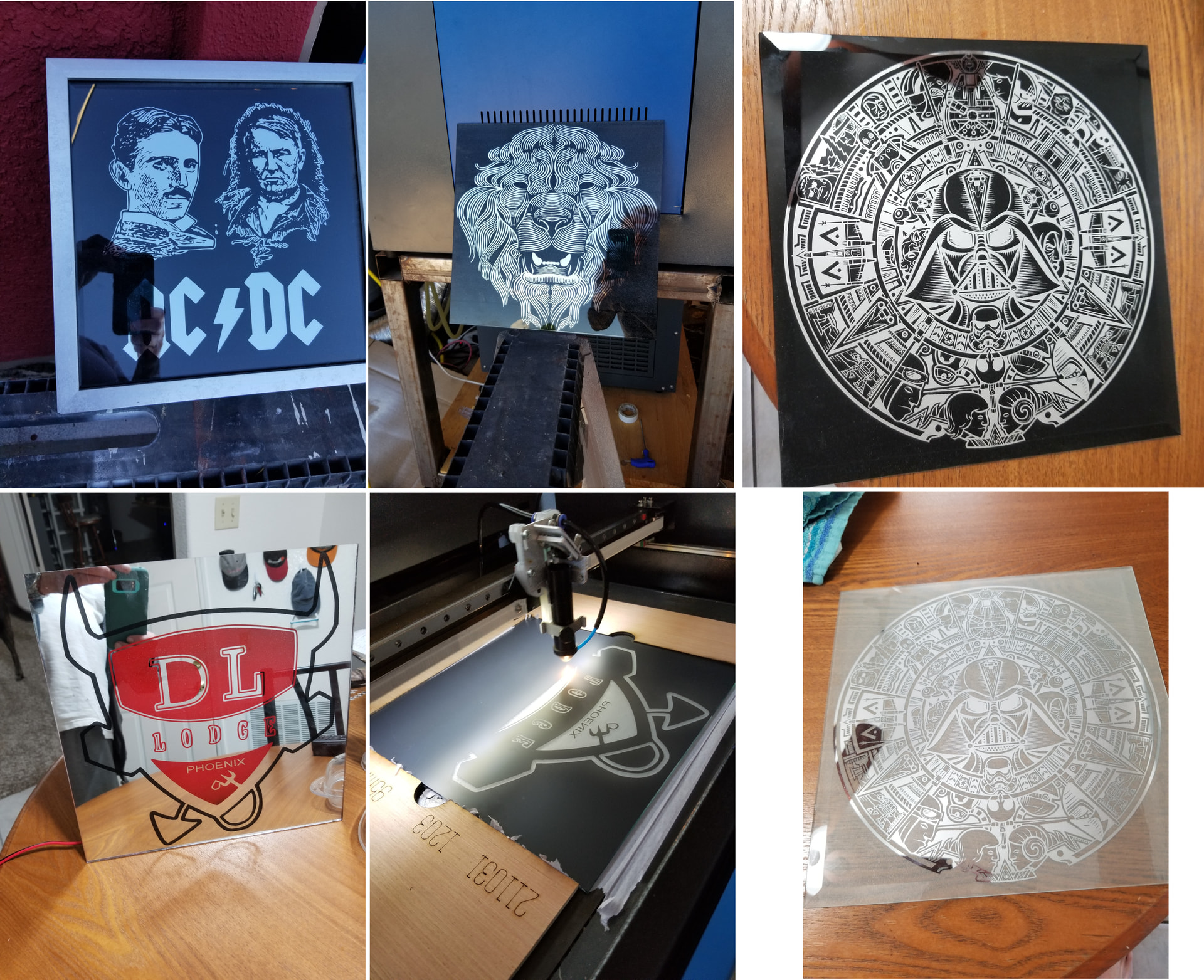
On my co2 machine I lase the back off mirror tiles and then paint the results to get good contrast. This is one that has been lased and you can see the glass isn’t clear.

After applying black acrylic paint to the back.

There is really no coating that I know of that allows for white results. One of the widest ranging coating colors are done with

Lasing glass, even with a coating, results in shattered glass. So it will be difficult to change the background of a clear glass. Even if there was a white color, it’s likely your laser wouldn’t affect it as it would reflect a majority of the laser energy.


I think I’d look at the link @misken posted. Their add states it sticks to smooth surfaces. Once you lase it, it’s no longer a smooth surface. At least in my view.

Using those products it might be worth trying to lase the product off then baking it might be something to try.

Good luck.

:grinning_cat:

For mirrors, I’ve had success removing the silvering and leaving the glass unaffected 9smooth and clear.

I use contact paper (shelf liner) and apply it to the silvered back. Lase off the pattern with a low power setting that burns away the masking but doesn’t reach the glass. I then daub on some paint remover which removes the exposed silvering, but is adequately repelled by the mask.

RInse and peel off the mask.

Of course if you are going to paint, then the etched glass is a bonus since the roughed up surface provides a good tooth for the paint to adhere.

Most contact papers are vinyl or PVC which produces toxic fumes so I lase with strong cross flow air and ventilation in my spray booth.

1 Like

I use my co2 machine, it’s pretty difficult to cut out the reflective material and leave smooth glass.

:grinning_cat:

Yeah, tough to throttle down a CO2!

I’ve been working with mirrors today.

Made some new changes that greatly simplify the process of selectively removing a mirror’s reflective coating without any glass etching/frosting.

The mirrors I am using are the 12”x12” tiles from Lowes. They have a dark grey backing (paint) over the, I assume, aluminum/copper plating.

Trick is to remove only the paint. For my laser (Diode, Ortur LM3, 10W), I used the fill layer with 254 LPI, 30 mm/s, 20%. Air assist at 12 LPM, No masking at all, just the mirror as-is.

This burns away the paint exposing a copper surface.

I then use a popular copper printed circuit board etching method.

Solution of Muratic acid pool cleaner from the hardware store (10% HCL) and standard 3% hydrogen peroxide.

(USE ALL PROPER PROTECTIONS AND PPEs!)

Mix 3:1 acid:peroxide, enough to submerge the mirror in a non-metallic tray.

Place the mirror, backing side up in the tray, then carefully pour in the mix.

In a matter of a few minutes, the metallic backing will disappear, some gentle brushing with an old toothbrush will speed the process.

When all the metal is gone, remove the mirror and rinse with water thoroughly.

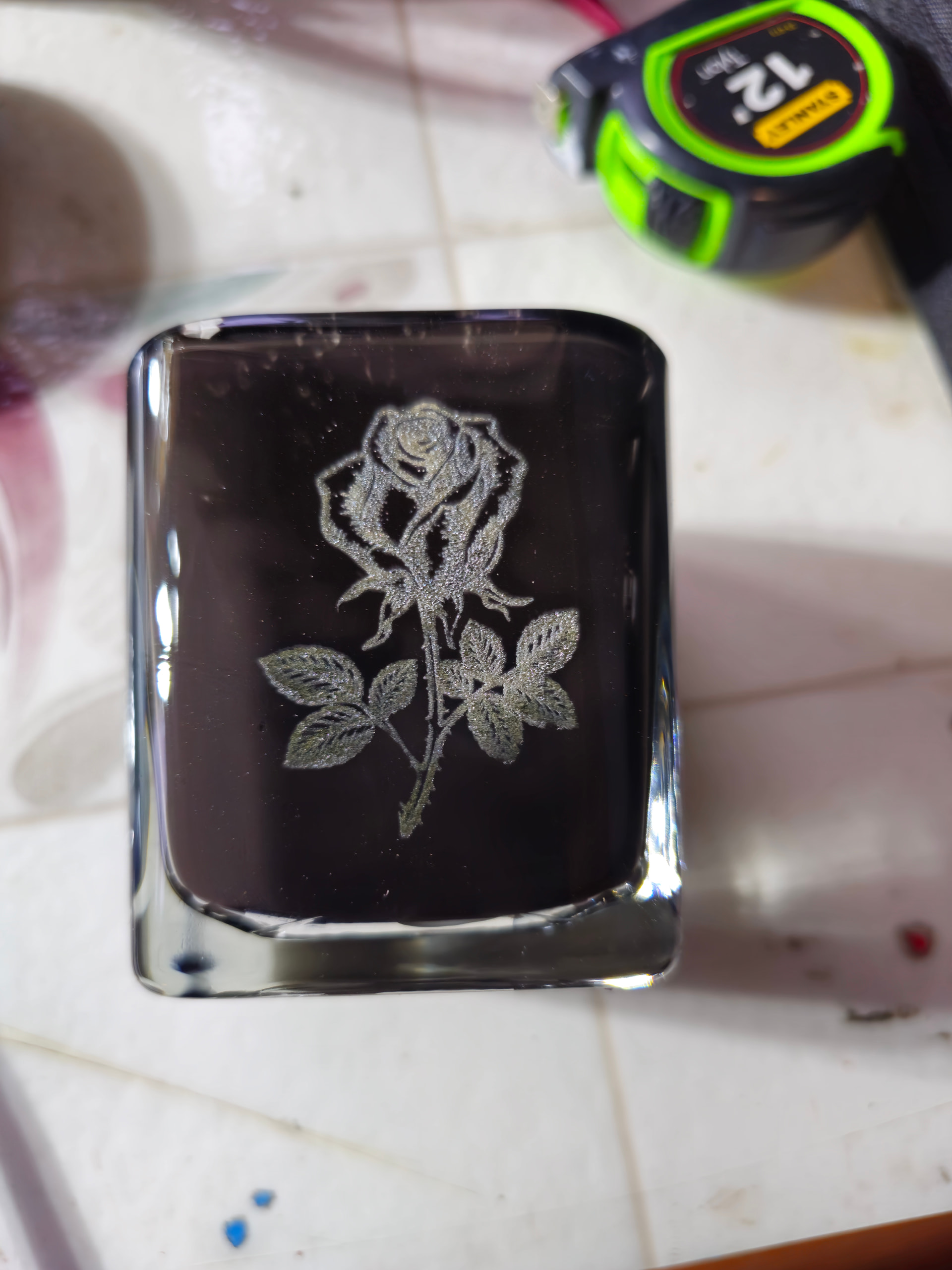
The paint will not react to the acid leaving clear, undamaged glass where you applied the laser.
2 Likes

Thanks for responding…a lot to think about.

Because your laser is a visible light led, once it removes the backing, the laser has no effect. Unlike a co2, it will engrave glass.

There’s similar problem with coated mugs, the co2 will removed the coating, but can’t mark the underlying metal. So when I do mugs, I use the co2, not the fiber, since it will engrave or mark the metal.

Have fun.

:grinning_cat:

The removal of the backing at high power does fracture the underlying glass leaving a frosted finish. Same with a coating of black paint (on clear glass or acrylic)

Someone stated they got clear glass after etching off the reflective coating. Maybe I misunderstood them.


I know my co2 leaves a rough surface when I do this. These are all 12” sq mirror tile.

:grinning_cat:

That might of been me.

If I carefully just remove the surface paint with low power and not exposing the glass, I can then acid etch away the metal layers and get the clear glass.

2 Likes