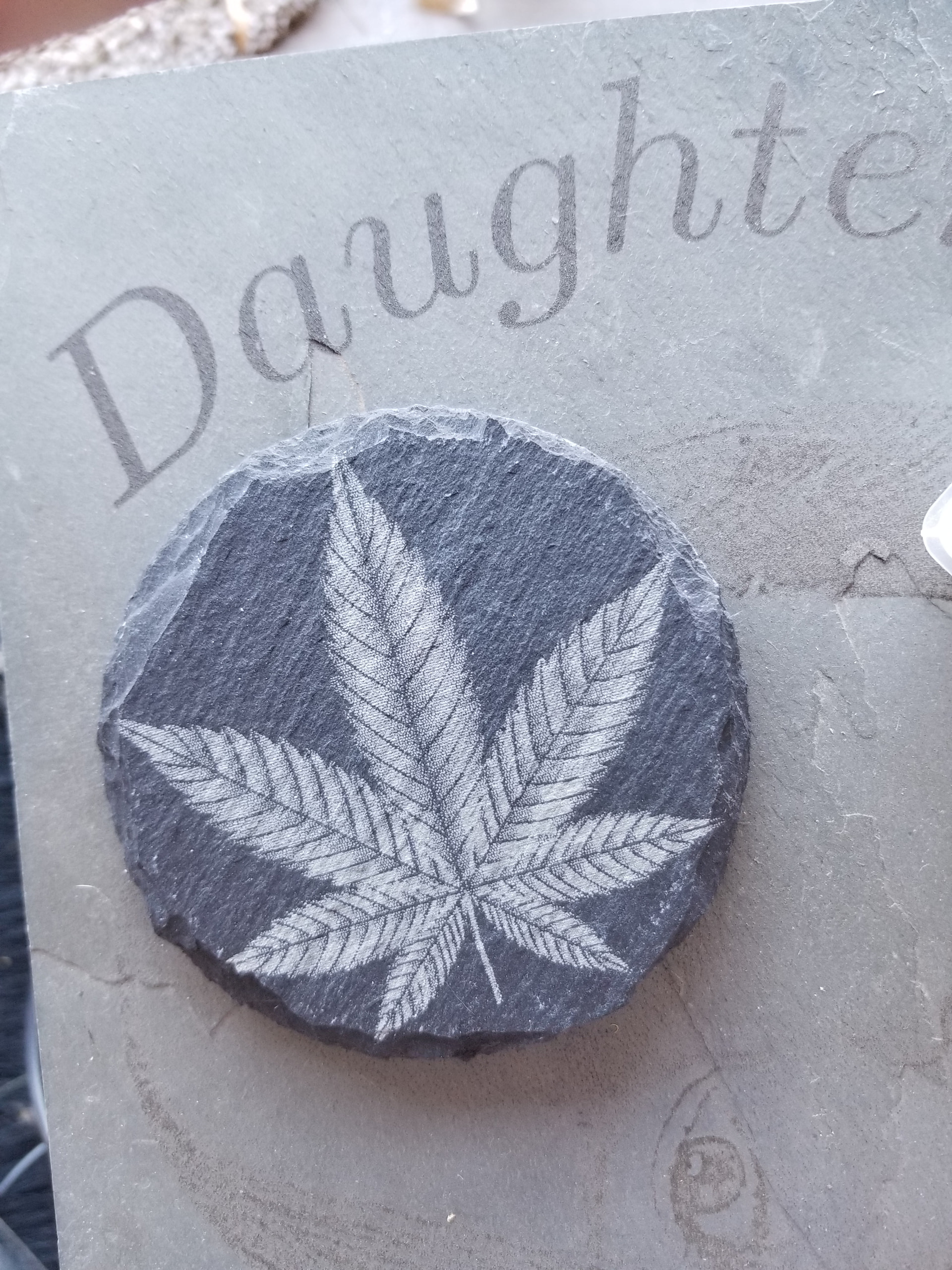
I’ve been working on getting a 255 greyscale index image lasered on slate then photographed, then converted to a CLUT (colour lookup table) using photo image software that is then used to replace the tones in another image/photo with a set of known laserable values.
The power and speed remain Set for initial burning of index (CLUT) and final engraving and no image adjustments are made after import.
After two tests using 15mm squares X 255 the range from ‘#0’ to ‘#175’ look usable but it all gets a bit washed out after that (speed 3000/power 8.5).
8.5 is quite low so there is a lot of mottled effect from uneven ablation and the varying material quality, and (#175 to #255) are not linear in increasing brightness.
Do you think switching from the 20w diode to the 2wIR module would give better consistency within each test square and variance across the index due to the smaller dot?
Are there any points I’m not taking into account concerning the viability of the endeavour.
We’ve all seen some excellent examples of what Ai assistance can achieve, but I will try to do things the hard way!
In my opinion, that’s the wrong approach, just right from the start. Slate is a more binary material. You either get a color (grey/white) or nothing (nearly no shades). So you should not use grayscale but a dithering algorithm.
I know that some people had success with some types of slate (it’s a natural material, so it will differ over each piece) and grayscale, but in general, you will fail.
Yeah, I have the same thinking but trying to figure out why it’s the wrong procedure and what are the limitations.
Could you suggest what you suspect may be the major barriers to contend with, I can’t stop thinking it’s all about calibration.
If all 255 shades can be lasered at a set power/speed, it should only remain to exclude the numbers/tones that repeat too often to be perceptably useful.
As I said, in general, your procedure is correct, but it does not work for slate (and natural materials in general). Even for the same type of wood, for example, you will get different results for every sheet. And slate is natural / individual as well. So it’s not like printing.
I think, you will never get 255 shades with slate, maybe 5 or so.
Most materials don’t have much of a range from when it starts to mark, to where it goes to black. So a grayscale isn’t a realistic target on slate or metal.
Most materials you have to look at like it’s a printing press, it either marks or it doesn’t. That’s the most dependable way, that involves using a dither of some type.
You can check out some of Nicky Norton for an idea of what is possible. He has a number of lasers. Of course it depends on the material.
These are done on a 60W MOPA fiber laser using aluminum or stainless coated cards.
And on leather with a 5W diode.
Compares Stucki and Jarvis.
These are only to show you that you can do some incredible reproductions using a dither.
Metal is much the same way. Most of these materials either damage the material or cause an oxide layer. A few materials can do this, many can’t.
It’s also natural stone with all kinds of debris can end up. So it may not engrave flat everywhere. I did a 3d type image and had mountains in it from something in the slate.
If it’s too hot it will melt, as will most things. Sometimes these get hot and just crack. I have a pile of rocks that I lase out of curiosity and find they are mostly different.